


When the history of 21st-century India is written, one chapter will stand out for its audacity: the decade in which technology became the grammar of governance, growth, and global influence. Prime Minister Narendra Modi’s vision of a “Digital India”, articulated soon after he assumed office in 2014, was not merely about putting services online. It was about rewriting the relationship between citizen, state, and market; about turning technology into the bloodstream of a resurgent nation.
From rural hamlets to fintech boardrooms, from AI research labs to launchpads of the Indian Space Research Organisation (ISRO), a new techno-civilisational ethos has taken root. India today is the world’s fastest-growing major digital economy, a cradle for more than 110 unicorns, and a trusted partner in shaping rules for the global “Techade”.
Behind these outcomes lies a web of purposeful policies: the JAM trinity (Jan Dhan–Aadhaar–Mobile), UPI’s payments revolution, Production-Linked Incentives (PLIs), the National AI Mission, the India Semiconductor Mission (ISM), and reforms in defence manufacturing. Modi Ji’s leadership brought clarity of purpose, administrative will, and strategic patience, the qualities essential to transform a populous democracy into a knowledge-powered superpower.
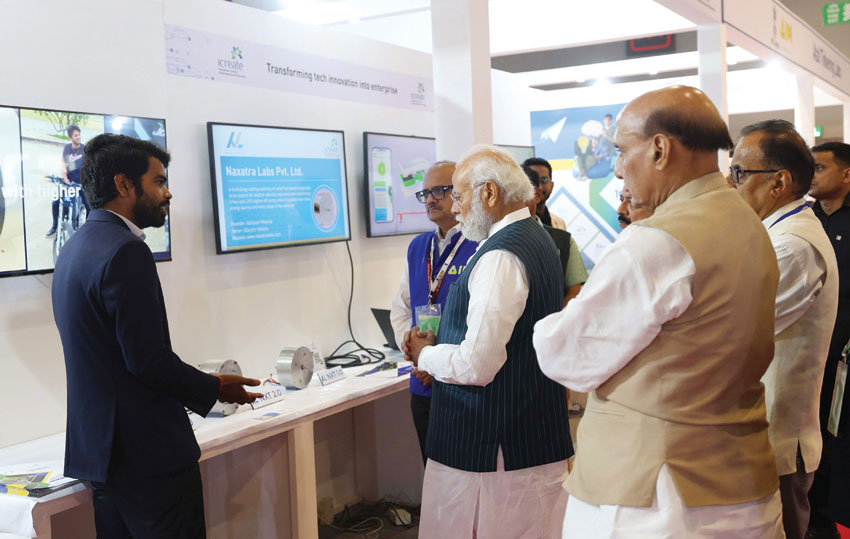
As the nation celebrates his 75th birthday, this essay traces the arc of that transformation: how Digital India leapt from concept to mass movement; how AI and semiconductors became national priorities; and how defence indigenisation is delivering dividends from the Himalayas to high seas. Together, they narrate a singular story: India’s technology renaissance is no accident; it is the outcome of vision married to execution.
This chapter have five inter-connected segments: i) Narendra Modi’s Technology Philosophy, ii) Digital Transformation: From JAM to 6G Leadership, iii) Artificial Intelligence: Making India an AI Leader, iv) Semiconductors: From Aspiration to Assembly Hub and v) Defence Indigenisation: The Rise of DefTech.
Narendra Modi’s Technology Philosophy
Prime Minister Narendra Modi’s approach to technology is marked by a rare blend of strategic foresight and cultural rootedness, making him one of the most technology-attuned heads of government globally. From the early months of his tenure as the PM in 2014, he positioned digital transformation as a central lever of governance; launching the Digital India programme in July 2015 to expand broadband connectivity, promote electronic delivery of services, and build citizen-centric platforms. The results have been measurable: India now executes close to 50% of the world’s real-time digital payments through the Unified Payments Interface (UPI), and over 510 million bank accounts have been opened under the Jan Dhan Yojana, integrated with Aadhaar and mobile services.
PM Modi has also used communication technologies to recast political pedagogy: Mann Ki Baat, first broadcast on All India Radio in October 2014 and now simulcast on television and streaming platforms, revived a legacy medium while leveraging podcasts and social media to reach an estimated 100 crore listeners. His speeches at global forums, such as the World Economic Forum in Davos (2018) and the G20 Leaders’ Summit (2023), consistently frame technology as a force for inclusion and a basis for India’s “quantum jump” in productivity, health, education, and security.
Unlike many leaders who treat technology policy as a sectoral issue, Modi articulates it as an organising principle of statecraft, encouraging ministries to integrate AI, blockchain, and geospatial analytics into agriculture, logistics, and welfare delivery. At the same time, he anchors these initiatives in an Indian civilisational ethos emphasising ethics, linguistic diversity, and societal harmony, evident in projects like Bhashini (real-time translation across 22 Indian languages). His support for indigenous innovation, from the India Semiconductor Mission (2021) to the National Quantum Mission (2023), reflects a conviction that technology can underpin strategic autonomy as well as inclusive growth. Prime Minister Shri Narendra Modi has positioned India at the forefront of the global artificial intelligence (AI) revolution with a transformative vision centered on “AI for All”. The Prime Minister has championed national AI initiatives that not only democratize technology but also unlock its transformative power for the greater good of society. Under his leadership, the Government of India approved the ambitious IndiaAI Mission in March 2024, aiming to build a robust and inclusive AI ecosystem aligned with national development goals. These efforts reflect a strong commitment to using AI not just for economic growth, but to solve real-world challenges in governance, healthcare, agriculture, and education, thus bringing technology to the last mile and ensuring no citizen is left behind.

Analytically, Modi’s record suggests three distinct but interlinked traits: an early-adopter mindset that personalises technology use; a systems-builder orientation that deploys institutional reforms, such as production-linked incentives and regulatory sandboxes; to scale innovation; and a narrative capacity to integrate modern tools with cultural idioms, lending legitimacy to rapid change in a diverse democracy. This triangulation has allowed India to bridge infrastructure deficits and participate credibly in frontier debates on AI ethics, 6G standards, and cybersecurity governance. While challenges remain, ranging from data protection enforcement to rural-urban divides, the trajectory of the past decade shows that Modi’s technology vision is neither utopian nor narrowly technocratic.
During his stint as Gujarat Chief Minister, Modi was one of the first political leaders in the country to be active on X (then Twitter) and YouTube prior to joining Meta and Instagram. During the 2012 Gujarat assembly elections, the BJP stalwart set a Guinness World Record by simultaneously broadcasting Modi’s holographic 3D address from 53 places across more than 25 cities in the state. The Prime Minister’s digital efforts and online popularity demonstrate his ability to engage millions of people via social media.
It is a calculated effort to embed digital capability, manufacturing depth, and ethical stewardship into the national project; positioning India to shape the emerging global order as a technologically confident, yet civilisationally grounded power.

Digital Transformation: From JAM to 6G Leadership
Laying the Foundations
2014–2016 marked the laying of a robust “plumbing” for digital governance. The Jan Dhan Yojana opened over 510 million bank accounts for the unbanked. Aadhaar, scaled rapidly with political backing, gave a verifiable identity to more than 1.3 billion people. Mobile telephony reached critical mass, aided by falling data tariffs, the so-called “JAM trinity” provided the rails for real-time, low-cost, inclusive services.
UPI and Fintech Revolution
The Unified Payments Interface (UPI), launched by NPCI in 2016 and championed by the government, democratised cashless transactions. Monthly volumes have crossed 14 billion (2025), with value topping ₹20 trillion. Start-ups like PhonePe, Paytm, and Google Pay ride on this protocol, while BHIM gives a sovereign anchor. India’s share in global real-time payments exceeds 45%, surpassing China.
Fintech sandboxes, account aggregators, and the Open Credit Enablement Network (OCEN) are deepening credit to MSMEs and gig workers. India Stack, an open API architecture, is now a “digital public good” exported to Asia, Africa, and Latin America.

e-Governance and Citizen Services
Flagship portals—DigiLocker, UMANG, GSTN, and CoWIN—have revolutionised service delivery. CoWIN’s vaccination platform managed over two billion doses, hailed by WHO as a global model. MyGov, PM-GatiShakti, and PM-Kisan apps have made governance interactive and data-driven.
Telecom Leap: 5G Today, 6G Tomorrow
Telecom reforms ended retrospective levies, enabled spectrum sharing, and attracted $20 billion FDI. The 5G roll-out, launched by the PM in October 2022, reached over 700 districts in two years. Indigenous 5G stack, developed by IIT Madras, C-DOT, and Tejas Networks, proved India’s capacity to innovate at scale.
The 6G Vision Document (2023) charts leadership in terahertz communications, satellite-terrestrial integration, and green networks by 2030. BharatNet, with 650,000 km of fibre, is delivering high-speed internet to 250,000 gram panchayats, bridging the rural-urban divide.
Start-up & Entrepreneurship Boom
Government initiatives, Startup India, Fund of Funds, Atal Innovation Mission have fostered a vibrant ecosystem. India houses the third-largest start-up base globally; tech start-ups attracted $15 billion in VC funding in 2024 alone. Sectors from agritech to spacetech showcase “frugal innovation with global ambition.”
Artificial Intelligence: Making India an AI Leader
“AI is already reshaping our economy, security and even our society. AI is writing the code for humanity in this century.” PM Modi
AI, described by experts as the “electricity of our era”, has moved from policy blueprint to transformative force in India, powered by a steady sequence of reforms and investments since 2018. Prime Minister Narendra Modi’s government, which launched the landmark AI for All initiative alongside NITI Aayog’s National Strategy for Artificial Intelligence, has over the past two years accelerated execution, positioning India among the world’s top five AI innovation ecosystems.
Policy & Institutional Architecture
India's policy and institutional architecture for AI has rapidly evolved, with the National AI Mission (2023) disbursing nearly ₹4,800 crore of its ₹10,000-crore corpus by September 2025, supporting over 300 research projects and 45 public-private pilots across healthcare, agriculture, smart mobility, and digital governance. The IndiaAI portal, revamped in May 2025, now hosts over 250 curated datasets and sandbox environments to empower start-ups and academic institutions in training responsible AI models. A robust network of 18 Centers of Excellence including IISc, IITs, IIITs, and private hubs has been established, featuring three new labs focused on Generative AI for Indian Languages. This innovation ecosystem is underpinned by strong regulatory frameworks such as the Digital Personal Data Protection Act (2023) and the AI Ethics & Safety Framework (July 2025), which together ensure adherence to privacy, fairness, and transparency standards.
Applied AI: Societal Scale
AI is increasingly embedded in governance and citizen services across India, driving transformative impact at a societal scale. In healthcare, the e-Sanjeevani tele-health platform, which surpassed 250 million consultations by August 2025, now integrates AI-powered triage and diagnostics for conditions such as tuberculosis, cervical cancer, and diabetic retinopathy. In agriculture, AI-based crop yield forecasting, piloted in Madhya Pradesh and Odisha, aids 1.2 million farmers in optimizing sowing cycles and managing weather risks. Tools like the National Pest Surveillance System, which covers 61 crops and over 400 pests, and “Kisan e-Mitra,” which has handled over 92 lakh farmer enquiries, are revolutionizing agricultural practices. In the domain of language and inclusion, Bhashini, India’s open-source language stack, now supports 24 Indian languages, offering speech-to-speech (S-S) translation and voice cloning, with its 2025 update introducing offline translation kits for schools in aspirational districts. AI is also enhancing governance through applications such as GST fraud detection, facial recognition for reuniting missing children, and satellite-AI models for urban flood management, demonstrating its wide-ranging role in public administration.
Industry & Start-ups
India's AI start-up ecosystem has expanded rapidly, crossing 2,500 companies with funding surpassing $4.2 billion in FY25. Deep-tech ventures in logistics, med-tech, agri-tech, and climate AI are increasingly securing global contracts, signaling India's growing influence in the global AI landscape. Big Tech continues to invest heavily in the country: Google’s Bengaluru lab launched the “Responsible LLMs for the Global South” programme in June 2025, while Microsoft partnered with C-DAC to co-develop Sanskrit-to-code translation tools aimed at enhancing educational access. At the same time, Indian unicorns like Krutrim AI and Sarvam are building indigenous large language models designed for local dialects and regulatory compliance, reinforcing India’s ambition to lead in culturally and contextually relevant AI innovation.
Responsible & Inclusive AI
India has emerged as a “laboratory and conscience-keeper” of AI. As chair of the GPAI Council (2025), India hosted the AI for Humanity Summit in New Delhi (August 2025), calling for global guardrails on generative AI, algorithmic bias, and deepfake misuse. Draft National AI Safety Standards, open for consultation since September 2025, set benchmarks for explainability, fairness, and red-teaming.
Strategic Trajectory
The foundation built since 2018, policy clarity, public digital goods, a talent-rich ecosystem, has positioned India to scale the next frontier: domain-specific models for education, health, agriculture, and defence; indigenous chips for AI workloads (via the India Semiconductor Mission); and sovereign cloud platforms for sensitive data. With over 1.6 million AI-skilled professionals trained through Skill India and private bootcamps, and a strong emphasis on ethics and inclusivity, India is not merely adopting AI, it is shaping its evolution for democratic societies.
By embedding ethics, scale, and purpose, Modi Ji’s government has ensured that AI becomes a driver of productivity and a guarantor of equity, enabling India to leapfrog into the ranks of trusted global AI powers.
Semiconductors: From Aspiration to Assembly Hub
Semiconductors are the new oil of the digital economy, what PM Modi calls “Digital Diamonds”. Supply-chain shocks during COVID-19 and geopolitical tensions underscored the need for trusted manufacturing bases. Modi Ji responded with the India Semiconductor Mission (ISM) in 2021, a ₹76,000-crore programme to build fabs, OSAT units, and design ecosystems.
Policy Catalysts
India's AI and semiconductor ecosystem is being strengthened through robust industrial policy measures, including Production-Linked Incentive (PLI) schemes for large-scale electronics, chip design, and compound semiconductors. Complementing these, the Design-Linked Incentives (DLI) scheme offers up to 50% support for IP creation, encouraging innovation and indigenous design capabilities. Investor confidence is further bolstered by streamlined single-window clearances, attractive fiscal incentives, and talent development initiatives such as the Chips-to-Startup (C2S) programme, which focuses on skilling a new generation of semiconductor and hardware professionals.
Industry Momentum
India is rapidly emerging as a key player in the global semiconductor supply chain, driven by major investments and strategic partnerships. Micron Technology broke ground in 2023 on a $2.75-billion assembly and test facility in Gujarat, while Tata Electronics is investing $11 billion in a combined fabrication and packaging unit. These developments are complemented by international collaborations with Taiwan’s PSMC, Japan’s Renesas, and leading U.S. semiconductor firms, positioning India as a critical hub for both manufacturing and advanced packaging within global value chains.
Design & Talent
India already hosts 20% of the world’s chip-design workforce. Qualcomm, Intel, and ARM run major R&D centres here. Indigenous processors like Shakti (IIT Madras) and Vega (C-DAC) exemplify self-reliance. Skill-development curricula in 100+ universities nurture VLSI engineers.
Strategic Significance
Trusted chips are essential for 5G/6G, AI, EVs, and defence platforms. By integrating fabs with electronics manufacturing clusters, India aims to capture a $100-billion market by 2030. The G20 Declaration (2023) recognised India as a key player in diversifying global semiconductor value chains.
Defence Indigenisation: The Rise of DefTech
Policy Thrust
India's defence policy thrust is firmly anchored in the Make in India and Atmanirbhar Bharat initiatives, pursued since 2014 to boost self-reliance in critical sectors. Progressive import bans on over 500 defence items have encouraged domestic sourcing and strengthened local manufacturing ecosystems. The Defence Acquisition Procedure (DAP) (2020) further reinforces this by prioritising indigenous content in procurement. Complementing these structural reforms, the ‘Innovations for Defence Excellence (iDEX)’ programme actively funds start-ups and innovators working on solutions to frontline operational challenges, fostering a dynamic ecosystem for homegrown defence technologies.
Industrial Upsurge
India’s defence production touched `1.2 lakh crore in FY24, up from `45,000 crore in 2014. Exports, missiles, radars, UAVs, exceeded `21,000 crore. Private majors (L&T, Tata, Bharat Forge) collaborate with DRDO, HAL, BEL.
Operation Sindoor: Proof of Concept
The success of Operation Sindoor, a precision strike capability revealed in 2025, owes much to long-term investments in sensors, guidance, and secure communications. Indigenous drones, swarm robotics, and AI-enabled targeting are reshaping the battlefield.
Space & Strategic Tech
ISRO’s Chandrayaan-3, Aditya-L1, and Gaganyaan align with dual-use R&D. Defence Space Agency and IN-SPACe foster synergy between civil and military applications. IN-SPACe, established in 2020, is a single-window, autonomous agency under the Department of Space to promote and regulate private sector participation in India's space activities. IN-SPACe complements ISRO’s evolving role from sole operator to enabler of space activities.
Human Capital & Exports
Sainik Schools’ STEM push, DRDO Young Scientist Labs, and collaborations with academia create a pipeline of DefTech talent. India is now exporting BrahMos missiles to friendly nations, positioning itself as a responsible arsenal of democracy.
Conclusion: Toward a Democratic Tech Superpower
India’s journey from a technology consumer to a technology creator is a parable of how political vision, institutional reform, and societal aspiration can converge. Modi Ji’s policies gave the nation a North Star: technology must empower the poorest while enabling India to claim its rightful seat at the high table of innovation.
The road ahead – including quantum computing, bioengineering, and climate tech which demands the same blend of ambition and inclusion. With a young demography, expanding capital, and a culture of entrepreneurship, India is poised to script the next chapter of the global knowledge economy.
As the world celebrates Narendra Modi’s 75th birthday, India stands tall not only as the largest democracy but also as a confident technology superpower, rooted in its civilisational ethos, yet agile in a rapidly changing world. The “Techade” is no longer a slogan; it is the lived reality of 1.4 billion people, and an enduring gift of leadership that marries dreams to delivery.

By Sujeet Kumar
(The writer is MP, Rajya Sabha.)
(The content of this article reflects the views of writer/contributor, not necessarily those of the publisher and editor. All disputes are subject to the exclusive jurisdiction of competent courts and forums in Delhi / New Delhi only.)














Leave Your Comment