


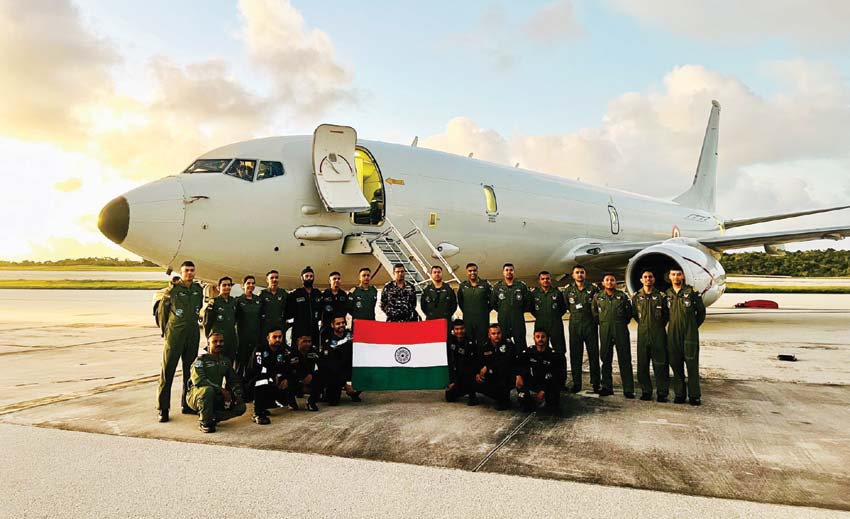
In a significant milestone for India’s strategic outreach and defense collaboration, an Indian Navy P8i Poseidon aircraft has made its inaugural deployment in Europe, specifically landing at France’s Air Base 125 Istres-Le Tube. This historic event marks the first-ever deployment of an Indian maritime reconnaissance aircraft to Europe, underscoring India's growing global military engagement and strengthening of bilateral ties with France. The aircraft's presence in France is not merely symbolic; it is a critical component of the joint naval exercise 'Varuna,' a cornerstone of Indo-French defense cooperation.
The Significance of the P8i Poseidon Deployment
The deployment of the Indian Navy’s P8i Poseidon aircraft to Europe marks a strategic high point in India’s maritime and defence diplomacy. This move is not just about showcasing the operational capabilities of one of the world’s most advanced maritime reconnaissance aircraft but also about demonstrating India’s readiness to project power and influence beyond its traditional areas of operation. The P8i Poseidon, a modified version of Boeing’s P-8A used by the U.S. Navy, is equipped with state-of-the-art sensors and weapons systems that make it a formidable platform for anti-submarine warfare, intelligence, surveillance, reconnaissance (ISR), and even search and rescue operations.
Its deployment to France signals India's intent to enhance interoperability with European forces, particularly the French Navy, which is among the most capable in Europe. By participating in the Varuna exercise, the P8i will engage in complex maritime scenarios, which will not only test its capabilities but also provide valuable operational insights that could shape future deployments. This is especially significant as the Indian Navy increasingly focuses on maintaining a robust presence in the Indian Ocean Region (IOR) while also expanding its reach into the Mediterranean and Atlantic, thereby contributing to global maritime security.
The Evolution of the Varuna Naval Exercise
The Varuna naval exercise, which has become an integral part of Indo-French military cooperation, traces its roots back to 1983 when the two nations began conducting naval exercises under the broader framework of bilateral defense relations. However, it was in 2001 that the exercise was formally named 'Varuna,' symbolizing the expanding scope and complexity of joint operations between the Indian and French navies. Over the years, Varuna has evolved from a basic naval drill into a sophisticated series of exercises that cover a wide range of operations including anti-submarine warfare, air defense, and maritime interdiction.
The exercise is named after Varuna, the Vedic god of water, which is fitting given the maritime focus of the collaboration. Varuna has served as a platform for both navies to refine their tactics, techniques, and procedures, enabling them to operate seamlessly in joint operations. Each iteration of the exercise has been designed to address contemporary maritime challenges, reflecting the evolving strategic landscapes in both the Indian Ocean and beyond.
This year's Varuna exercise is particularly significant as it takes place against the backdrop of an increasingly complex global security environment. The Indo-Pacific region, where both India and France have significant interests, has witnessed heightened geopolitical tensions, making the need for enhanced naval cooperation more pressing than ever. The inclusion of the P8i Poseidon in this year’s exercise adds a new dimension to the Indo-French partnership, emphasizing the importance of maritime reconnaissance and anti-submarine warfare in the current strategic context.
Capabilities of the P8i Poseidon: A Force Multiplier
The P8i Poseidon, with its advanced technology and multi-mission capabilities, is a force multiplier for the Indian Navy. The aircraft is equipped with the Raytheon AN/APY-10 radar, which provides high-resolution radar images and enables detection of both surface and subsurface targets. Additionally, the P8i is fitted with a Magnetic Anomaly Detector (MAD) that is capable of detecting minute changes in the Earth’s magnetic field caused by a submerged submarine. This makes the P8i an invaluable asset in anti-submarine warfare, a domain of increasing importance given the proliferation of submarines in the Indian Ocean Region.
The P8i’s long-range capabilities allow it to conduct extended maritime patrols, covering vast areas of the ocean with minimal need for refueling. This endurance, combined with its speed and agility, makes it ideal for covering the expansive waters between India and Europe. The aircraft's ability to launch and control sonobuoys and torpedoes also enhances its strike capability, making it a potent tool in India’s maritime arsenal. Its deployment to France for the Varuna exercise allows Indian and French forces to integrate their ISR capabilities, providing a comprehensive picture of the maritime domain.
Strategic Implications of the P8i Deployment
The deployment of the P8i Poseidon to France for the Varuna exercise has several strategic implications. Firstly, it signals India’s intent to expand its strategic footprint beyond the Indian Ocean Region. By deploying a maritime patrol aircraft to Europe, India is demonstrating its capability to operate in distant theaters, a crucial aspect of power projection in the 21st century. This deployment also showcases India’s growing defense ties with European nations, particularly France, which is emerging as a key partner in India’s strategic calculus.
Secondly, the deployment underscores the importance of maritime reconnaissance in modern naval warfare. With the increasing presence of submarines in the Indo-Pacific, the ability to detect and track these vessels is crucial for maintaining maritime security. The P8i Poseidon, with its advanced sensors and weapons systems, provides the Indian Navy with a significant edge in this domain. Its participation in the Varuna exercise will allow the Indian Navy to refine its anti-submarine warfare tactics in collaboration with one of Europe’s most capable navies.
Thirdly, the deployment highlights India’s commitment to enhancing its defense capabilities through joint exercises and collaborations. By participating in exercises like Varuna, the Indian Navy not only hones its operational skills but also builds lasting partnerships with other navies. These partnerships are crucial for maintaining a stable and secure maritime environment, particularly in the Indo-Pacific, where several nations have overlapping interests.
The deployment of the Indian Navy’s P8i Poseidon aircraft to France for the Varuna naval exercise marks a significant milestone in India’s defense diplomacy. It underscores the growing strategic partnership between India and France, particularly in the maritime domain. The P8i Poseidon, with its advanced capabilities, adds a new dimension to the Varuna exercise, enhancing the scope and complexity of joint operations.
This deployment also signals India’s intent to project power beyond its traditional areas of operation, showcasing its ability to operate in distant theaters. As India and France continue to strengthen their defense ties, the Varuna exercise will remain a key platform for advancing their shared security interests. The successful deployment of the P8i Poseidon is a testament to the deepening Indo-French partnership, one that will play a crucial role in shaping the future of maritime security in the Indo-Pacific and beyond.
Uday India Bureau















Leave Your Comment