


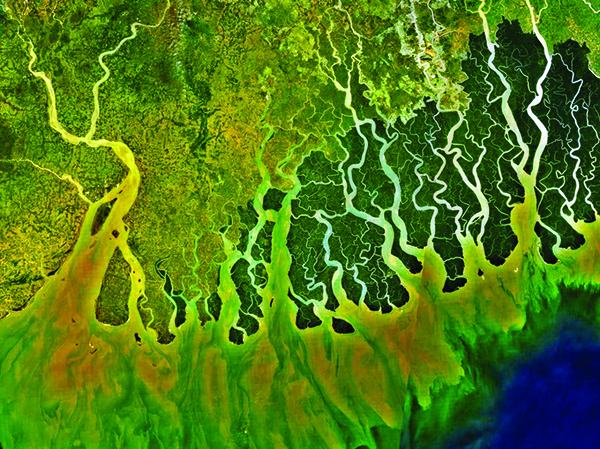
India’s great river deltas have long been seen as landscapes of abundance. A river delta is a triangular lobular landform created when rivers empty their water and sediment into another body of water, such as an ocean, lake, or an estuary. A river slows down as it reaches its end and this causes the sediment and solid material that it carries through its currents to fall or accumulate at the base of the river that gradually builds up into new land. A mature deltaic lobe includes a distributary network—a series of smaller, shallower channels, called distributaries, that branch off from the mainstream of the river.
Built slowly over centuries by rivers carrying sediment from mountains to the sea, these regions support fertile agriculture, dense settlements, fisheries, ports, and unique ecosystems. From the Ganga Brahmaputra plains to the Mahanadi and Godavari coasts, deltas have sustained livelihoods and shaped regional economies for generations.
When the land itself begins to sink
A new global scientific study now reveals a troubling shift beneath these productive landscapes. More than half of the world’s major river deltas are sinking, and several of India’s largest deltas are subsiding at rates faster than global sea level rise. The driver is not only climate change or coastal erosion, but human activity itself, particularly unsustainable groundwater extraction.
Published in the journal, Nature, the study uses satellite based observations to show that excessive withdrawal of groundwater, combined with reduced sediment flows and rapid urban expansion, is causing land surfaces across delta regions to slowly collapse. As underground water reserves are depleted, sediments compact and land elevation declines, making already vulnerable coastal regions more exposed to flooding, salinity intrusion, and permanent land loss.
The deltas of the Ganga Brahmaputra, Brahmani, Mahanadi, Godavari, and Cauvery rivers are sinking, placing millions of people at increasing risk of flooding. The study identifies uncontrolled groundwater extraction as a major driver of this land subsidence.
For India, where large populations live and farm across low lying delta regions, this finding changes how coastal risk must be understood. The danger is not only from rising seas. In several regions, the land is sinking faster than sea levels are rising.
The concern now goes beyond future climate impacts. Current patterns of groundwater use are steadily weakening delta landscapes, raising an urgent question about how long these fragile systems can continue to support lives and livelihoods.
Why river deltas matter
Like most wetlands, deltas are incredibly diverse and ecologically important ecosystems. These dynamic landforms serve important socioeconomic, ecological and energy-related functions.
They support agriculture:
Deltas have a rich accumulation of silt, that serves as fertile land for agriculture. The world's largest delta is the Ganges–Brahmaputra delta in India and Bangladesh, which empties into the Bay of Bengal. Fish, other seafood, and crops such as rice and tea are the leading agricultural products of the delta.
They harbour incredible biodiversity
Deltas are also important wetland habitats and a large number of rare plants grow in the delta regions such as lilies, hibiscus, herbs such as wort, which are used in traditional medicines. Many animals are found in the shallow, shifting waters of a delta. For example, a large variety of fish, crustaceans such as oysters, birds, insects, and even apex predators such as tigers and bears are a part of river deltas.
Human settlements thrive near deltas
Many major cities and civilizations developed around deltas that serve as important places for trade and commerce with their ports and transportation networks being vital to national, regional and global economies.
Deltas offer natural protection from disasters
Deltas absorb runoff from floods (from rivers) and storms (from lakes or oceans). They also filter water as it slowly makes its way through the distributary network helping reduce the impact of pollution flowing from upstream.
Deltas are vulnerable to the impacts of climate change and anthropogenic activities
While deltas occupy only 1% of land area, they are among the most vital landforms on Earth. Globally, deltas host an estimated 350–500 million people including 10 of the 34 megacities of the world. Deltas are vulnerable to rising sea levels, storms, land subsidence, shifting temperatures and rainfall patterns that are exacerbated by climate change. These can degrade agricultural land, reduce freshwater availability, trigger coastal and fluvial flooding, lead to wetland loss, saltwater intrusion and shoreline retreat thus threatening infrastructure in the deltas. Land loss and freshwater scarcity can also drive displacement and migration, heightening competition for dwindling resources, fuelling social tensions.
Land subsidence is an important contributor to global river deltas. This human-driven process could have more serious implications than climate-induced sea-level rise (SLR) in the twenty-first century, but remains underrepresented and understudied due to lack of high-resolution subsidence observations.
The study examined delta-wide temporal trends, subsidence rates and horizontal motion at 75 m resolution, spanning five continents, 40 river deltas and 29 countries. between 2014 and 2023 using advanced multitemporal interferometric SAR (InSAR) analysis (Methods). InSAR measures surface-elevation changes, capturing vertical land motion (VLM), sediment deposition and erosional processes.
What did the study find
Sixty percent of global deltas are sinking
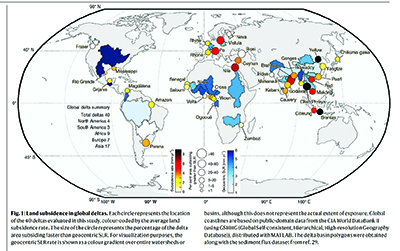
More than 50 percent of the area in majority of the deltas is sinking
Indian river deltas are experiencing high levels of subsidence
The Ganga-Brahmaputra, Brahmani, Mahanadi, Godavari, Cauvery and Kabani deltas in India are thus among those experiencing high levels of land subsidence, placing millions of people at growing risk of flooding.
Coastal cities are at risk
What is causing this high level of subsidence
The study analyses the relationship between three main anthropogenic drivers—groundwater storage change, sediment flux alteration and urban expansion on subsidence across the 40 deltas.
The paper argues that majority of the low and middle income nations such as India, fall into the unprepared divers group showing relative sea level rise, but having a diminished adaptive capacity. Local indigenous communities are the ones who are most affected by the impacts of subsidence as they live in the lowest-lying delta areas; lack the resources needed to implement large-scale adaptation; and face relocation barriers due to cultural and subsistence ties despite escalating risks.
(https://www.indiawaterportal.org/rivers-and-lakes/rivers/indias-sinking-river-deltas-signal-rising-flood-risks-for-millions-along-the-coast)
(The content of this article reflects the views of writer and contributor, not necessarily those of the publisher and editor. All disputes are subject to the exclusive jurisdiction of competent courts and forums in Delhi/New Delhi only)




















Leave Your Comment