


Arecent World Bank report has placed India in a remarkable position on the global stage: 4th in terms of income equality, ahead of major economic powers like the United States and China. This significant development is not just a statistical milestone—it signals a broader transformation in India’s socioeconomic structure. It reflects the results of sustained policy initiatives, inclusive growth models, and efforts to bridge long-standing economic disparities.
But what does this mean for India domestically and globally? How does this affect the lives of its 1.4 billion people, and how will it shape India’s global narrative? This article explores the implications of this ranking and unpacks the underlying factors that have led to this transition.
Understanding the World Bank Ranking
The World Bank report used several key indicators to assess income equality, such as the Gini coefficient, income distribution among deciles, access to public services, and poverty reduction metrics. A lower Gini coefficient implies greater income equality, and India’s significant improvement indicates that its wealth distribution has become more balanced over time.
The Gini coefficient (also known as the Gini Index) is a standard measure of income inequality within a country. Its value ranges from 0 (perfect equality, everyone earns the same) to 100 (maximal inequality, where one person earns everything). A lower Gini score indicates that income is distributed more evenly. According to the World Bank’s Spring 2025 Poverty & Equity Brief, India recorded a Gini score of 25.5 for 2022–23, placing it as the 4th most equal country globally.
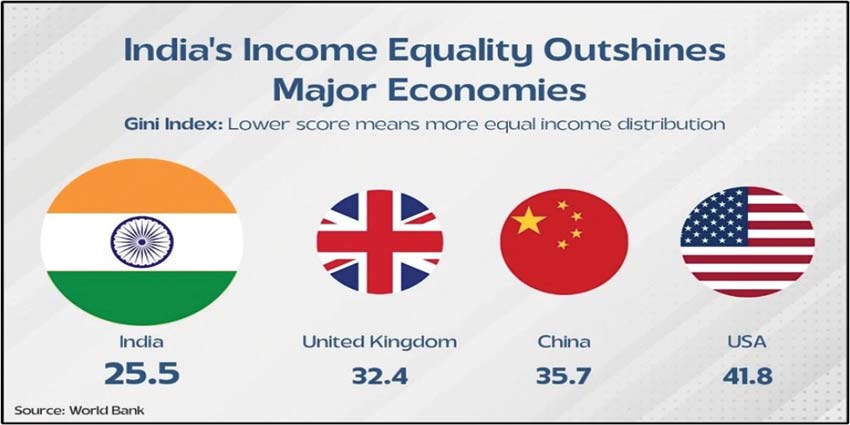
This ranking is headed by the Slovak Republic (24.1), Slovenia (24.3), and Belarus (24.4). Following India in the top ten are Ukraine (25.6), Netherlands (25.7), Moldova (25.9), Czechia (25.9), and Belgium (26.4). The index remains subject to factors like taxes, welfare policies, and economic growth. India’s sharp decline in extreme poverty—lift¬ing 171 million people out of poverty and reducing daily income below $2.15/day from 16.2per cent to 2.3 percent—played a pivotal role.
This report is especially noteworthy because it ranks India above the United States, where income disparity has been rising, and China, whose economic miracle has not been matched by equitable income distribution. In India, the bottom 50% has seen an improvement in real incomes, while the top 1% has not experienced unchecked acceleration, which is in contrast with trends in several developed and emerging economies.
The Domestic Impact of Increased Income Equality
1. Strengthening Social Cohesion
Income inequality has historically been a source of social friction in India. It divides rural from urban, upper castes from lower castes, and formal economy participants from informal workers. As income equality improves, it reduces class and caste antagonisms and promotes a sense of shared progress. Social cohesion is foundational to political stability, peace, and long-term growth.
The rise in equality can also be attributed to targeted welfare schemes such as Jan Dhan Yojana, PM-KISAN, Ayushman Bharat, PM Awas Yojana, and free food grain programs under Garib Kalyan Anna Yojana. These schemes have directly reached the poorest households, ensuring access to bank accounts, insurance, healthcare, housing, and food security—empowering the bottom strata economically and socially.
2. Boosting Domestic Consumption
When income is more equitably distributed, lower- and middle-income households gain greater purchasing power. Unlike the ultra-rich, these households tend to spend a larger portion of their income, boosting domestic demand for goods and services. This is especially crucial for a country like India, whose economy is significantly driven by domestic consumption (nearly 60% of GDP).
With more equitable income distribution, demand is likely to be broad-based and sustainable, benefiting small businesses, MSMEs, and local industries. This reduces economic volatility, creates jobs, and insulates the economy from global shocks such as a demand slump in the West.
3. Better Outcomes in Health, Education, and Gender Equality
Income equality enables better access to education, health, and gender rights. When families at the bottom of the pyramid are economically empowered, they can invest in their children's education, afford better nutrition, and access healthcare. This translates into improved human capital development, essential for long-term economic competitiveness.
Gender disparities are also addressed when income barriers are lowered. Schemes like Beti Bachao, Beti Padhao and Lakhpati Didi have empowered women economically and socially. Financial inclusion through Self Help Groups (SHGs) and access to microcredit is helping Indian women emerge as equal contributors in the economy.
Global Implications of India's Position
India’s rise to the 4th position in income equality is not merely a domestic triumph—it carries important geopolitical and soft power implications as well.
1. Enhancing India’s Soft Power and Global Image
In the global narrative, India has often been perceived as a country of contradictions—home to billionaires as well as the world’s largest number of poor. But the World Bank ranking offers a counter-narrative: that of an emerging economy actively addressing its structural inequalities while maintaining democratic institutions.
India’s success story becomes a model for other developing nations, especially in the Global South. It shows that inclusive growth is possible without abandoning democratic values and liberal market mechanisms. This enhances India's soft power and strengthens its leadership position in multilateral forums like the G20, BRICS, and the United Nations.
2. Strategic Leverage in Trade and Investment Negotiations
Income equality translates into a broad consumer base with rising aspirations, making India an attractive market for global investors. Countries and corporations looking for long-term, stable, and scalable markets would increasingly turn to India. Furthermore, in trade negotiations and multilateral economic platforms, India can use this achievement to push for more favorable terms as a stable and equitable economic partner.
3. Credibility in Global Development Leadership
India’s role in South-South cooperation, particularly in Africa, Southeast Asia, and Latin America, is likely to expand. As India showcases its model of inclusive growth—marked by digital public infrastructure (like UPI, Aadhaar), targeted subsidies, and transparent governance—it can offer technical assistance, policy expertise, and developmental partnerships to other nations seeking similar outcomes.
India’s own journey now provides proof of concept to the world that poverty alleviation and equality are achievable at scale. This could make India a preferred partner for global developmental institutions like the World Bank, IMF, and UNDP.
Factors Behind India’s Improved Equality Ranking
India’s position in the income equality index has improved due to a confluence of factors, many of which are policy-driven and deliberate:
1. Welfare Schemes Targeted at the Bottom of the Pyramid
The government’s focus on Direct Benefit Transfer (DBT) has reduced leakages in welfare delivery. Schemes like Ujjwala Yojana (free LPG connections), Swachh Bharat (sanitation and toilets), and PM Awas Yojana (housing for all) have significantly enhanced the standard of living of the poor. These are not just handouts but assets for economic empowerment.
2. Financial and Digital Inclusion
India has created one of the largest and fastest-growing digital economies in the world. The Jan Dhan-Aadhaar-Mobile (JAM) trinity has enabled even the poorest citizens to enter the formal financial ecosystem. Access to credit, digital payments (UPI), and identity verification has made government support transparent, efficient, and inclusive.
3.Rural Employment and Skilling Initiatives
Schemes like MGNREGA, Skill India, and Start-Up India have generated employment and entrepreneurial opportunities across rural and semi-urban regions. These initiatives reduce the rural-urban divide, mitigate migration pressures, and enable people to generate income closer to home.
4. Improvement in Taxation and Redistribution
India has also made structural changes in its taxation system to improve equity. The Goods and Services Tax (GST) has streamlined indirect taxation, while direct tax reforms have widened the tax base. Subsidies are increasingly being directed towards productive spending (fertilizers, food, health) and away from inefficient legacy schemes.
Challenges Ahead: Sustaining the Momentum
While the report is encouraging, India must be cautious. Inequality can re-emerge if the growth process becomes skewed or if new technologies (like AI and automation) disproportionately benefit a small segment of the population.
To ensure that income equality continues to improve, India must:
Conclusion: A Defining Moment in India’s Economic Journey
India’s 4th rank in global income equality is more than just a statistical achievement—it is a reflection of a decade-long effort to foster inclusive, people-centric growth. As the country eyes becoming a $5 trillion economy, ensuring that the benefits of growth are equitably distributed is essential for sustainable prosperity.
Domestically, this milestone helps in building trust in institutions, fueling demand, and empowering citizens. Internationally, it strengthens India's moral authority, economic credibility, and strategic value.
In a world grappling with rising inequality, India’s model stands out. It sends a powerful message: growth with equity is not just desirable—it is achievable.

By NILABH KRISHNA
(The content of this article reflects the views of writers and contributors, not necessarily those of the publisher and editor. All disputes are subject to the exclusive jurisdiction of competent courts and forums in Delhi/New Delhi only)















Leave Your Comment