


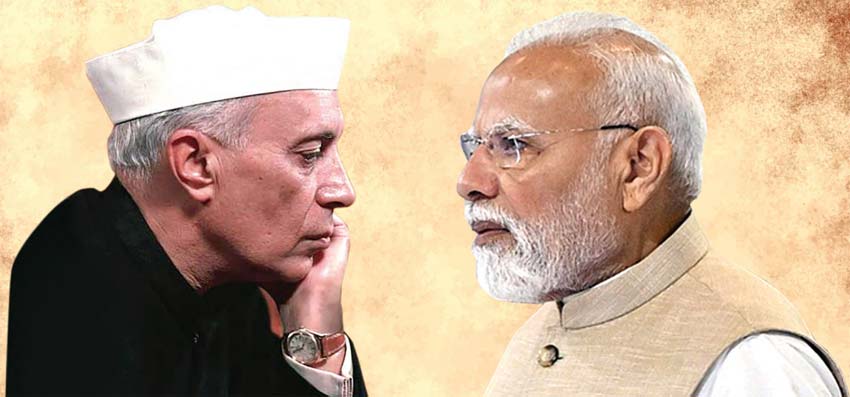
The comparison of India’s first Prime Minister Jawaharlal Nehru and the incumbent Prime Minister Narendra Modi has been frequently discussed in the political discourses in the country since the latter’s advent in 2014. The former led the country through its formative years post-independence, while the latter is shaping contemporary India. Numerous parameters can be invoked to compare the two political titans, but the analysis has to be based on very limited ones due to the constraint of the writing space available.
Nehru was born into an elite Kashmiri Pandit family and educated in England. He was an important figure in Indian independence movement. He ascended to the Prime Minister’s throne by the blessings and machinations of the British and Gandhi. Modi was born in a modest family, had a humble upbringing, worked at his family’s tea stall and spent the life of vairāgya for few years. He rose through the ranks of the Rashtriya Swayamsevak Sangh (RSS) and Bharatiya Janata Party (BJP), serving thirteen years as Chief Minister before being elected the Prime Minister.
Nehru administered during a period of transition from colonial rule to building institutions for the independent India and laying the core philosophies to address the issues of economy and diversity. Modi assumed office in an era of globalization, information technology, fragile economy, crony capitalism, corruption, and heightened aspirations for development.
Nehru is often criticized for being overly centralized in decision-making and for his trust in bureaucracy, which sometimes slowed progress. He abhorred personal criticisms, hence throttled the freedom of expression on many occasions. Modi is charismatic and decisive, with a strong emphasis on personal branding. He leverages media, technology, and direct communication (e.g., radio show Mann Ki Baat, social media) to connect with the public. His oratory emphasizes nationalism, self-reliance (Atmanirbhar Bharat), and efficiency, often projecting himself as a decisive leader. According to his critics, he has less tolerance for dissent, and a polarising persona compared to Nehru’s inclusivity.
The traits and duties of a good administrative head of a country have been propounded since the ancient times. The Mahabharat and Ramayana contain umpteen discourse regarding the same. Lord Rama sermoned to the monkey king Sugriva that none can be a better king than a sanyasi or tapashwi. He will not indulge in personal luxury. Day and night, he will be devoted to the welfare of his people. He will have neither friend nor foe. Renouncing attachment, he will treat all his subjects equally. Kautilya’s Arthashastra postulated the concept of rajarishi (sage king). Plato visualised a Philosopher King. However, most of the ingredients of all these paradigms are common. Each believes that political life is not independent of moral life, hence emphasise dharma (morality and righteousness) as the key trait of a ruler, whose prime duties are people’s happiness and welfare (yogakshema), prosperity and security of the country from the internal and external inimical forces. Furthermore, the King should be a karmayogi and must control his kama, krodh and greed.
People’s happiness and prosperity are contingent upon the economic policy and the social welfare schemes. The economic policies of both leaders emanate from differing philosophies. Nehru advocated a socialist-inspired mixed economy and state-led development through public sector heavy industrialization. Critics argue his policies led to the “Hindu rate of growth” due to the License Raj’. This system inhibited economic dynamism on the one hand, and fostered corruption among the politicians and the bureaucrats, on the other hand. Corruption became epidemic in the Indian society.
India’s GDP ranked sixth worldwide in 1947, but the country faced acute poverty and the social development indices were abysmal by the end of his era in 1964. The economy and the poverty level remained stagnant. The latter level was relatively constant at around 41% to 45% during the 1950s and 1960s. The inequality grew exponentially. The masses survived on PL-480 wheat, not worth consumption by the humans.
Modi believes in liberalization, entrepreneurship, market-friendly reforms aimed at fostering a market-driven economy, and private sector growth, hence Make in India, GST and Ease of Doing Business reforms. He emphasizes digital economy, as evident from the Digital India, Jan Dhan and UPI and infrastructure development. The GDP has grown steadily. There is a plethora of social welfare measures benefitting the downtrodden and the disadvantaged groups through the DBT schemes. Programs like Pradhan Mantri Awas Yojana, Ayushman Bharat, Ujjwala Yojana, and Swachh Bharat highlight efforts at inclusive development and empowerment. India has lifted 170 million people out of extreme poverty between 2011–23. Extreme poverty has dropped to 2.3% in 2022-23. India is also one of the most equal societies today. According to the World Bank, India’s Gini Index stands at 25.5, making it the fourth most equal country in the world.
According to Kautilya, the King should possess the acumen to understand the intricate dynamics of diplomacy and international relations. The fulcrum of Nehru’s international relations was Non-alignment, avoiding alignment with either the US or USSR during the Cold War period after the World War-II. He positioned India as a leader of newly independent nations, emphasizing peace, decolonization, and international cooperation. His monumental folly was trusting China that captured Tibet and thousands square kilometres of Indian territory. China got a seat in the P5 pantheon of the UNSC due to Nehru’s altruism, and now it has become the enemy number one of India, openly egging Pakistan against India and scuttling the UNSC efforts to declare those having committed terrorism and taken refuge in Pakistan as terrorists.
Modi pursues a proactive, multi-aligned or all-aligned foreign policy, balancing ties with the US, Russia, China, and others. He emphasizes India’s global stature through initiatives like International Yoga Day, International Solar Alliance, and leadership in forums like G20 and BRICS. Other ingredients are strategic partnerships, and diaspora engagement. Modi has catapulted India as a de facto entity wielding influence equal to, if not more than the members of the P5. He has been conferred with the highest civilian honours by over 20 countries.
The policy of external defence followed by Nehru and the successive governments led to alienation of large parts of Kashmir and Ladakh to Pakistan and China, respectively. The terrorism in Kashmir promoted by Pakistan caused Hindus’ exodus. Modi has brought a paradigm shift in the doctrine of external defence and its practice, as would be evident from India’s response to Chinese misadventures at Doklam and Galwan, as well as the surgical strikes and Operation Sindoor against Pakistan’s centres of training of terrorists. There have been huge investments in developing infrastructure in the border areas, procurement of state of the art arms and equipments and modernisation of the defence forces. The country has created the Nuclear Triad designed to support its doctrine of Credible Minimum Deterrence (CMD), ensuring that a nuclear attack would always result in a devastating response. India has also enhanced its defence manufacturing and increased its exports manifold.
The notions of national identity articulated by these leaders also reflect divergent visions for India's future. While Nehru visualised a society based on the Western concept of democracy, secularism, socialism and nation-state, Modi’s narrative emphasizes cultural nationalism and civilisational nation. Nehru wished nation’s Hindu identity to remain dormant, Modi has catalysed Sanatana’s resurgence. The academia entrenched by Nehru and perpetuated by the successive governments comprised the Macauleyians, Islamists and the Communists that wrote history eulogising the Western values and the Mughals. The new history curriculum being written in Modi’s regime is giving enlarged space to Bharatiya culture, dynasties, and heroes, especially women, of struggles against the invaders.
Integrity is an important ingredient of Kautilya’s rajarishi and Plato’s philosopher king. The seven Nolan Principles of Public Life established by the Committee on Standards in Public life set up by the United Kingdom in 1995, too, emphasises selflessness, integrity and honesty as quintessential traits for those holding public offices. Although Nehru is considered personally honest and free of corruption, critics allege nepotism, claiming that he promoted his kins in politics and various government institutions. Critics point appointments of family members to significant diplomatic positions. For instance, his cousin Ratan Kumar Nehru served as India's Foreign Secretary and held ambassadorial roles in China and Egypt. Additionally, Nehru's sister, Vijaya Lakshmi Pandit, was appointed as ambassador to several countries, including the USSR, USA, and the UN. Furthermore, his personal habits lacked austerity.
Modi’s brand value lies in his incorruptibility and austerity. He is known for simple living and self-discipline. He maintains a visible distance from his kins, and there is no allegation of nepotism against him. While Nehru's tenure is often associated with initiating dynastic politics, Modi has publicly positioned himself against such practices and consistently criticized dynastic politics. Modi's administration has introduced initiatives to involve youth from non-political backgrounds in governance, aiming to dismantle entrenched political dynasties.
On the parameter of karmayogi, Modi is the indisputable winner. Modi, embodies the essence of karmayogi through selfless action and dedication to duty as outlined in the Bhagavad Gita. His leadership style reflects a commitment to serving the nation without personal gain, working tirelessly to uplift the masses through initiatives like Mission Karmayogi, which aims to transform civil servants into future-ready professionals. Modi's life, marked by ascetic virtues like discipline and renunciation, showcases his focus on collective welfare over individual desires. Despite facing relentless challenges and criticism, he remains steadfast, channelling his energy into nation-building efforts, earning him recognition as a true karmayogi who prioritizes duty above all.
The domestic and global political environments are also the determinants of the actions and achievements of leaders. They were not antagonistic to Nehru. But Modi has negotiated extremely hostile domestic forces comprising opposition parties, communists, urban Naxals, Islamists, intelligentsia, academia, NGOs, etc., and the global force known as the Deep State, working in tandem with the former.
To conclude, Nehru and Modi have led India in vastly different eras- Nehru in a post-colonial, nation-building phase, and Modi in a globalized, aspirational India phase. Nehru’s legacy is rooted in democratic institution-building and addressing the aspirations of a newly independent nation, while Modi focuses on economic liberalization, cultural nationalism, national confidence, and global ambition. Both have shaped India profoundly, earning praises and controversies that are natural for any political titan.
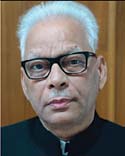
By Ajit singh
IAS (retd.)
(The writer is former Additional Chief Secretary, Rajasthan.)



















Leave Your Comment