


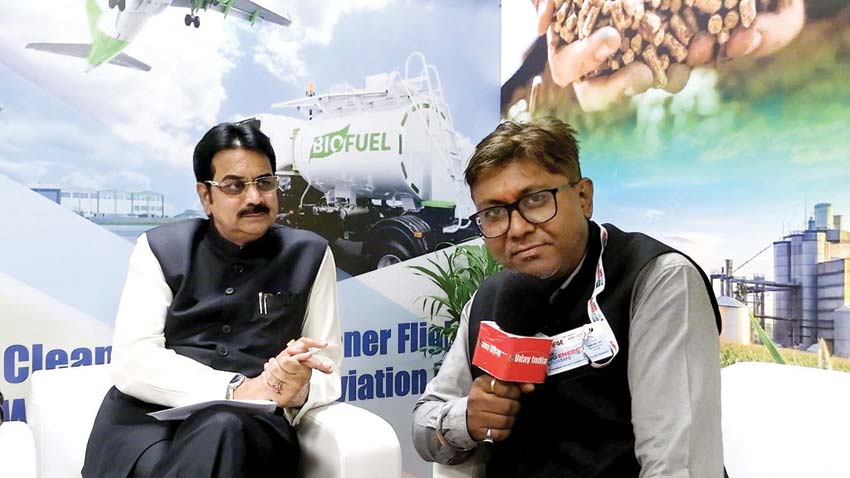
Our nation is progressing, and significant work is happening, especially in the energy sector. Harshvardhan Patil, President of National Federation of Cooperative Sugar Factories (NFCFS) has done extensive work on Ethanol. Following are excerpts of an interview given by him to Anshuman Anand.
Sir, the government is doing a lot of work on ethanol, and its future prospects seem very bright. How do you view this?
Firstly, this India Bioenergy and Tech Expo is a large two-day seminar that has been organized, and Mr. Gadkari was also here. I believe that regarding this matter of bio-energy, and specifically ethanol, I would like to congratulate the Government of India for having supported it immensely.
Just yesterday, a notification was declared; they have floated a quarterly tender. They have issued a tender for ethanol worth 1050 crore rupees. And the happiest news is that out of that, they will procure 466.5 crore litres of ethanol from the sugar industry. That means they have given an 8% boost to it.
They have also done excellent work in the green sector regarding this. For rice, they have issued a tender for 234 crore litres, which is 22%. After that, for maize, they have issued a tender for 285 crore litres, which is a 27% quota for ethanol.
Sir, in the new list, we have seen that the ratio for rice has changed. The ratio for rice has increased, the ratio for maize has decreased, and the ratio for sugarcane has increased. What is the logic behind this?
No, it depends upon the production. All the reports come to the Government of India. How much is the production of maize in the country this year? How much is the production of rice? How much is the production of sugar? If sugar production is going to be in excess this year, that is why they have increased the sugar-based ethanol program by 8%. Rice production is also increasing. Maize production is slightly lower. So, it depends on the production.
How does the government decide the quota? It's based on what the production will be in a year, minus-plus 10%, which always happens. Sometimes there are floods, sometimes droughts, sometimes heavy rains. So, they have all these figures.
This is a quarterly tender for the first three months. If maize increases in the second quarter, they can increase the maize quota then.

It is often said that the cost of producing biofuel is very high. What can be done to reduce this?
The Honourable Prime Minister, Mr. Modi, has taken a very good decision on this. But currently, there are some issues with the costing. Currently, all the sugar factories that produce ethanol... ethanol is made in three ways: from C-molasses, from B-heavy molasses, and from syrup.
In the last two years, the Government of India increased the rates for C-molasses, but they did not increase the prices for B-heavy and syrup. So, our demand is that they haven't increased the rates for three years, so the costing doesn't work out. We have given many presentations on this, and we are hopeful that the government will increase the price of ethanol. We hope so.
Another thing we observe is that we import 80% of our fuel, and we blend 20% ethanol into it. But the import of carbon fuel is not decreasing. Why is that?
The issue is that there are two or three matters here. One is the issue of flex engines. Until we move totally to 100% flex engines, the consumption of ethanol cannot increase. So, currently, the E20 formula has been worked out.
I think the Government of India has also decided this. Mr. Gadkari has also mentioned this many times: if we install flex engines in all upcoming automobiles in the industry, then ethanol consumption from flex engines can go up from 20%.
And the flex engine you are referring to is the one used in Brazil, I assume?
No, no. Brazil's flex-engine system is different. Our system is different. Brazil started their ethanol program 20-25 years ago. We have only just started. So, there are some challenges.
The thing is, the international rate of crude oil fluctuates; sometimes it is low, sometimes it is high. But I believe that green fuel is the future. We have also made great provisions for the environment, ensuring there is no pollution. And this is green energy.
Sir, you are President of National Federation of Cooperative Sugar Factories and are connected to the sugarcane farmers. PM Modi has said that we are continuously striving to double the farmers' income. How is your ethanol production helping to double the farmers' income?
Look, ethanol is a new booster for giving a better price to farmers. I feel that in the last five to six years, the FRP of sugar, which is the Fair and Remunerative Price, has been increased by up to ₹650 by the Government of India in the last 5 years. So, the farmer is currently getting a good price.
But who will give the price to the farmer? It is the sugar mill that will give it. So, the MSP of our sugar, the Minimum Support Price, is currently around ₹3900 on average in the domestic market, and the retail rate is around ₹40, ₹41, ₹42.
So, from our Federation's side, we have also made a demand and placed figures before the government, stating that if this price is stable for the consumer in the market, then give us that much as the MSP.
Even after giving this, we can give an even better price to the farmers. And Mr. Modi's dream is that we will double the farmers' revenue in 5 years. I believe that through this, it is possible.

By Anshuman Anand




















Leave Your Comment