


India’s space sector is witnessing a historic transformation with the emergence of a vibrant private space industry driven by policy reforms, technological innovation, and increased investment. The opening up of the space sector to private players in 2020 and the subsequent implementation of the Indian Space Policy 2023 have created a favourable ecosystem for Non-Government Entities (NGEs) to participate in satellite manufacturing, launch services, space applications, and commercial utilization of space technologies. The reforms have not only encouraged entrepreneurship but have also positioned India as an emerging global hub for space innovation.
The impact assessment carried out by IN-SPACe highlights the significant progress achieved since the liberalization of the sector. In 2026, private entities reported investments of around $187 million, reflecting growing investor confidence in India’s space capabilities. Till date, IN-SPACe has granted 108 authorizations to NGEs for undertaking various space activities, including the establishment and operation of satellites, payload development, and space transportation systems. These approvals demonstrate the increasing participation of private companies in areas that were traditionally dominated by government institutions.
The regulatory framework introduced by IN-SPACe has played a crucial role in balancing commercial growth with national security and strategic interests. The Norms, Guidelines and Procedures for Implementation of Indian Space Policy-2023 in respect of Authorization of Space Activities provide a structured mechanism for evaluating applications from private entities. The guidelines ensure that space activities are conducted responsibly while promoting innovation and investment. In addition, IN-SPACe is working on Safety and Security Guidelines for space activities undertaken by Indian entities in consultation with stakeholders to strengthen operational standards and risk management.
Government initiatives have been instrumental in creating an enabling environment for private participation. The liberalized Foreign Direct Investment policy has encouraged global investors to explore opportunities in India’s space sector. The establishment of a Rs. 1,000 crore Venture Capital Fund aims to provide financial support to promising space start-ups, while the Rs. 500 crore Technology Adoption Fund seeks to accelerate the development, demonstration, and commercialization of indigenous space technologies. The IN-SPACe Seed Fund Scheme has further supported young enterprises by helping transform innovative ideas into commercially viable products.
Access to ISRO’s infrastructure, technical expertise, and mentorship has provided private companies with critical support during their growth journey. The discounted pricing policy for NGEs to access ISRO facilities, technology transfer initiatives, and opportunities to test space systems through platforms such as the PSLV Orbital Experimental Module (POEM) have significantly reduced entry barriers for start-ups and research institutions. The establishment of the IN-SPACe Technical Centre has further strengthened the ecosystem by providing affordable testing, validation, and simulation facilities for space systems.
The growth of India’s private space sector is reflected in the increasing number of start-ups and successful missions. The number of active space start-ups has grown from just one in 2014 to more than 400 today. Private investment in the sector has crossed $600 million, with cumulative funding reaching approximately $618.5 million by March 2026. Indian companies have successfully demonstrated launch and orbital capabilities, with private firms placing more than 30 satellites into orbit and deploying numerous payloads through platforms such as POEM.
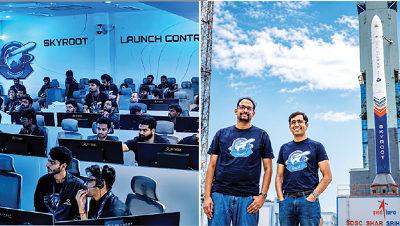
Several Indian space start-ups have gained international recognition through technological achievements and global investments. Skyroot Aerospace emerged as the country’s first space unicorn, while companies such as Pixxel, Digantara, Agnikul Cosmos, and Dhruva Space have attracted investments from leading global and domestic investors. These developments indicate that India’s private space ecosystem is moving beyond experimentation towards commercial-scale operations.
Private companies have also expanded their presence in international markets. Indian firms are collaborating with foreign partners, supplying advanced satellite data solutions, and participating in global space missions. Earth Observation Public-Private Partnership programmes have further strengthened commercial opportunities by bringing together private players to develop indigenous satellite constellations. Initiatives such as Satellite Bus as a Service are expected to enhance domestic manufacturing capabilities and accelerate satellite development.
The government is also focusing on skill development and human resource creation to meet the growing requirements of the space industry. Industry-oriented courses, student immersion programmes, and specialized training initiatives have been introduced to bridge skill gaps. Fourteen short-term skill development courses covering various aspects of the space sector have been designed to prepare a skilled workforce for future demands.
Infrastructure expansion, technology transfer, demand generation, and international cooperation remain key pillars of India’s space strategy. The government is encouraging states to establish dedicated space manufacturing clusters to strengthen supply chains and create integrated industrial ecosystems. At the global level, India is expanding partnerships with leading space-faring nations and facilitating market access through international events, business forums, and technology collaborations.
The rapid evolution of India’s private space sector represents a major shift from a government-led model to a collaborative ecosystem involving start-ups, industries, research institutions, and international partners. With continued policy support, investment opportunities, and technological advancement, India is steadily increasing its share in the global space economy. The reforms undertaken through IN-SPACe and the Indian Space Policy 2023 are laying the foundation for a self-reliant, innovative, and globally competitive space industry that can contribute significantly to economic growth, national development, and scientific progress.





















Leave Your Comment