



MANOJ DUBEY
The education system in ancient India was highly developed and centred on moral values, knowledge, and discipline. Education was imparted mainly through the Gurukul system, where students lived with their teachers and studied subjects such as philosophy, mathematics, astronomy, medicine, warfare, politics, and scriptures. Great centres of learning such as Nalanda University and Takshashila University attracted students from across Asia. Teaching emphasised character building, practical knowledge, debate, and spiritual growth. Both oral tradition and written texts played important roles. Ancient Indian education contributed significantly to science, literature, governance, and cultural development worldwide. Bhojshala was an important centre of learning during the rule of King Bhoj in medieval India. It was known for the study of Sanskrit, grammar, philosophy, astronomy, and literature. Scholars and students gathered there for higher education and intellectual discussions. Bhojshala reflected the rich educational and cultural heritage of ancient India.
Post-Independence
India’s education system underwent major reforms after independence to promote literacy, equality, and national development. At the time of independence in 1947, the literacy rate was very low, and access to education was limited. The government focused on expanding schools, colleges, and universities across the country. Important policies, including the National Policy on Education of 1968 and 1986, and the National Education Policy 2020, aimed to modernise education and improve quality. The Constitution directed the state to provide free and compulsory education for children. Programs such as Sarva Shiksha Abhiyan, Mid-Day Meal Scheme, and the Right to Education Act helped increase enrolment and reduce dropout rates. Institutions such as the Indian Institutes of Technology, Indian Institutes of Management, and the University Grants Commission strengthened higher and technical education.
The Kothari Commission was established in 1964 under Dr. D.S. Kothari to reform India’s education system. It recommended a common school system, equal educational opportunities, the 10+2+3 structure, an emphasis on science and vocational education, a three-language formula, teacher training, and a higher allocation of funds to education to promote national development and social integration. The National Education Policy (NEP) 1968 was announced based on the recommendations of the Kothari Commission. The Second NEP was introduced in 1986 and revised in 1992. It focused on universal education, women’s education, vocational training, adult literacy, and the modernisation of education.
The National Education Policy 2020 is India's latest education policy to transform the education system. Its main features include the 5+3+3+4 school structure replacing the 10+2 system; emphasis on early childhood care and education; promotion of mother tongue or regional language as the medium of instruction till Grade 5; focus on skill development, vocational education, and critical thinking; greater use of technology and digital learning; and the establishment of the Higher Education Commission of India (HECI) for higher education reforms.
India also expanded vocational training, digital learning, and research facilities. However, challenges such as unequal access, teacher shortages, regional disparities, and quality concerns persist. Despite these issues, the education system has played a major role in India’s social and economic progress since independence.
Primary Education
It is often said that the future of any nation lies in its classrooms, particularly in primary classrooms. Primary schools in India face several challenges that affect the quality of education and the overall development of children. A major problem is the shortage of trained teachers, especially in rural and remote areas. Many schools suffer from poor infrastructure, including a lack of classrooms, toilets, clean drinking water, electricity, and playgrounds. In some schools, a single teacher manages multiple classes, reducing the effectiveness of learning. High student-teacher ratios and irregular teacher attendance also affect the quality of education. Many children from economically weaker families face difficulties due to poverty, malnutrition, and a lack of educational support at home. Dropout rates remain high in certain regions because of child labour, migration, and social issues.
Another concern is the emphasis on rote learning rather than creativity, practical knowledge, and skill development. Limited access to digital technology and learning materials creates inequality between urban and rural students. Language barriers and insufficient attention to regional languages further hinder understanding among young learners. Despite government schemes to improve primary education, implementation gaps and a lack of monitoring remain major obstacles. Improving infrastructure, teacher training, nutrition, and modern teaching methods is essential to building a strong and inclusive primary education system in India.
Education belongs to the concurrent list of the Constitution; both the central and state governments make rules to promote education. India has around 28–30 State Education Boards, as almost every state and some Union Territories have their own board for school education. There are three national boards: the Central Board of Secondary Education (CBSE), the Council for the Indian School Certificate Examinations (CISCE/ICSE), and the National Institute of Open Schooling (NIOS). Apart from these, some international boards, such as the IB and Cambridge, also operate in India.
Competitive Exams
India can improve its education system through comprehensive reforms focused on quality, equality, and skill development. Teacher training and accountability must be strengthened to improve classroom learning. Schools should receive better infrastructure, including modern classrooms, laboratories, libraries, toilets, and digital facilities, especially in rural areas. The education system should encourage critical thinking, creativity, research, communication, and practical skills. Vocational education and industry-oriented training should be integrated with school and college education to improve employment opportunities. Greater emphasis must also be placed on science, technology, innovation, and entrepreneurship.
The government should ensure equal access to education for economically weaker sections through scholarships, nutrition programmes, and affordable higher education. Education in regional languages, along with strong English proficiency, can improve learning outcomes. Regular curriculum updates are necessary to keep pace with global developments and technological change.
Examination reforms are also crucial to reduce excessive pressure and dependence on coaching. Transparent and secure systems should be adopted for competitive exams. Increased public spending on education, effective implementation of the National Education Policy 2020, and stronger collaboration among government, private institutions, teachers, and parents can help build a modern, inclusive, and globally competitive education system in India.
NTA
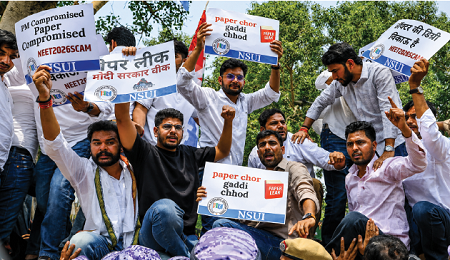
The National Testing Agency (NTA) was established in 2017 by the Government of India to conduct transparent, efficient, and standardised entrance examinations for higher education. It was created to reduce the burden on organisations like CBSE and to improve professionalism in conducting national-level exams such as JEE, NEET, CUET, and UGC-NET. The agency introduced computer-based testing, centralised systems, and wider access to exams across the country. However, the NTA has faced criticism in recent years over the conduct of the National Eligibility cum Entrance Test (NEET). Allegations included paper leaks, irregularities in grace marks, technical issues, lack of transparency, and poor management at some examination centres. The 2024 NEET controversy especially raised serious concerns after reports of unusually high scores, delayed responses, and suspected malpractice. Students and opposition parties questioned the credibility of the examination process, leading to protests and court cases. Again in 2026, the NEET paper was leaked, prompting serious allegations about the NTA's credibility. The Supreme Court has expressed its serious concern over the leakage of the question paper.
The NTA has failed to ensure complete security, fairness, and accountability in such a high-stakes examination affecting millions of students. In response, the government promised reforms, stricter security measures, improved monitoring, and stronger technological safeguards to restore public confidence in the examination system. It has already been announced that the NEET exam will be conducted online.
Coaching Centres
Coaching institutes have become important for competitive exams in India, such as JEE, NEET, UPSC, SSC, and banking examinations. They provide structured guidance, study materials, mock tests, time-management strategies, and expert mentoring, helping students compete in highly challenging examinations. Many students, especially from small towns, rely on coaching institutes to understand exam patterns and improve performance. The growth of coaching centres has also created a parallel education system. Cities like Kota have emerged as major coaching hubs for engineering and medical entrance preparation.
However, excessive dependence on coaching has several drawbacks. High fees create inequality, rote learning often replaces conceptual understanding, and intense competition increases stress and mental health problems among students. It also weakens the importance of regular schooling in some cases. Coaching institutes are helpful support systems, but strengthening school education, improving teaching quality, and making competitive exams more balanced can reduce overreliance on the coaching culture. This system provides jobs for a large number of people. On the other side, it promotes a culture of dummy admissions in the 11th and 12th grades. In the recent NEET paper leak case, some coaching centres are also under investigation.
Private Sector in Education
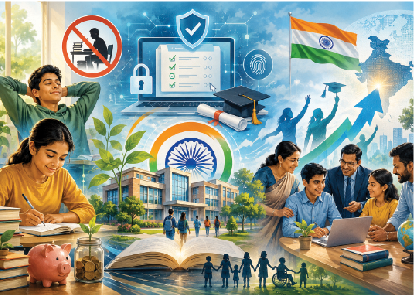
The private sector plays a vital role in education by expanding access, improving infrastructure, and fostering innovation and competition. Private schools, colleges, universities, and training institutions help meet the growing demand for quality education in India, especially in areas where government institutions face resource and teacher shortages. The private sector has made significant contributions in fields such as engineering, management, medical education, digital learning, and skill development. Many institutions offer modern facilities, research opportunities, industry-oriented courses, and global exposure.
Private participation also creates employment for teachers and promotes investment in educational technology and vocational training. In many areas, private institutions have helped improve educational standards through better accountability and management. However, excessive commercialisation, high fees, unequal access, and profit-oriented practices remain major concerns. Therefore, effective government regulation, transparency, scholarships, and social responsibility are essential to ensure that private education remains affordable, inclusive, and focused on national development rather than on profit alone.
Education Abroad
Many wealthy Indian families send their children abroad for higher education because foreign universities often offer better research facilities, global exposure, flexible learning systems, advanced technology, and stronger industry connections. Institutions such as Harvard University, the University of Oxford, and the Massachusetts Institute of Technology are globally recognised for innovation, academic freedom, and high-quality education. Many students also prefer studying abroad for better career opportunities, international networking, and improved living standards. In India, challenges such as limited seats at top institutions, excessive exam pressure, outdated curricula, insufficient research funding, bureaucratic hurdles, and uneven quality of education encourage students to look overseas. Some parents also view foreign education as a symbol of social prestige.
To retain talented students, India must strengthen its universities by investing in world-class infrastructure, research grants, academic autonomy, and international collaborations. Universities should prioritise innovation, practical learning, entrepreneurship, and skill-based education. Improving faculty quality, reducing political interference, and creating better employment opportunities are equally important. Expanding institutions such as the Indian Institutes of Technology and promoting globally competitive universities can help India become an international education hub and reduce brain drain.
Conclusion
India’s education system has expanded rapidly since independence, but major reforms are still necessary to meet the needs of a modern, competitive society. One of the biggest challenges is the quality gap between urban and rural schools. Many government schools suffer from poor infrastructure, a shortage of trained teachers, and a lack of digital facilities. Reforms are needed to ensure equal access to quality education for all children. Students often memorise facts rather than develop critical thinking, creativity, communication, and problem-solving skills. Education reforms should promote practical learning, research, innovation, and skill development to prepare students for employment and entrepreneurship.
The mounting pressure of competitive exams and dependence on coaching institutes also highlight weaknesses in the system. School education should be strengthened to reduce excessive reliance on private coaching. Greater transparency and efficiency in examination bodies are also essential. India also needs reforms in higher education to strengthen research, industry collaboration, and the global competitiveness of universities. Vocational training and digital education should be expanded to meet the demands of emerging sectors such as artificial intelligence, renewable energy, and advanced manufacturing.
The implementation of the National Education Policy 2020 is a significant step towards multidisciplinary learning, flexibility, and skill-based education. However, effective implementation, adequate funding, teacher training, and accountability are essential for real transformation. Education reforms are essential not only for economic growth but also for social equality, national development, and the creation of an informed and innovative society.
There was a time when students from other countries came to study at Nalanda University. The modern university was established through an Act of Parliament in 2010, near the ruins of the ancient Nalanda in Bihar. Supported by several Asian countries, it aims to become an international centre for higher education and research. Even after 15 years, the work remains incomplete. We will have to begin with primary education, with quality teachers recruited under a proper salary structure, as in KVs and JNVs. Reforms in education are required at all levels; more government funding and strict monitoring will help improve the system.
(The content of this article reflects the views of writer and contributor, not necessarily those of the publisher and editor. All disputes are subject to the exclusive jurisdiction of competent courts and forums in Delhi/New Delhi only)



















Leave Your Comment