


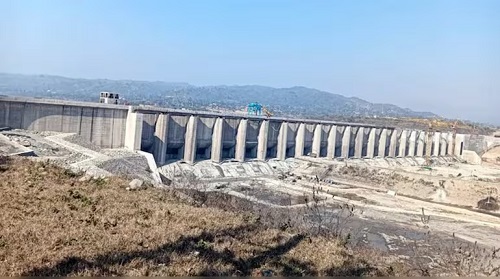
As the mercury rises and the specter of another scorching summer looms over South Asia, the water dynamics between India and Pakistan are undergoing a historic shift. With the Indus Waters Treaty currently in abeyance, New Delhi is moving swiftly to operationalize a half-century-old ambition: fully utilizing the waters of the eastern rivers in Indus basin. The centerpiece of this strategy is the near-completion of the Shahpur Kandi Dam on the Ravi River, a project that will soon stop the flow of "surplus" water into Pakistan and redirect it to water-starved regions of Jammu and Kashmir and Punjab.
According to Jammu and Kashmir water resource minister Javed Ahmed Rana, the dam is on track for completion by March 31. Once operational, it will effectively block the excess water that currently meanders from the Madhopur headworks into Pakistan. For decades, this flow has continued unabated, but the dam now promises a long-awaited reclamation of water rights over the eastern rivers of the Indus basin.
"A long-awaited shift," Rana stated, confirming that the water will be diverted to the drought-prone districts of Kathua and Samba. "Excess water to Pakistan will be stopped. It has to be stopped. Kathua and Samba districts are drought-hit areas, and this project, which is our priority, is being constructed for the Kandi area."
A 45-Year-Old Dream Nears Fruition
The Shahpur Kandi Dam is not a new idea; it is a legacy project plagued by delays. First envisaged in 1979, its foundation stone was laid by then-Prime Minister Indira Gandhi in 1982. However, inter-state disputes between Punjab and Jammu and Kashmir repeatedly stalled construction, leaving the waters to flow unused into Pakistan. It was only in 2008 that the central government stepped in, declaring it a national project to break the deadlock.
Now, with a price tag of Rs 3,394.49 crore—largely funded by Punjab and the Government of India—the project is finally taking shape. The 55.5-meter-high dam, complete with a 7.7 km hydel channel, will serve a dual purpose: generating power and quenching the thirst of parched lands. Officials estimate it will irrigate approximately 5,000 hectares in Punjab and over 32,000 hectares across the Kathua and Samba districts of Jammu and Kashmir.
The Geopolitical Context: Treaty in Abeyance
The rapid finalization of the dam coincides with a major diplomatic rupture. On April 23, 2025, following a deadly terrorist attack in Pahalgam, India formally placed the Indus Waters Treaty "in abeyance." For the first time since the treaty was signed in 1960, New Delhi explicitly linked cross-border water cooperation with Pakistan's continued use of terrorism as an instrument of state policy.
While the treaty was in force, it granted India rights over the three eastern rivers—Ravi, Beas, and Sutlej—but pragmatic utilization was often slow. With the treaty now suspended, the Centre has accelerated work on a slew of hydroelectric and storage projects across the Indus basin, including Ratle, Pakal Dul, and Sawalkote. The Shahpur Kandi Dam is the most immediate beneficiary of this policy shift.
Former irrigation minister Taj Mohideen clarified that even under the original framework, India had exclusive rights to the Ravi. However, the suspension removes any diplomatic friction, allowing India to maximize its usage without concern for downstream protests. For Pakistan, which depends on the Indus system for nearly 80-90 percent of its agriculture and has minimal water storage capacity, the closure of this tap adds a critical layer of pressure as summer intensifies.
By finally closing the sluice gates at Shahpur Kandi, India is not just building a dam; it is cementing a new doctrine where water security and national security flow in the same direction.





















Leave Your Comment