


The World Bank in its recent report has placed India among world’s most equal societies. India now ranks fourth globally in income equality, based on Its Gini score.
Understanding the Gini Index
The Gini Index (or Gini Coefficient), developed by Italian statistician Corrado Gini in 1912, measures income or wealth inequality within a population. After the Second World War, the World Bank and the UN adopted it to compare inequality across nations. It provides a simple yet powerful way to understand how evenly income, wealth, or consumption is distributed across households or individuals in a country. Its value ranges from 0 to 100 (or 0 to 1 as a coefficient). A score of 0 indicates perfect equality, where everyone has the same income. A score of 100 signifies absolute inequality, where a single individual possesses all the income, wealth, or consumption. A lower Gini Index reflects a more equitable society, while a higher score indicates greater inequality. The Lorenz curve is a graphical representation of this measure.
India’s Economic Growth Story
In June 1991, under Prime Minister Narsimharao and finance minister Manmohan Singh, India introduced bold economic reforms. These included liberalization, privatization, and globalization (commonly referred to as LPG reforms), which opened up the Indian economy and dismantled the Licence Raj. These reforms, though late, laid the foundation of the economic growth.
India became a $1 trillion economy in 2007, after 60 years of independence. In just seven more years, it doubled to $2 trillion in 2014. By 2021, India’s GDP crossed $3 trillion mark. As of May 2025, India has become the world’s fourth largest economy with a GDP of $4.2 trillion, trailing only America, China, and Germany. At the current growth rate, India is poised to be the third largest economy soon.
The IMF has repeatedly acknowledged India’s rapid growth trajectory. In its April 2024, World Economic Outlook, the IMF projected India’s economy to grow at 6.8%, the highest among the major economies. The IMF described India a ‘bright spot in the global economy’, attributing this to strong domestic demand and meaningful structural reforms.
India’s Gini Index and Global Ranking
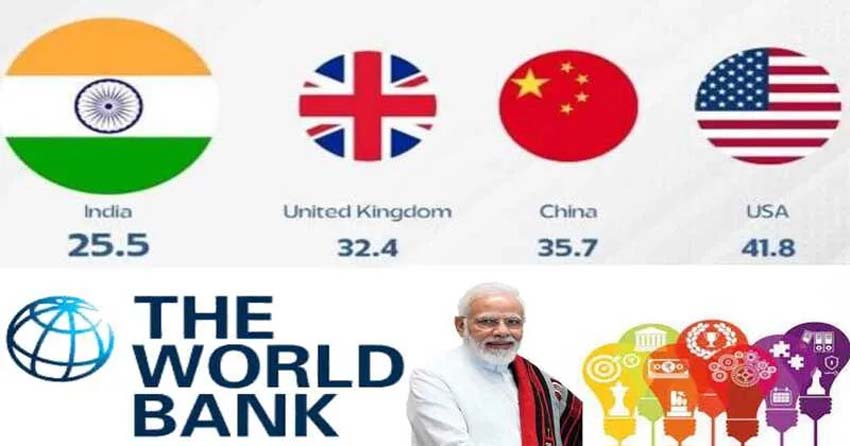
A ccording to the World Bank’s latest release, India’s Gini Index stands at 25.5, placing it among the most equal countries globally. This score surpasses that of UK (32.4), China (35.7) and the US (41.8), and is better than every G7 and G20 nation. Only the Slovak Republic (24.1), Slovenia (24.3), and Belarus (24.4) rank higher. In 2011-12 India’s Gini score was 28.8, reflecting greater inequality than today.
Poverty Alleviation and Social Transformation
This achievement stems from sustained efforts to reduce poverty across urban and rural regions. The World Bank’s Spring 2025 Poverty and Equality Brief highlights India’s achievement as one of the most significant global developments in recent years. According to the World Bank, 27 crore people have risen out of poverty in the past 11 years. Extreme poverty (defined as living on less than $2.15/day) fell from 16.2% to just 2.3% over the decade, lifting about 17.1 crore out of extreme poverty. Even under the more lenient $3/day standard, poverty remains low at 5.3%.
Key Government Initiatives Driving Equality
Infrastructure Development
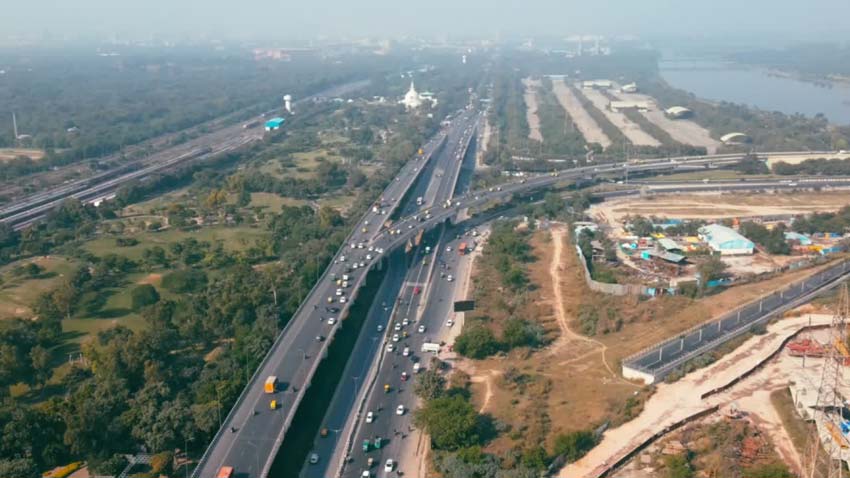
India’s infrastructure development has been pivotal in this transformation. National highways expanded from 91,000 km in 2014 to 147,000 km in 2024, with construction speed rising from 12 km per day to 34 km per day. Rural road networks have expanded significantly. Operational airports increased from 74 in 2014 to 160 in 2025. Indian Railways laid over 27,000 km new tracks in last 10 years averaging 7.4 km/day, much higher than the previous decade. India now leads in locomotive manufacturing, producing 1,681 units last year. Metro network has grown from 248 km in 2014 to 1013 km in 2025. This massive expansion has generated large scale employment.
PM Jan Dhan Yojana
Financial inclusion has been a significant achievement to reduce economic inequality, presently over 55.7 crore people have Jan Dhan accounts, giving them direct access to government benefits and banking services.
Women Empowerment
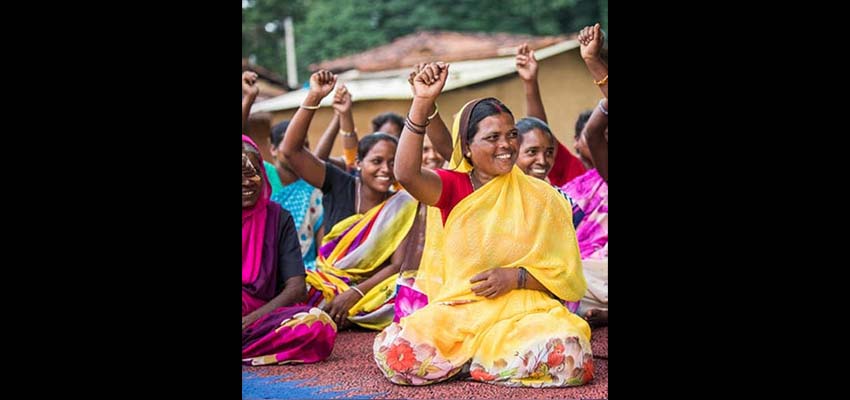
Women have emerged as key drivers in India’s growth story. The Nari Shakti Vandan Adhiniyam has secured one third reservation for women in legislatures. Women now constitute 43% of STEMM enrollments and over two crore entrepreneurs. Self Help groups have grown to over 90 lakhs, fostering grassroots leadership. Women have received over 35 crore Mudra Loans worth Rs.14.7 lakh crore, 68% of the total disbursement. The government has pledged to support three crore women in becoming ‘Lakhpati Didis’. In 2014, there were about 3000 women officers in the defence forces, today, the number exceeds 11,000.
Digital Revolution
One of the most significant successes has been the rapid expansion of India’s public digital infrastructure. Over 142 crore Aadhar cards have enabled unique digital identities for residents. Platforms like UPI and Aadhar have enabled real time payments and direct benefit transfers (DBT). Rural banking has expanded through Jan Dhan accounts. According to government data, Rs.44 lakh crore has been transferred through DBT, greatly reducing corruption. The World Bank has recognized that the Digital Payment Infrastructure (DPI) has accomplished in six years what usually takes decades.
Agriculture and Farmer Support

Under PM Kisan Samman Nidhi, the small and marginal farmer with cultivable land up to two hectares are provided Rs.6,000 per year, through DBT. Over Rs.3.68 lakh crore has been directly transferred to 11 crore farmers. PM Fasal Bima Yojana has settled claims worth Rs.1.75 lakh crore, providing crucial crop insurance. Agriculture budget has increased nearly six fold, with substantial hike in minimum support prices for major crops.
Healthcare Expansion

Ayushman Bharat Scheme provides health insurance of Rs.5 lakh per eligible family annually. In addition, the Ayushman Vay Vandan scheme extends this coverage to all the citizens aged 70 and above, regardless of income. Over 79 crore health accounts have been created to link individuals to digital health services. In last decade, around 400 new medical colleges were established, medical seats doubled, and AIIMS institutions tripled. Maternal and infant mortality rates have declined significantly.
PM Garib Kalyan Ann Yojana
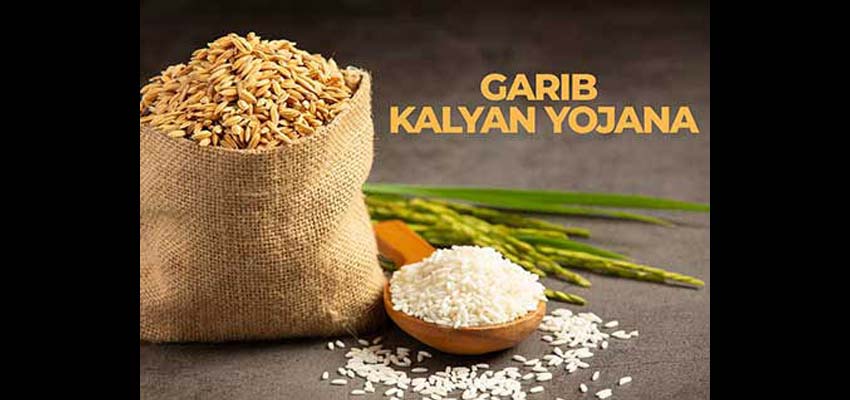
This food security scheme of the government provides 5 kg free food grains per person per month to economically vulnerable families. It was initiated in 2020 as a Covid 19 relief measure to combat food insecurity and continuing as a long term support program for 80 crore beneficiaries. It has substantially reduced malnutrition and food insecurity and supports children, pregnant women, and elderly dependents.
Stand-Up India

To promote inclusive entrepreneurship, this initiative provides loan to SC/ST and women entrepreneurs. By now more than 2.75 lakh applications have been sanctioned, with total funding of over Rs.62000 crores. This support empowers the individuals from disadvantaged communities to participate in economic growth on their own terms.
PM Vishwakarma Yojana
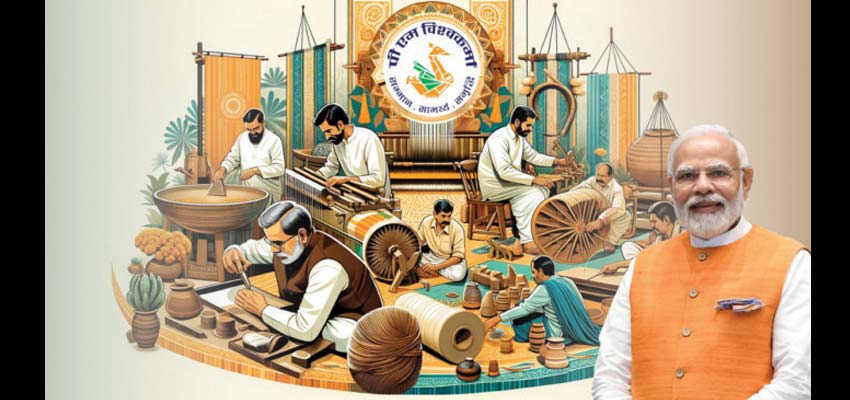
This scheme provides artisans and craftsmen with collateral-free loans, toolkits, digital training, and marketing support. So far around 30 lakh people have been registered under this initiative, helping preserve livelihoods and promote inclusive growth across rural and urban areas.
Conclusion
India’s ascent to the fourth most equal position globally marks a milestone in its economic journey. The path to income equality has been steady and focused. The Gini Index of 25.5 reflects tangible improvements in access to food, banking, education, healthcare, and jobs. Initiatives like Jan Dhan, Ujjawala, PM Ann yojana, Ayushman Bharat, and DBT have bridged long standing gaps, while the schemes like Stand-Up India and PM Vishwakarma foster self-reliance. As the world searches for the model that combines growth with fairness, India’s example stands out. It shows that the equality and development are not opposite goals. When supported by sound policy and inclusive intent, they progress hand in hand.
This achievement highlights progress in poverty reduction and social inclusion. Over the past decade no major corruption case has been reported against the central government. Through DBT, government assistance directly reaches the beneficiary, without any leakage. With continued efforts, India aspires not only to become the third largest economy but also one of the top three most equitable societies worldwide.

By Manoj Dubey
Principal (Retd.)
Delhi Public Schools
(The content of this article reflects the views of writers and contributors, not necessarily those of the publisher and editor. All disputes are subject to the exclusive jurisdiction of competent courts and forums in Delhi/New Delhi only)














Comments (1)
D
India from the era of prime minister shri Narsimha Rao and Sn Man Mohan Singh started the revolution in the Indian economy. Now in the regime of shri Narendra Modi, the Indian economy has been developed enormously and reached to fourth position. The development is clearly seen in the field of infrastructure, roads, power, education, agriculture, industry, employment etc. The progress will assume new heights in the comming years. The author has analyzed the economy and progress of the country very critically. Congratulations to him for very nice presentation.