


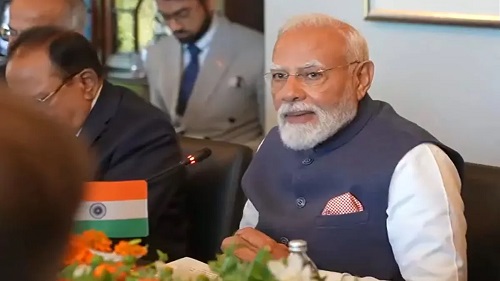
Prime Minister Narendra Modi and his New Zealand counterpart Christopher Luxon on Saturday hailed the signing of the India-New Zealand Free Trade Agreement (FTA) as a landmark achievement, describing it as a new chapter in bilateral relations. During delegation-level talks in Auckland, the two leaders also announced the elevation of ties to a Strategic Partnership, pledging deeper cooperation in trade, security, the Indo-Pacific and people-to-people exchanges.
Calling the FTA a "historic milestone," Prime Minister Modi praised the New Zealand government for concluding the agreement in a remarkably short period. He said the successful completion of negotiations reflected the commitment of both countries to strengthening economic and strategic ties.
"It gives me great pleasure that an Indian Prime Minister has visited New Zealand after 40 years," Modi said, expressing gratitude to Prime Minister Luxon for hosting him in Auckland and for creating an opportunity to inject new momentum into bilateral relations.
The Prime Minister noted that the FTA negotiations had begun during Luxon's visit to India last year and credited the New Zealand leadership for bringing the agreement to fruition with exceptional speed. "The way all of New Zealand united to bring the FTA to fruition in such a short time is remarkable. I extend my heartfelt gratitude to your leadership, your government and your team for this achievement," he said.
Recalling Luxon's visit to India during the festival of Holi last year, Modi remarked that it had "added new colours" to the bilateral relationship. He said the newly announced Strategic Partnership would provide fresh momentum and confidence for future cooperation.
Emphasising the shared democratic values of the two nations, Modi described India and New Zealand as "natural partners" and said their close maritime cooperation would strengthen peace and stability in the Indo-Pacific region. He expressed confidence that the visit would further deepen bilateral ties while enhancing the two countries' contribution to global peace, stability and security.
Prime Minister Christopher Luxon described Modi's visit as a historic occasion, noting that it marked the first visit by an Indian Prime Minister to New Zealand in four decades. Welcoming Modi, he recalled the warmth and hospitality extended during his own visit to India last year and thanked the Indian leader for his personal commitment to strengthening bilateral relations.
Luxon said the two countries had achieved "tremendous progress" on the trade agenda within a short period. While the Free Trade Agreement represented a significant breakthrough, he stressed that the partnership extended well beyond commerce.
"Today's focus is about more than just the FTA. It is about where we go next in this relationship and how we broaden it further," Luxon said. He announced that the Strategic Partnership would provide a comprehensive framework for expanding cooperation across multiple sectors in the years ahead.
The Free Trade Agreement is expected to significantly boost bilateral trade, investment, supply chain cooperation and market access for businesses in both countries. Officials believe the agreement will also strengthen collaboration in technology, agriculture, education, innovation and services while creating new opportunities for businesses and investors.
Later in the day, Prime Minister Modi is scheduled to meet leading business and sports personalities in New Zealand. Reflecting the strong people-to-people ties between the two nations, he will also address a large gathering of the Indian diaspora in Auckland, according to the Ministry of External Affairs.
Soon after arriving in Auckland on Friday, Modi described his visit as "historic" in a post on X, thanking Prime Minister Luxon for personally welcoming him at the airport. He highlighted that the visit marked the first Prime Ministerial visit from India to New Zealand in 40 years and expressed optimism about discussions aimed at taking the India-New Zealand partnership to greater heights.
The visit is widely seen as a turning point in bilateral relations, with the signing of the Free Trade Agreement and the launch of a Strategic Partnership laying the foundation for expanded cooperation across trade, security, maritime affairs and regional stability in the Indo-Pacific.



















Leave Your Comment