


As the character of warfare undergoes a profound transformation driven by artificial intelligence, drones, cyber capabilities and space-based technologies, India must evolve a military strategy that reflects its own geopolitical realities and security requirements. Chief of Defence Staff General N. S. Raja Subramani has called for a distinctly Indian approach to future warfare, emphasising that lessons from international conflicts must be adapted to the country's operational environment. He also underlined that self-reliance in defence production, joint military capabilities and technological preparedness will be decisive in safeguarding India's national interests in an increasingly complex security landscape.
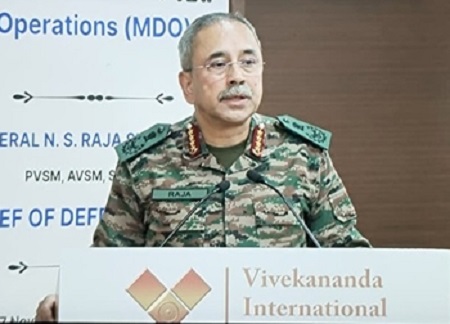
Chief of Defence Staff General N. S. Raja Subramani has stressed that India cannot afford to depend entirely on military doctrines developed by other countries while preparing for the wars of the future. Addressing a lecture on the future of warfare and India's preparedness for multi-domain operations in New Delhi, he said the country must formulate its own strategic framework by studying contemporary global conflicts and assessing their implications for India's distinctive security challenges. His remarks come at a time when the nature of military confrontation is changing rapidly, with technological innovation, information superiority and the ability to coordinate operations across multiple domains increasingly determining the outcome of conflicts.
General Subramani made it clear that Atma Nirbharta in defence must be understood as a strategic necessity rather than a political slogan or an economic aspiration. A country that remains dependent on foreign suppliers for critical military equipment, technology and essential components could face serious operational constraints during a prolonged conflict. Indigenous defence manufacturing, research and development, and domestic technological capabilities are therefore essential to ensure uninterrupted military preparedness. Self-reliance, he indicated, must extend beyond manufacturing platforms and weapons systems to include the development of advanced technologies, secure communication networks and the capacity to maintain and upgrade military equipment independently.
One of the significant observations in his lecture concerned the changing character of military operations. Warfare, he explained, is gradually moving away from the traditional network-centric model towards decision-centric operations. While network-centric warfare focused on connecting military platforms, sensors and command structures to facilitate information-sharing, the emerging approach places greater emphasis on converting enormous volumes of information into timely and effective decisions. Artificial intelligence, persistent surveillance, real-time intelligence and integrated military capabilities are becoming central to this transformation. The ability to identify threats, analyse information and respond faster than an adversary could provide a decisive operational advantage.
For India, achieving this transformation will require much closer coordination among the Army, Navy and Air Force. General Subramani emphasised the importance of jointness and called for the development of an integrated communication network that would enable the three services to exchange information seamlessly and take coordinated decisions. In a multi-domain battlefield, isolated service capabilities may not be sufficient to address complex threats. Military operations on land, in the air and at sea increasingly intersect with activities in space and cyberspace. Consequently, the armed forces must develop a common operational understanding and the ability to employ their combined capabilities effectively.
The CDS also drew attention to domains that are likely to become increasingly important in future conflicts, including space-based assets, cyber defence, electronic warfare and subterranean warfare. Satellites have become indispensable for navigation, communication, surveillance and targeting, making space infrastructure a critical component of national security. Similarly, cyberattacks and electronic interference can disrupt military communication, command systems and essential infrastructure without a conventional military confrontation. Subterranean warfare, meanwhile, presents its own challenges, particularly in environments where adversaries use underground tunnels and concealed installations to protect personnel and military assets. India's preparedness must therefore extend well beyond conventional battlefield capabilities.
Drawing lessons from conflicts involving Israel, Iran, Russia and Ukraine, General Subramani highlighted how modern battlefields are increasingly shaped by intelligence, long-range precision strikes, unmanned aerial systems, artificial intelligence and cyber operations. The Russia-Ukraine conflict, in particular, has demonstrated the extensive use of drones for surveillance, reconnaissance and attacks, while also highlighting the importance of electronic warfare and the ability to sustain military operations over extended periods. Developments in West Asia have further illustrated the growing significance of precision weapons, intelligence-led targeting and the integration of different military technologies. However, the CDS's underlying message was that India must study these experiences without mechanically adopting the strategies of other nations.
He also cautioned against the assumption that technological superiority alone guarantees victory. Advanced weapons and sophisticated digital systems can provide important advantages, but their effectiveness ultimately depends on the people, institutions and infrastructure supporting them. Well-trained military personnel, dependable logistics, adequate ammunition supplies, industrial production capacity and reliable international partnerships remain essential elements of military strength. A technologically advanced force must also possess the resilience to continue fighting when communication networks are disrupted, supply chains are threatened or critical infrastructure comes under attack. The ability to sustain operations over time is as important as the ability to deliver an initial strike.
Citing Operation Sindoor, General Subramani praised the coordination demonstrated by India's armed forces, the precision of targeting and the operational effectiveness of indigenous weapons systems, including BrahMos and Akash. The operation, he indicated, offered important lessons about the value of integrated military planning and domestically developed capabilities in contemporary security operations. The use of indigenous systems also reinforced the importance of building a defence industrial ecosystem capable of meeting the armed forces' evolving requirements.
His observations underline a larger strategic challenge confronting India: preparing for conflicts that may not resemble the wars of the past. The future battlefield will demand a combination of military professionalism, technological innovation, industrial strength and inter-service coordination. India's ability to anticipate emerging threats, develop indigenous solutions and integrate its military capabilities will play a crucial role in determining its strategic readiness. The message from the CDS is clear: India must not merely prepare to fight the next war with existing capabilities; it must develop the doctrine, technology and institutional strength required to shape the character of future warfare.




















Leave Your Comment