


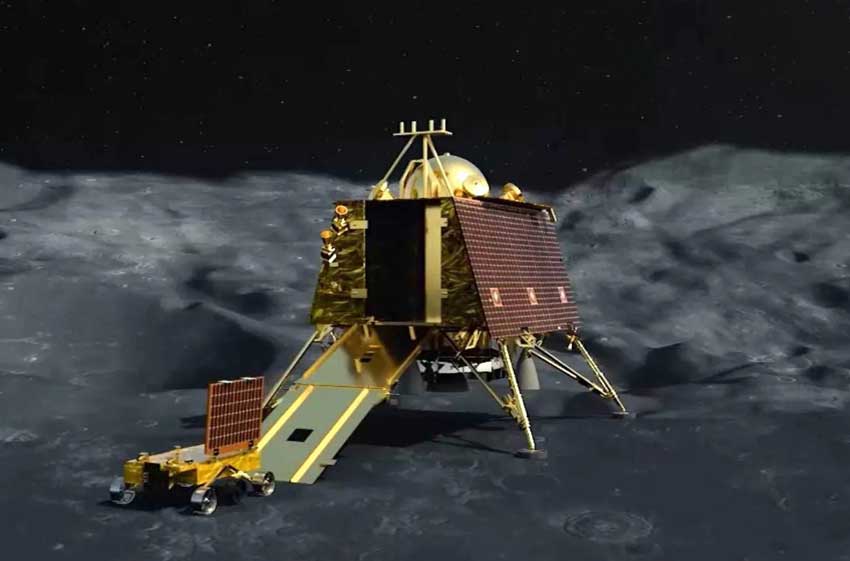
India scripted history on the moon by successfully landing Chandrayaan 3 on the south pole of the moon. So far the US, Russia and China are the only three nations which have reached the moon. But none of them has been able to land on the southpole. Against this backdrop, it is apt to mention here that India now is the fifth-largest economy in the world and is the most populous country. It has a sizable young population and is home to an expanding innovation and technological center. Additionally, under Modi, India's space goals have been playing catch-up. PM Modi sees India's space programme as a sign of the nation's rising significance on the international stage after being elected in 2014 on an agenda of nationalism and future greatness. India launched the Mangalyaan spacecraft into orbit around Mars in 2014, becoming the first Asian country to do so. The mission cost $74 million to launch, less than the $100 million Hollywood spent on the space drama "Gravity." India set a record by launching 104 satellites in one operation three years later. PM Modi in a rare broadcast address said that India has shot down one of its own satellites in an alleged anti-satellite test in 2019, making it one of only four nations to have done so. In the same year, India's former head of ISRO, K Sivan, stated that the country intended to launch a space station by 2030. The International Space Station, a multi-national project, and China's Tiangong Space Station are the only space stations currently accessible to expedition crews.
Space technology has become one of India's hottest investment industries due to its rapid development and innovation, and foreign leaders seem to have taken notice. The White House stated that when Modi and US President Joe Biden met in Washington in June 2023 on a state visit, they both desired greater cooperation in the space sector. Additionally, India has space aspirations beyond the moon and Mars, has launched Aditya mission to the Sun and is planning to send an orbiter to Venus. Landing on the South Pole has always been considered a challenge because of the topography of the region where there is no sunlight for millions of years. However, at the same time, the South Pole offers immense scope for future humankind because of the likely presence of water in the form of ice. Overall, the launch of Chandrayaan-3 is a major event with far-reaching implications. The success of this mission would be a major boost for India's space programme and its economy, and it would further solidify India's position as a leading spacefaring nation. The success of Chandrayaan-3 would be a major milestone for India and for the global space race. It would show that India is a serious player in the field of space exploration, and it would help pave the way for future missions to the moon and beyond.

By Deepak Kumar Rath














Leave Your Comment