


By Simran Sodhi
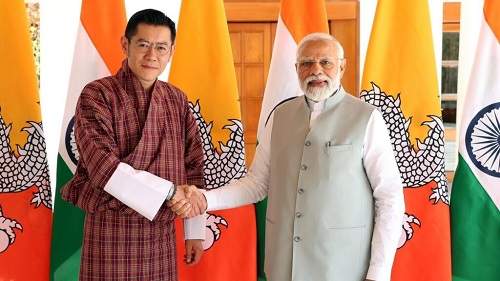
India and Bhutan have historically enjoyed a close relationship. Bhutan has maintained a special relationship with India since the signing of the Treaty of Friendship and
Cooperation in 1949. This treaty takes Delhi's security concerns into account. A revised treaty in 2007, gave Thimphu more freedom in areas of foreign policy and military purchases. For India, Bhutan is a neighbouring country with great strategic significance.India looks at Bhutan as a “buffer” state against China’s aggression and military adventures. China’s recent activities across the border with India has created tensions in the India-China ties which also gets transferred to its relations with Bhutan.
Bhutan’s adjacent location to the Siliguri Corridor or “chicken’s neck”—which connects India to the rest of the North
East Region (NER)—has only reinforced and strengthened these anxieties over a possible Chinese invasion. These anxieties are heightened by Chinese global ambitions and greed to gobble territories as it seeks to expand its global footprints.
There are some Chinese scholars who are of the view that China’s territorial differences with
Bhutan are insignificant, in the sense that, China’s policy and territorial disputes with Bhutan are largely defined by its external and internal calculations that are not necessarily linked to Bhutan. Internally, China remains anxious of the Tibet question, and a “friendly” or even “neutral” Bhutan is seen as a means to legitimise China’s control in Tibet, which shares racial, cultural, and ethnic similarities with Bhutan. For India, China’s attempts to get a greater foothold in its neighbourhood, from Nepal to Bhutan to Sri Lanka is a matter of concern.
The China Factor
China and Bhutan do not have diplomatic relations, but with Tibet coming under China’s rule in 1951, they share borders since then. China has also been wooing Bhutan for a long time now, in a fashion similar to the overtures and aid packages it holds out for nations like Nepal.
In 1984, Beijing and Thimphu began discussing the territorial dispute resolution and 25 rounds of discussions have taken place till October 2023. The 2012 and 2021 bilateral MoUs further added momentum on the border talks. The 477-km long border is gradually being converted into a war zone by China, with military mobilisation, constructing the so-called ‘well-off society’ villages, and mercantilist policies of aid, loans and coercive diplomacy.
Bhutan, it must be recalled, has signed “perpetual friendship” treaties with India in 1949 and 2007 to ward off challenges from China. However, Beijing is now testing such “special relations” between Bhutan and India as it seeks a greater role in the region and also seeks global hegemony. China, it must be understood, sees itself as a global power and that is why it has also been challenging the United States on the global stage, whether it is in economic or military arenas. China is not content to be just an Asian power. Also, it seeks to expand territorially and that is where much of the conflict and tensions arise, with India and other countries.
2017 coincided with the Doklam crisis, when China unilaterally began constructing a road in opposition to Bhutan, which requested India’s help. The 73-day military stand-off was finally called off. It has however soured relations between India and China and has also put Bhutan in a difficult position.
India used to be Bhutan’s biggest trading partner as well as aid provider. However, in the last few years, China has displaced India and now accounts for more than a quarter of Bhutan’s trade.
In Oct 2023, Bhutan’s Foreign Minister Tandi Dorji visited China, and that visit was unprecedented on several levels. Let’s recall the basic fact that Bhutan and China do not maintain diplomatic relations. His visit was the first ever by a Bhutanese Foreign Minister.
Moreover, the main purpose was the holding of boundary talks that had not taken place in more than seven years. The talks appeared to yield substantive progress, according to a joint statement, with both countries having also signed a cooperation agreement outlining the functioning of a new joint technical team for the delimitation and demarcation of the boundary. For India, this was a worrisome development.
India, given its special relationship with Bhutan, has been very wary about the possibility of the establishment of diplomatic relations and the signing of a boundary agreement between Bhutan and China. But many analysts believe that both those outcomes increasingly appear inevitable and it seems India will have to change its Bhutan policy accordingly.
Given Bhutan’s unique dependence on India, there is little doubt that it will have taken New Delhi on board in its efforts to normalise relations with China, in return guaranteeing India’s security interests and red lines. One such red line that Bhutan will have to keep in mind will involve keeping China away from southern Doklam’s ridges that overlook India’s “Siliguri corridor”, even as Beijing and Thimphu consider a “swap” between territories in the valleys of the north, where Bhutan is coming under intense Chinese pressure, and on the Doklam plateau in the west.
China also perceives Bhutan’s China policy as a by-product of India’s dominance and control. It is therefore keen for Bhutan to shed the last signs of India’s historical hegemony in the region. Having diplomatic and economic presence in Bhutan and solving its territorial disputes can also help China expand to new markets and improve its offensive positioning against India vis-à-vis the Siliguri Corridor.
The Way Forward
So even as India-Bhutan ties seem strong, it seems that with the increasing Chinese pressure, one can expect to see some movement in China-Bhutan ties. As a 2023 report in Foreign Policy (FP) summed it up aptly, "The status of Doklam is ultimately a trilateral concern.
Bhutan and India have shared a special relationship since signing a treaty of friendship in 1949, which afforded India guidance over Bhutan’s foreign and defense policy; they have maintained this connection even after the treaty was relaxed in 2007. In 2017, Chinese troops clashed with Indian soldiers in the region over a Chinese attempt to build a road connecting Doklam with Tibet. The disputed region represents a vulnerability for both India
and China. To the south, Doklam borders the Siliguri corridor, a sliver of land that connects the heart of India to its northeastern regions. It is the only land route for Indian troops to reach territory including the state of Arunachal Pradesh, which was a major theater of conflict in the 1962 Sino-Indian war and where the two armies have clashed as recently as last year.”This summary helps put in perspective as to why this territory issue is at the heart of India-China ties. Also, it helps one understand the Chinese desire to get its foot in the door as far as Bhutan goes.
It is also significant to note here that the the Chumbi Valley which lies to the north of Doklam, and often described as a Chinese dagger into Indian territory, “represents
a weakness for China, which sees the ancient gateway to Tibet as vulnerable to a pincer movement, in which Indian troops could strike from both sides of the valley at once—from Bhutan and India. By extending its claim by 89 square kilometres south of the intersection with Bhutan and India, China hopes to gain a vantage point that could serve both offensive and defensive purposes in a potential conflict with India,” as pointed out by FP.
Given all these factors, it is then important to understand that China’s increased urgency toward border talks with Bhutan cannot be seen in isolation. Resolving the dispute over
Doklam is inextricably linked to the conflict on China and India’s shared border, and specifically to the status of Arunachal Pradesh, which China claims as an extension of South Tibet. The danger for India is that with Doklam under its control, China could exert more pressure on India; Chinese forces could easily sever India’s connection to the eastern part of their disputed border. Such a resolution would also almost certainly precede more ambitious moves from China in Arunachal Pradesh. The Chinese intentions on Arunachal are made obvious every time an Indian leader visits the State and Chinese Foreign Ministry issues expected statements.Conclusion
Looking forward, it is safe to state that the future of India-Bhutan ties will be greatly influenced by the actions of China. For India, this is something it remains wary of and hence in all its dealings with Bhutan, it needs to ensure that Bhutan stays out of the Chinese influences. For Bhutan, it is not an easy road ahead as it balances out its ties with India and also with China, which is intent on breathing down its neck.
By Simran Sodhi

















Leave Your Comment