


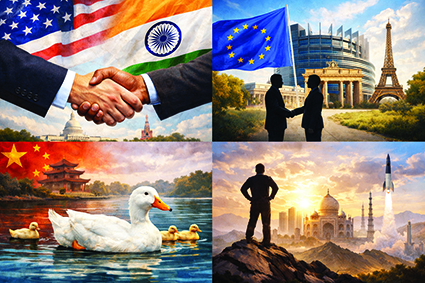
The global order is being reconfigured by overlapping disruptions like tariff wars, supply-chain fragmentation, energy insecurity, technological rivalry and intensifying geopolitical blocs. High economic interdependence now coexists with strategic mistrust, echoing earlier eras of unstable globalisation. Yet within this turbulence, India has moved from the margins of rule-taking to the centre of rule-shaping. Through what may be called “duck diplomacy,” anchored by the “Mother of All Trade Deals” with the European Union, a calibrated trade reset with the United States and deepening engagement with the Arab world, India is emerging as a viable “third pole” in a fragmented global economy.
India’s macroeconomic trajectory provides the foundation. From roughly $1.8 trillion in GDP in 2014, India has expanded to approximately $3.7–4 trillion by 2024–25, becoming the world’s fifth-largest economy. According to IMF projections, India remains the fastest-growing major economy, sustaining growth rates near 6–7 percent annually. Combined exports of goods and services have risen from about $470 billion a decade ago to nearly $800 billion, while foreign direct investment inflows have consistently ranged between $60–80 billion annually despite global capital volatility. India today contributes one of the largest incremental shares to global growth.
The trade reset with the United States restored equilibrium at a critical juncture. Bilateral trade between the two countries crossed $190 billion in 2023, making the US India’s largest trading partner. Tariff recalibrations improved competitiveness for labour-intensive sectors such as textiles, leather, marine products, chemicals and processed foods. In highly competitive export markets, even a 1–2 percent tariff differential can shift billions of dollars in sourcing decisions. Industry bodies estimate that marginal tariff advantages can decisively redirect global supply chains.
Equally important is what the agreement protects. Agriculture and dairy, the sectors employing tens of millions, remain excluded, safeguarding rural livelihoods. Strategic autonomy in energy sourcing remains intact. India neither retaliated impulsively nor conceded structural leverage. Instead, it calibrated, preserving long-term defence and technology cooperation under frameworks such as iCET while defending domestic sensitivities. This approach exemplifies “duck diplomacy:” calm, balanced and measured above the surface, yet strategically agile beneath it.
If the US deal restored balance, the India–European Union Free Trade Agreement which is often described as the “Mother of All Trade Deals,”signals transformation. The EU accounts for roughly 14–15 percent of India’s trade, with goods trade exceeding €120 billion. Together, India and the EU represent nearly a quarter of global GDP and close to one-third of global trade flows. In an era of weaponised supply chains and rising protectionism, this agreement creates a stabilising economic corridor.
Its scope extends beyond tariffs. Maritime cooperation in the Indo-Pacific, joint defence manufacturing, resilient supply chains, regulatory convergence and green technology partnerships elevate commerce into strategic architecture. The EU’s formal “de-risking” strategy from China aligns structurally with India’s ambition to scale manufacturing and attract technology flows. Surveys by European business chambers and global consulting firms consistently rank India among the top alternatives for supply-chain diversification under the “China-Plus-One” strategy.
This diversification is already visible. Electronics exports from India have crossed $20–25 billion annually. Apple’s supply-chain expansion in India has rapidly increased the country’s share in global iPhone production, symbolising industrial realignment. Production-Linked Incentive schemes across sectors such as electronics, pharmaceuticals and renewable energy have attracted over $20 billion in committed investments. Logistics upgrades, dedicated freight corridors, port modernisation and highway expansion, are reducing transaction costs and improving global competitiveness.
India’s demographic profile further strengthens its case. With a median age of around 28 years, compared to China’s nearly 39 and Europe’s above 44, India is poised to remain a primary contributor to global labour-force growth. Combined with expanding tertiary education and English-language proficiency, this demographic dividend enhances investor confidence.
Beyond the transatlantic axis, India’s engagement with the Arab world adds a crucial strategic arc. Trade between India and the Gulf Cooperation Council (GCC) countries exceeds $150 billion annually, making the Gulf one of India’s largest regional trade partners. The United Arab Emirates alone accounts for bilateral trade exceeding $80 billion, reinforced by the Comprehensive Economic Partnership Agreement (CEPA). Saudi Arabia, Qatar and other Gulf economies are key energy suppliers and increasingly significant investors in infrastructure, renewable energy and technology ventures within India.
The Delhi Declaration with the Arab League institutionalises this engagement. It encompasses energy security, sovereign wealth investments, fintech collaboration, food security corridors, maritime stability and diaspora linkages. The India–Middle East–Europe Economic Corridor (IMEC), announced during the G20 summit, envisions connectivity linking India to Europe through the Gulf, integrating ports, rail, digital infrastructure and clean energy pipelines. This structured engagement demonstrates India’s ability to strengthen ties across West Asia without compromising relationships with Israel, Iran, Europe or the United States. The duck glides expanding each vector without destabilising another.
India’s Russia engagement reflects mature multi-alignment. Bilateral trade surged from under $10 billion in 2021 to over $60 billion by 2024, largely driven by discounted energy imports. This pragmatic approach cushioned domestic inflation and stabilised supply chains. India navigated sanctions frameworks without breaching international law while preserving national interest. Simultaneously, it deepened defence and technology cooperation with the US and Europe. Participation in BRICS+, SCO, Quad and G20 illustrates that India is not choosing sides; it is expanding choices.
Security credibility underwrites this diplomacy. India’s defence expenditure exceeds $70 billion annually, supporting both modernisation and indigenisation. Defence exports have grown from under $1 billion a decade ago to over $2 billion annually, with Indian-made missile systems, naval platforms and aerospace components reaching markets across Asia, Africa and Latin America. Indigenous capacity strengthens strategic autonomy and enhances India’s standing as a net security provider in the Indo-Pacific.
Investor and market confidence corroborate this rise. Major global investment banks project India as a long-term growth anchor in Asia. Portfolio inflows and sovereign credit outlooks reflect improved macroeconomic stability. Digital public infrastructure such as Aadhaar, UPI and open digital commerce frameworks, has transformed governance and financial inclusion, reducing transaction costs at population scale.
Yet India’s ascent is not merely statistical. It rests on civilisational confidence translated into modern statecraft. Democratic institutions, imperfect but resilient, offer shared legitimacy with Europe and North America. Survey data across advanced economies consistently show favourable perceptions of India relative to authoritarian competitors, lowering the political cost of deeper partnerships.
However, challenges remain: accelerating manufacturing’s share of GDP beyond 17 percent, increasing female labour-force participation, advancing artificial intelligence capability, strengthening healthcare and education ecosystems and sustaining private-sector innovation. But the structural direction is unmistakable.
Through the Mother of All Trade Deals with the EU, the calibrated reset with the US, expanding trade with the Arab world, pragmatic energy ties with Russia and the steady rise of indigenous industrial capacity, India is no longer reacting to global shifts, it is shaping them. Duck diplomacy allows it to navigate turbulent waters without rhetorical escalation, combining restraint with resolve.
In a world increasingly fragmented yet economically interlinked, India stands as a stabilising centre of gravity. Not a substitute for any power, nor a replica of any model, but a distinct and consequential third pole which is economically credible, strategically autonomous and institutionally compatible across blocs. The wake it leaves in the global order is clear, measured and enduring.
Dr Sunil Mohanty
(The writer is a Ph.D from School of International Studies, JNU and former Assistant Professor at University of Delhi)
(The content of this article reflects the views of writer and contributor, not necessarily those of the publisher and editor. All disputes are subject to the exclusive jurisdiction of competent courts and forums in Delhi/New Delhi only)





















Leave Your Comment