


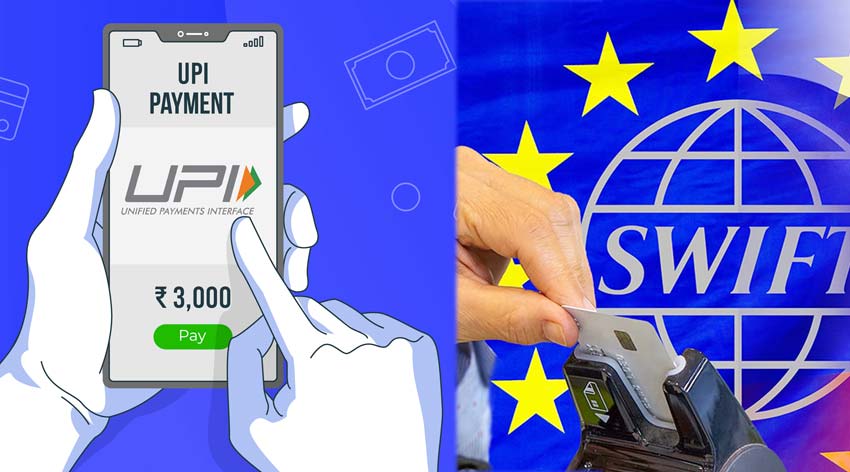
In a bold and symbolic move, India and Russia are forging ahead with a new financial highway—one that bypasses the traditional Western-dominated payment architecture. At the heart of this endeavor is the growing interoperability between India's RuPay and Russia's Mir card networks, as well as the integration of India’s Unified Payments Interface (UPI) with Russia’s System for Transfer of Financial Messages (SPFS), Moscow’s alternative to SWIFT. This is more than a technical development—it’s a quiet revolution with global implications.
For decades, global finance has been governed by a tightly knit Western infrastructure. Visa and Mastercard have dominated retail payments. SWIFT has served as the backbone of international bank messaging. But these systems are more than just pipes—they are tools of influence and, increasingly, of enforcement. When Russia was cut off from SWIFT in 2022 following its invasion of Ukraine, it was a stark reminder of how financial tools can be weaponized. For countries like India, which walk a more nuanced geopolitical path, the risks of overdependence on Western financial rails became impossible to ignore.
Enter the India-Russia partnership. These two old allies, with deep Cold War-era ties, are now leveraging their political trust to build economic autonomy. Linking RuPay with Mir and enabling UPI to interact with SPFS not only simplifies bilateral trade—it reduces vulnerability to third-party sanctions. Indian tourists in Russia, and vice versa, may soon pay seamlessly using their domestic systems, while businesses settle trade in local currencies without routing through New York or London. The implications are far-reaching.
This shift is not about isolating from the world but about rebalancing it. Both countries recognize that resilience in the 21st century comes from diversification. For India, integrating UPI—a digital payments juggernaut now processing billions of transactions monthly—with friendly nations is part of a larger strategy to project technological sovereignty. For Russia, which has been forced to operate under financial sanctions, it’s a lifeline. But together, this collaboration signals a shared vision: a multipolar world must be matched by a multipolar financial system.

There are, of course, limits. RuPay and Mir remain regional players compared to Visa and Mastercard’s global reach. UPI and SPFS can process payments between India and Russia, but expanding this model to a global scale will take time, trust, and serious infrastructure. The challenge lies in persuading other countries to join this emerging ecosystem—not just for convenience, but for a redefined understanding of financial independence.
Still, the symbolism is powerful. In a world increasingly fragmented along geopolitical lines, financial decoupling is both a symptom and a strategy. The India-Russia model offers a preview of how sovereign financial systems might cooperate in the coming decades. It is a response to both the overreach of traditional powers and the aspiration of emerging ones to shape their own destiny.
The creation of a financial corridor between New Delhi and Moscow is not a rejection of globalization—but rather a call for its evolution. By building infrastructure that reflects a more balanced power dynamic, India and Russia are not just conducting trade—they are making a statement. The world is watching. And some are quietly taking notes.
Uday India Bureau














Leave Your Comment