


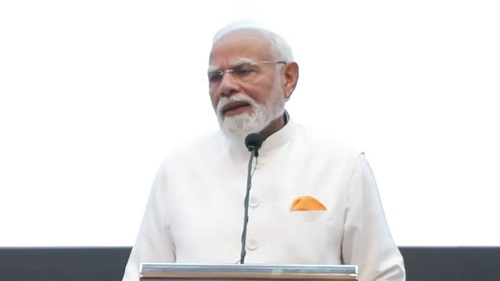
Prime Minister Narendra Modi on Tuesday delivered a landmark address to the Indonesian Parliament, presenting a vision of stronger India-Indonesia relations founded on shared democratic values, maritime cooperation and centuries-old civilisational bonds. His speech came on the second day of his official visit to Indonesia, shortly after he was conferred with the country's highest civilian honour, the Bintang Adipurna, by Indonesian President Prabowo Subianto.
The address marked another significant milestone in bilateral relations, reflecting the growing strategic importance of the partnership between the two Indo-Pacific nations. From regional security and economic cooperation to cultural diplomacy, the Prime Minister outlined a comprehensive roadmap for the future while celebrating the enduring friendship between the two countries.
Opening his address, Prime Minister Modi expressed heartfelt gratitude for the warm reception extended by the Indonesian people and Parliament. Calling it a privilege to represent India's 1.4 billion citizens, he described the honour bestowed upon him as a reflection of the deep affection Indonesians hold for India.
Referring to India as the "Mother of Democracy," the Prime Minister conveyed greetings from the people of India and praised his close friendship with President Prabowo Subianto. He reaffirmed New Delhi's commitment to expanding cooperation across multiple sectors and strengthening the comprehensive strategic partnership.
The conferment of the Bintang Adipurna symbolised Indonesia's recognition of Modi's efforts to elevate bilateral relations and strengthen cooperation in the Indo-Pacific region.
One of the central themes of the Prime Minister's speech was India's approach to global engagement. Stressing that India's rise is driven by cooperation rather than confrontation, Modi declared that development—not expansion—defines the country's vision for the future.
He reiterated the guiding philosophy of "Sabka Saath, Sabka Vikas" (Together with all, development for all), explaining that India's international outlook is rooted in inclusive growth, mutual respect and shared prosperity.
According to the Prime Minister, India believes lasting peace and stability can only be achieved when nations work together to improve the lives of their people instead of pursuing territorial ambitions. This message resonated strongly in the context of the rapidly evolving Indo-Pacific geopolitical landscape.
Highlighting the geographical closeness of India and Indonesia, Modi drew attention to the narrow stretch of sea separating the two countries despite the considerable distance between their capitals.
He remarked that unlike many regions where oceans have served as barriers, the waters connecting India and Indonesia have historically functioned as bridges of commerce, culture and civilisation.
The Indian Ocean, he observed, has shaped the destinies of both nations for centuries and continues to offer enormous opportunities for economic integration, maritime security and regional connectivity.
The Prime Minister urged both countries to harness this shared maritime heritage by expanding cooperation in shipping, trade, blue economy initiatives and regional security frameworks.
Perhaps the most memorable part of Modi's address was his celebration of the rich cultural ties binding India and Indonesia.
He emphasised that the relationship extends far beyond diplomatic engagement and is deeply rooted in a common civilisational legacy spanning thousands of years.
Referring to the Ramayana and the Mahabharata, Modi noted that these ancient epics continue to influence Indonesian culture, theatre and traditions. He also highlighted the historical contributions of the ancient Nalanda University in fostering intellectual exchanges across Asia.
The Prime Minister further cited Indonesia's renowned Wayang puppet theatre, traditional dance forms, classical music and iconic monuments such as Borobudur and Prambanan as enduring symbols of the close cultural connection between the two nations.
He also mentioned Indonesia's national emblem, Garuda, and the traditional Bali Yatra celebrations as reminders of the historical maritime links between India and Southeast Asia.
Adding a touch of humour, Modi remarked that it was difficult to determine whether Indonesia's Krupuk or India's papad was crunchier, noting that both countries equally cherish their rich culinary traditions and aromatic spices.
Building on this shared heritage, the Prime Minister called for a stronger strategic partnership capable of addressing emerging regional and global challenges.
He stressed that India and Indonesia, as two major democracies and influential Indo-Pacific powers, have a responsibility to work together in promoting peace, stability and sustainable development.
Greater cooperation in defence, maritime security, trade, digital technology, connectivity and people-to-people exchanges, he said, would unlock the full potential of the bilateral relationship.
His remarks reflected the increasing convergence between New Delhi and Jakarta on issues related to regional security, supply chains, economic resilience and freedom of navigation in the Indo-Pacific.
Prime Minister Modi's address to the Indonesian Parliament underscored the transformation of India-Indonesia relations from historical friendship into a forward-looking strategic partnership.
By combining cultural diplomacy with economic and security cooperation, both nations are positioning themselves as important pillars of stability in the Indo-Pacific.
As India and Indonesia deepen collaboration across diverse sectors, their partnership is expected to contribute significantly to regional prosperity, strengthen democratic values and reinforce a rules-based international order.
The Prime Minister's visit, crowned by Indonesia's highest civilian honour and a message centred on shared history and common aspirations, has reaffirmed that the relationship between the two countries is not merely shaped by geography but by a civilisational bond that continues to evolve with time.




















Leave Your Comment