


The media is busy with debates generated by a comment from RSS office bearer. Now an FIR has added fuel to it.
“Complaint filed against RSS general secretary Hosabale over Preamble remarks” HT June 30 2025.
I was curious to understand what offence had been presumed. To my surprise, the issue was about giving a call to remove the words "secular" and "socialist" from the Preamble of the Constitution. How, such a demand can be deemed offensive—especially when these very words were inserted during the Emergency, through the 42nd Amendment (1976), when most of the opposition leaders were either in jail or underground. No public debate, no national consensus, and yet the Preamble—our constitutional soul—was altered. If that unilateral insertion wasn’t seen as damaging the constitutional framework, how can merely demanding their removal be considered criminal?
Moreover, the individual making the statement holds no office of power and has no capacity to enforce such a change. So, what exactly is the fear?
At the heart of this debate lies a much deeper question: Why did India undergo Partition? The answer is straightforward—Partition happened on religious grounds. If one part of the subcontinent was created as a homeland for Muslims, how could the remaining part alone be labelled secular, especially when secularism is a Western construct, not rooted in Indian civilizational thought? It was never tested, never debated, and has largely failed to resolve the deep religious and communal challenges the nation faces.
The current outrage is ironic, as the loudest protests are coming from a party whose Prime Minister was once convicted by a High Court, and who went on to amend the Constitution to place herself above judicial scrutiny. That very moment was a blatant attack on constitutional morality.
Let’s now get to the core of the matter.
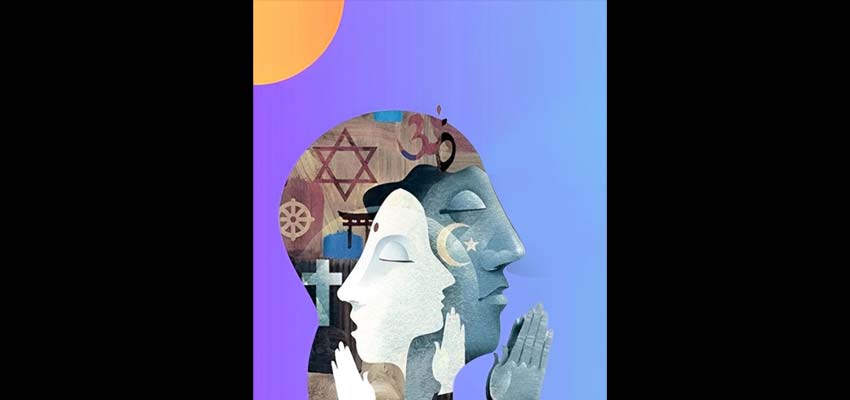
Secularism, as it exists today, was propagated by Nehru, and endorsed in spirit by Gandhi. Its stated purpose was noble: to ensure religious harmony, equality among all faiths, and separation between religion and state. Yet the word "secular" was not included in the original Constitution of 1950.
Unfortunately, secularism has failed India in practice. Rather than uniting, it has often been used as a political tool for appeasement, vote-bank politics, and selective outrage. It has widened divides instead of healing them.
So, the real debate the nation should have is, whether our model of secularism has lived up to its promise.
Misinterpretation of Secularism
According to the Oxford Dictionary, secular means “not concerned with religion.” The Merriam-Webster Dictionary defines it as “not overtly or specifically religious.” The first edition of the Encyclopædia Britannica (1768–71) described secular as “something that is temporal; in which sense, the word stands opposed to ecclesiastical.” Later, in 1851, the English thinker George Holyoake coined the term secularism to represent a non-religious civic and ethical philosophy.
From these definitions, it is clear that:
= Western secularism implies a strict separation between church and state, with the state taking no interest in religion and religious institutions having no influence over governance.
This model of secularism never fit India’s cultural and civilizational context.
Long before the word secular was inserted into the Indian Constitution, India had already demonstrated an unparalleled tradition of religious tolerance and pluralism. Throughout history, India welcomed persecuted communities—from Zoroastrians (Parsis) fleeing Iran, to early Christians and Muslims. It is claimed that the second mosque in the world was built in Kerala in 629 AD. This deeply rooted culture of openness emerged out of India’s own spiritual and civilisational ethos. It’s an irony that secular India of today failed to accept persecuted Hindus, Sikhs and Buddhists due to violent opposition by a minority community
Indian civilization, goes beyond secularism. It has celebrated dissent, debate, and spiritual diversity. Even atheist philosophies like Charvaka’s "Bhogvad" (materialist) school of thought—which preached "Take a loan and enjoy ghee (butterfat)"—were given a place among the ancient darshanas (philosophical schools). The demon king Ravan’s Shiv Stotra is still recited today, and Buddha’s transformation of the dacoit Angulimal stands as a powerful example of compassion, reform, and human dignity.
India’s civilizational approach is not merely secular—it is inclusive, integrative, and spiritually liberal. The imposition of a narrow, Western notion of secularism diluted this richness and replaced it with a politicized, selectively applied doctrine that neither reflects India’s soul nor serves its people. It led to state intervention in religious matters, selectively. the state exploited this model to:
= Manage Hindu temples while excluding mosques or churches,
= Funded religious pilgrimages like Hajj, spent money on maintenance restoration of religious places of minorities, on the other hand Hindu temples controlled by government are charging fee for quick darshan and ‘Abhishek Puja’ etc.
= Pass religion-specific laws (like personal laws in marriage, divorce, inheritance).
= The state is controlling and enjoying the wealth of temples, as a result temples are not able to promote Hindu religion, it’s literature and languages etc. As a result, Hindu in crisis have no place to look for! Exodus of pandits from Kashmir, is a sad case.
In the Name of Secularism: The State’s Inconsistent Application of Laws
= One of the fundamental contradictions in India's version of secularism is its inconsistent application of laws across religions. India continues to follow religion-based personal laws—with separate legal codes for Hindus, Muslims, Christians, and Parsis in matters such as marriage, divorce, and inheritance. This directly undermines legal uniformity, which is a cornerstone of any truly secular state.
= It is alarming that even the judiciary has often adopted this selective approach. For instance, in the Sabarimala temple case, the courts intervened in the religious customs and entry protocols of a Hindu shrine. Similarly, the ritual procedures at the Mahakal temple in Ujjain were scrutinized by the judiciary. In contrast, similar pleas concerning practices in other religious places have either been dismissed or not entertained with the same urgency.
Distorted interpretation has led to religious appeasement, often visible in state policies.
= Subsidized pilgrimages (like Hajj subsidies until recently) were provided to one community, while Hindu pilgrims faced bureaucratic restrictions and financial burdens. For instance, registration fees are charged for the Amarnath Yatra, a pilgrimage of immense spiritual significance.
= Even more concerning is the politicization of Hindu pilgrimages. A stark example is the Amarnath land transfer controversy of May 26, 2008, when the government allotted 40 hectares of forest land in Baltal, Sonmarg (Ganderbal district) to the Shri Amarnath Shrine Board (SASB), which manages the yatra. The aim was merely to create facilities for pilgrims facing harsh conditions. Yet, the decision triggered massive protests in the Kashmir Valley, leading to its abrupt cancellation by then Chief Minister Ghulam Nabi Azad yet he has to resign.
= This incident is telling: In a secular country, why should the development of a Hindu pilgrimage be held hostage to the objections of another community?
= These events reveal that secularism in India has often been reduced to selective sensitivity—where one religion’s demands are handled with deference, while another’s needs are treated as negotiable or dispensable.
= Allowing religious educational institutions (like madrasas) to bypass mainstream curricula.
= Tolerance of practices like triple talaq, halala, four marriages were seen as appeasement, not equality.
Vote Bank Politics: Secularism Turned into a Strategy to polarise
Secularism has often been reduced to a vote bank strategy, where political parties pander to specific religious communities that are influenced by centralized religious leadership capable of issuing fatwas or directives.
Key examples include:
= The Shah Bano case, where legal justice was overturned to appease religious orthodoxy;
= Suppression of majority concerns to maintain a politically correct "secular" image;
= Selective outrage, where FIRs and media reports are influenced by the religion or caste of the victim or accused. Offenders from minority communities are often protected by omitting names or softening coverage.
Such practices have eroded public trust in Indian secularism, which now often appears as majority-bashing in the guise of minority protection.
Globally also, India is not known for its secular policies, but for its knowledge systems—like scriptures, yoga, Ayurveda, and a civilisational culture rooted in mutual respect and interfaith harmony. It’s time for serious introspection: Should India continue posturing as secular when many minorities don’t adhere to secular values, and when jihadist and missionary forces openly target the majority through violence or conversion?
“Banned Group PFI Wanted to Turn India into Islamic State By 2047: Anti-Terror Body
In the chargesheet filed on February 2, the ATS claimed to have seized a document called "India 2047- towards rule of Islam in India". Press Trust of India Feb 09, 2025
Socialism in India: A Noble Ideal, Poorly Practised and forgotten
Welfare of the society, had deep historical roots much before the present constitution. It was executed in a uniquely Indian way. It was embedded in the culture through sayings like “Atithi Devo Bhava”, meaning an uninvited guest is like God. Long before the British arrived, India was building 15,000 ponds annually, funded by kings, traders, and commoners alike. Post-independence too, hospitals, schools, orphanages, and Birla Mandirs were built by public initiative. The government lacked both the skill and will to implement socialism. Without being impartial and detached from religion, caste, language, and region, practicing true modern socialism is impossible.
Let’s examine why; despite being enshrined in the Constitution, socialism hasn’t delivered transformative results:
Historical Embrace: Practical Retreat
= Post-independence vision: Nehru adopted a socialist-inspired model focused on state-led development, public sector expansion, and centralized planning.
= License Raj & inefficiency: Socialism soon became entangled in red tape and corruption. The License Raj killed entrepreneurship, rewarding political influence over innovation. Politicians dominated industries—not as entrepreneurs, but as gatekeepers of licenses.
= Economic stagnation: Between the 1950s and 1980s, India’s growth was dismal—called the “Hindu Rate of Growth”, ironically exposing the hollowness of secularism, as the world still viewed India through its civilisational Hindu identity.
Cultural and Structural Challenges
= Diverse social fabric: India’s caste, class, and religious diversity made it difficult to build a unified working-class movement, unlike in more homogeneous societies.
= Aspirational middle class: As liberalization took hold in the 1990s, a growing middle class leaned toward capitalism and consumerism, not collectivism.
= Informal economy dominance: Over 90% of India’s workforce is in the informal sector, making centralized labour reforms and redistribution difficult to implement effectively.
= Corruption and lack of will to control it. Right from the time of Nehru family took priority over the nation. Vallabh Bhai Patel and Lal Bahadur Shastri ji attempted to curb it but died early. The legal system is slow and inefficient. Politicians are power hungry. So, the MPs who could not get ministerial position were placed in different committees of monitoring the public sector, leading to hampering the decision making and adding to inefficiencies. As a result, most of the public sector companies became white elephants and government after government had made effort to get rid of the loss making ones. ITDC, Air India are few examples.
Still in the Constitution, But…
The word “socialist” was officially added to the Preamble in 1976 during the Emergency, but in practice, India has moved toward to a mixed economy with a strong capitalist tilt which is making effort to serves the society with corporate social responsibility. In short, modern socialism in India was a non-starter—it started, stumbled, and was eventually overtaken by pragmatism and global economic trends.
Conclusion
Both the word secular and socialist have failed to inspire harmony and growth. Just enjoying their position in the preamble as ceremonial adjective. So called secular India has created such a non-secular precedence which are not found in the Islamic countries even. Even the educational system is not spared. Appeasement in the name of secularism has divided India and has created rift in the society. Free and fair discussion both inside the parliament and on public forums, are needed to address the issue. Dropping these words from preamble may correct the anomaly but interfaith harmony and citizens welfare need better focus.

By Rakesh Kumar
(The conteBy nt of this article reflects the views of writers and contributors, not necessarily those of the publisher and editor. All disputes are subject to the exclusive jurisdiction of competent courts and forums in Delhi/New Delhi only)















Comments (1)
R
Very balanced article.Writer has clarified each point very methodically.Excellent article