


As Indian Air Force ((IAF) celebrates its 91st birthday, it is time to reflect on its glorious past, strong current capability, and the global power future. Defence Minister Rajnath Singh has already exhorted IAF senior leadership: “Indian Air Force should become an Aerospace Force and be ready to protect the country from ever-evolving threats.” “Conflicts in last few decades established pre-eminence of aerospace power” said Air Chief Marshal VR Chaudhari, the Chief of Air Staff. He further added that the IAF has the unique capability of undertaking "independent strategic operations" as well as operations coordinated with other services and arms of the national security apparatus. IAF needs to evolve into aerospace power, he said. The same is very nicely elucidated in IAF’s Doctrine 2022.
It is well understood globally that the one who controls air and space, controls the planet. Military aviation directly supports outcomes of all air, surface and sub-surface battles. Air and space superiority remains essential. If we lose the war in the air, we lose the surface and sub-surface war, and lose it quickly.
The IAF has come a long way since being established on October 08, 1932. It got its first four Westland Wapiti IIA biplane aircraft on April 01, 1933 when No.1 Squadron was formed with six RAF-trained officers and 19 Havai Sepoys (air soldiers) at Drigh Road, Karachi. Today it is the fourth largest air force with global reach, long-range precision strike capability, and ability to exercise dominance over the region between the West Asia and ASEAN countries. It has built major capabilities and experience in handling humanitarian aid and disaster relief (HADR) operations at global scale and is a first responder in the region. IAF is, what it is today, due grit and determination of its air warriors, and years of wartime exposure, and training, including with most of the major air forces of the world.

Magnificent Past – Great Service to the Nation
IAF’s professional ethos and combat capabilities have got tested repeatedly in the past 90 years. Christened through the early operations the North West Frontier Province in mid 1930s, IAF took active part in the World War II. 25 IAF pilots were awarded the Distinguished Flying Cross (DFC). IAF airlifts through the uncharted routes of high mountains of Jammu and Kashmir, and Ladakh during 1947-48 operation, and fighter attacks helped Indian Army push out the Pakistani intruders, and regain territory. The IAF was a much superior force than PLA Air Force (PLAAF) in 1962, but the country’s leadership decided not to use its full potential in the Sino-Indian war. The IAF was very skilfully employed in the 1965 and 1971 Indo-Pak Wars, and played a game-changing role. IAF’s compete air superiority in 1971 war allowed a blitzkrieg for Indian Army towards Dhaka. The Tungail Para Drop, Megna Heli-crossing, and the air strike on Governor House were directly instrumental in the liberation of Bangladesh.
The IAF’s massive air effort in Operation “Safed Sagar” during the 1999 Kargil War with Pakistan, not only inflicted heavy damage to enemy operational positions, and logistic nodes, but was directly responsible for hastening the eviction of intruders, and in turn, also greatly reducing Indian casualties. Earlier, the ‘Operation Vijay’ (December 1961) for liberation of Goa, Daman and Diu involved air strikes that supported a quick decisive victory. IAF provides the life-line and is actively involved in ‘Operation Meghdoot’ in the Siachen Glacier. IAF fighters now operate very regularly at Ladakh airbases. Also the advanced landing grounds such as DBO are kept active.
IAF – Strong and Growing
IAF has around 31 fighter squadrons. By 2025, the remaining MiG 21 squadrons will be phased out. IAF has increased the order for LCA Mk1A from 83 to 183. These should start inducting in 2024. The production rate is planned to be increased to 24 aircraft a year with an assembly line at Nashik. Fighter numbers must reach 42 Squadrons quickly.
IAF has a significant transport fleet with global reach and airlift capability. The EADS CASA C-295 has just been inducted. The helicopter fleet numbers are good, and more indigenous ALH variants are inducting. IAF is currently a little low in number of AEW&C and FRA aircraft for the continental sized country and the two front threat, and the need to cover the Indian Ocean Region (IOR). These will soon be made good.
The air defence radar and missile cover and the Integrated Air Command and Control System (IACCS) make a good potent combination. Indigenous aerial weapons with better precision and reach are inducting. IAF is further building its UAV and UCAV fleet, including indigenous ones. Kamikaze drones and drone swarms are being inducted.

IAF’s Increasing Combat Reach
Any significant global power must have the capability for “global vigilance and global reach”. IAF prepares to ensure that the country has “freedom from attack and the freedom to attack”. IAF recently carried out three long-range missions to train for and showcase its long-range strike and air patrol capability. These 7-10 hour long missions were flown by the Su-30 MKI, and Rafale fighters. They were supported by the FRA and AEW&C aircraft for aerial radar cover. India’s immediate area of regional influence demands ability to cover and dominate the entire Bay of Bengal up to and beyond the Malacca Strait. Have an operational reach till British Indian Ocean territories (Diego Garcia) in northern Indian Ocean. Similarly cover the entire Arabian Sea up to Gulf of Aden and Gulf of Oman. The strategic long-range missions demonstrate area domination and area denial capability. From Andaman and Nicobar Islands, IAF can launch missions till South China Sea with a single aerial refuelling. With Operational logistics agreement with all QUAD members and other friendly neighbours, IAF will be able to use their airfields.
International Air Exercises and Interoperability
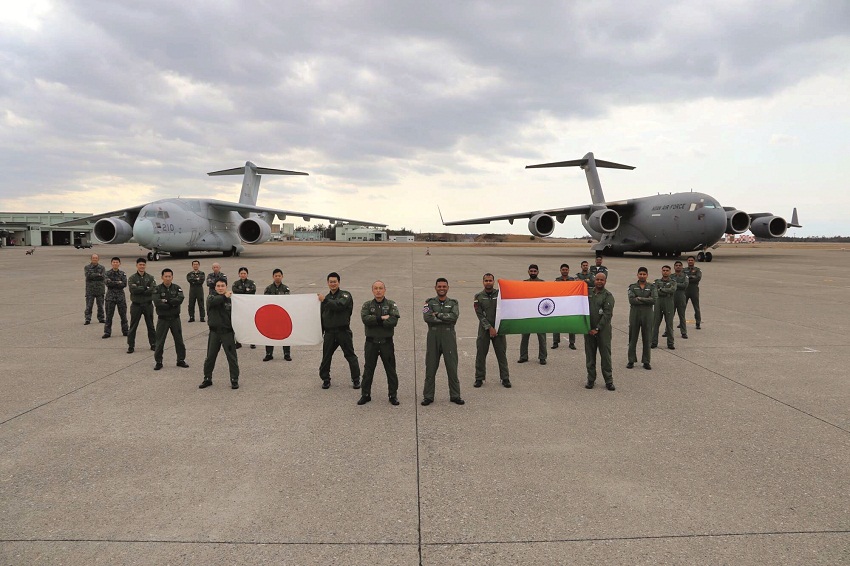
Today IAF exercises with all the major air forces of the world on regular basis in bilateral or multilateral exercises. IAF and USAF participate in Cope India series. Exercise 'Garuda’ series and Exercise Orion were with the French Air and Space Force (FASF). The multination exercise ‘Pitch Black’ was in Australia. Exercise SINDEX is with Republic of Singapore Air Force (RSAF). IAF and Royal Air Force (RAF), conduct Exercise “Indradhanush”. IAF has also been participating in the US Air Force (USAF) ‘Red Flag’ exercise; Desert Eagle multi-lateral exercise organised by United Arab Emirates Air Force; exercise Eastern Bridge with Oman; exercise INIOCHOS with Greece; and Blue Flag held by the Israeli Air Force. In July 2022, the IAF carried out a one-month long engagement with the Egyptian Air Force (EAF) at the Egyptian Fighter Weapon School, in Cairo. IAF exercises with the Japanese Air Self Defence Force (JASDF). All these exercises improve tactics and interoperability and expose crew to newer tactics, ideas and concepts. On this count, and exposure to actual combat operations, IAF has clear edge over PLAAF.
Air Power across Himalayas
I ndia has clear advantage in terms of number of airfields vis-à-vis China. Indian airfields also have the advantage of lower altitude allowing better load carrying capability. IAF will be able to launch higher number of missions. More airfields and Advance Landing Grounds (ALG) are being made operational, including one at Nyoma, Ladakh. IAF is building stronger air defences and also increasing cruise missile inventories. India will work towards achieving local sectorial air superiority. Interdiction will pay high dividends in the mountains.
The radar cover has terrain related constraints in the mountains. However there are also vantage points for their positioning. Yet, much greater dependence would have to be on AWACS. Satellites and UAVs would have to be used for ISR. Drones will also support over-the-hill surveillance.
Effects based, network centric operations would be employed. The side that better employs electronic warfare and cyber means and tools will have advantage. Securing own networks and denying the same to adversary will be important.
Air Maintenance in the Himalayas

The IAF carries out round the year air maintenance missions to help sustain the Indian Army, Assam Rifles, Indo-Tibetan Border Police (ITBP), BSF and other paramilitary forces deployed in the entire Himalayan region, including Siachen glacier. IAF transport and helicopter fleets carry over 30,000 tons of load from plains to the high altitude posts. IAF plays a major role in intra-theatre and inter-valley transfers of ground forces. IAF supports the Border Roads Organisation to carry their aggregates. Similarly, supports Indian Railways to build bridges, and Power Grid for HT tower maintenance. IAF often sets up Air Bridge in support of civil administration when roads are blocked due to heavy snow.
IAF’s Very Significant Role in UN Peace Keeping
India has contributed nearly 275,000 troops, the largest number from any country, participated in more than 49 missions and 168 Indian peacekeepers have made the supreme sacrifice while serving in UN missions. IAF had deployed six Canberra B (I) MK-58 bombers in Congo (1960-64). The IAF took part in peacekeeping duties in Somalia (1993-94). Two Chetak helicopters modified with anti-tank guided missiles were sent. IAF operations in Sierra Leone (1999-2001) included casualty evacuation, medical aid, armed rescue, communication and logistic support. Mi-8 and Chetak were modified for armament role. IAF had also deployed Mi-25 Gun Ships. In Congo (2003) IAF deployed four night upgraded Mi-35 attack helicopters and six night-capable Mi-17 utility helicopters. IAF helicopters were used in Sudan in 2008-09.
HADR – IAF the First Responder
The IAF has invariably been the first responder in most HADR operations in aid to civil power. IAF has a significant transport and helicopter fleets with heavy lift capability and global reach. Most recently IAF aircraft were used for evacuating Indians from Sudan, including night missions from semi-prepared surfaces. Earlier similar missions were flown from Iraq, Kuwait and Jordan (1990); Lebanon (2006); Libya (2011); Yemen (2015); and Wuhan and Iran (2000). IAF led the drinking water supply ‘Operation Neer’ to Maldives (2014). During the 2015 Nepal earthquake, IAF and Indian Army made 2223 sorties and rescued 11200 people. IAF was in action in Orissa Cyclone (1999); Bhuj Earthquake (2001); Tsunami (2004); Sikkim earthquake (2011); Uttarakhand floods and Category 5 super cyclone Phailin in Orissa (2013); and Kerala floods (2018). IAF had deployed 42 transport aircraft for COVID relief. IAF helicopters with bambi-bucket routinely extinguish fires. All IAF bases have coordination with local Indian Army units and the National Disaster Relief Force (NDRF) battalions. IAF aircraft, including UAVs, are used for aerial assessment of disasters.
Technology Dynamics of Modern Air Warfare
The obsolescence sets in much faster for aerial systems. India needs to invest more in game-changer technologies. These include cyber and electronic warfare, stealth, artificial intelligence (AI), unmanned systems, hypersonic, among others. Hypersonic flight and weapons will act as force multipliers against high-value targets such as PLAN aircraft-carriers and large ships. There is a lot of action in Directed Energy Weapons (DEW), and Lasers that can burn incoming missile electronics or dazzle electro-optical sensors. For India to become significant, it must also master aircraft engine, and AESA radar technologies. Joint venture route is the best to imbibe high-end technologies. We need very long-range weapons, including aerial missiles with around 400 kilometres ranges. Similarly air-launched cruise missiles with ranges of around 1,500 kilometres are required.
In times of rapid technological changes, air engagements too are evolving. The unmanned systems, manned unmanned teaming, drones and drone swarms, will all shape IAF’s future. Modern means of runway restoration will have to be adopted.
Merging Air and Space Domains
Harnessing space as a vantage point has to get high priority. The air and space separation is fast disappearing. More crafts and weapons are now routinely transiting between the two domains in the single mission. The situational awareness, the tactical employment and air and space management are similar. Most major countries like UK, France, and Russia have already combined the two under their air forces. The USA has put the air and space forces under the Secretary of the Air Force. India too needs to combine the two under IAF. The initial work for the same has begun. The air defence assets which include the ballistic missile defence (BMD) and anti-satellite capability should also be under the IAF. This transition must take place quickly. Satellite supported ISR, navigation, targeting, and secure communications, command and control will be important. The Navic would be having advanced applications by then. The IAF must invest in advanced space-based surveillance, early warning systems, and satellite technologies. IAF will require more dedicated satellites for all this. Also India must keep space assets secure.
Joint Operations While Retaining Core Competencies

Air power will be crucial for surface and sub-surface battles. It will be needed for securing our sea-lanes of communications. While each force must build domain expertise, the armed forces will have to jointly fight, simultaneous operations, in multiple domains. This would require greater understanding of each other’s strengths and challenges. There will be need for coordination between the air assets and also ensuring coordinated fires so as to allow greater freedom of action to all weapon systems while avoiding fratricide. Services will face combined threats that will have to be engaged jointly through coordinated operations. Asymmetric warfare will require joint responses. This will mean shared intelligence, and regular, realistic, joint exercises.
IAF’s Rebuilding Priorities
IAF will retire the remaining three more MiG 21 fighter squadrons by 2025. India must hasten design and development and production of LCA variant and Advanced Medium Combat Aircraft (AMCA). It should be able to add 6-8 squadrons of LCA Mk1A by 2030. I feel that 114 Made-in-India new fighters must be acquired. If we order now, they can induct by 2028. There should be at least one squadron of LCA Mk2 by 2030. The AMCA would still be at trails stage. Effectively IAF may have to stretch the Mirage and MiG 29 fleets. Six more ‘Netra’ are being ordered. With larger Ex-Air India aircraft being converted, at least 12 AEW&C will add in next 6-8 years.
Most of the 56 C-295W transport aircraft would have been inducted by 2030. IAF would have to take a call to add more numbers to replace the An-32 also with C-295. Some numbers of Saras-2 should have started supplementing the Dornier-228. Six indigenous FRA and 12 AEW&C should have inducted by then. Large number on indigenous helicopters including LUH and LCH would be flying. The Indian Medium Multirole Helicopter (IMRH) should be on final trails.
DRDO’s TAPAS BH-201 and “Ghatak” UCAV should have been inducted in large numbers. Indigenous drones and drones warms would part of IAF inventory in large numbers. IAF would have good radar cover, significant ground-based air defence systems. More advanced variants of BrahMos, Astra and other indigenous weapons would have inducted.
Push in Aviation Atmanirbharta
DRDO has to accelerate development of some key technologies. India needs to cover a long distance in indigenous aero-engine development. Licence production of GE-414 is not good enough. India has produced engines under similar arrangements in the past. We will need greater transparency in Design. Some joint-venture (JV) must evolve where India retains the intellectual property rights of the engine. Developing hypersonic weapons, modern EW systems, and latest avionics, futuristic AESA radars are important. Entry of private sector in air space industry has shown very positive results. This must increase for easing access to funding and technology and also for marketing of products.
National Security Strategy and Doctrinal Reviews
Being a major military power with global aspirations, India must announce its National Security Strategy (NSS). Based on the NSS will flow the desired capability building, defence budgeting, command structures and higher defence management. IAF has recently released its Doctrine 2022. Other services have been revising theirs. Future doctrines must be adaptive to newer technologies and operational realities. Joint doctrine is very important.
Joint Structures and Civil Military Fusion
Joint structures to improve joint planning, optimise operational efficiency, and enhance the ability to respond to dynamic security challenges and synergising operations will come up. These could be in the form of theatre commands, joint helicopter maintenance hubs, centralised logistics structure, more joint training institutions, etc. IAF’s Maintenance Command can ideally look after maintenance and repair of all aircraft of the three services. These institutions will support better resource management and quicker decision-making. The human resource management issues would have to be fine-tuned. Some resources would have to remain centrally controlled by the Joint Chiefs of Staff. The civil-military dynamics of the new structures would have to be evolved. The political executive would have to become more knowledgeable and involved in military affairs. Civil-Military integration has to be given greater importance. It cannot be ‘They versus Us’ approach.
Challenges Ahead IAF
As IAF faces the spectre of two-front war with significantly powerful nuclear armed neighbours, its priority would be to continue to build capability and imbibe new technologies. LCA and AMCA must not only succeed but succeed quickly. While assets such as fighter aircraft FRA, AEW&C are very important, much smaller and cheaper drones could bring disproportionate combat returns. Building electronic warfare capability, securing networks from cyber-attack will be crucial, and ISR assets in space must increase. Hypersonic and DEW will play a game changing role in times to come. Acquiring and stocking longer range aerial weapons would be a priority. IAF is well trained and operationally well exposed, and must continue to do so with partners. ‘Need to be prepared to respond on short notice,’ told Defence Minister Rajnath Singh to IAF commanders. As it grows from strength to strength, IAF will continue to “Touch the Sky with Glory”.

By Air Marshal Anil Chopra
(The writer is Director-General, Centre for Air Power Studies {CAPS})
(The content of this article reflects the views of writers and contributors, not necessarily those of the publisher and editor. All disputes are subject to the exclusive jurisdiction of competent courts and forums in Delhi/New Delhi only)



















Comments (8)
K
A very well written Article covering all aspects of India’s Air Power .
S
A comprehensive review of various aspects of IAF. It is recommended to be studied by all under training and serving AF personal.
S
A comprehensive review of various aspects of IAF. It is recommended to be studied by all under training and serving AF personal.
S
A comprehensive review of various aspects of IAF. It is recommended to be studied by all under training and serving AF personal.
S
An excellent article commemorating 91years of our glorious ,battle hardened and ever ready to respond IAF.The holistic review has appropriately brought the need to be vigilant about the ever evolving threats as shown by the latest surprise attacks on Israel!
J
Great Informative article giving important milestones from 8 October 1932 till today
N
An excellent as also informative and interesting article, narrating the 90 years journey of the IAF from inception in 1932 - achieving "Freedom from attack and Freedom to arrack", as the author emphasized.
N
An excellent as also informative and interesting article, narrating the 90 years of journey of the IAF from inception in 1932 - achieving "Freedom from attack and Freedom to attack, as emphasized by the author.