


The Indian Air Force (IAF) celebrates its 91st anniversary on 08 October this year and, during the run up to the anniversary, the United Service Institution of India (USI) invited the Chief of Air Staff (CAS), Air Chief Marshal VR Chaudhari, PVSM, AVSM, VM, ADC to speak on ‘IAF at 100: Strengths, Weaknesses, Opportunities and Threats’ on August 29, 2023. During his forthright and candid talk the CAS identified IAF’s weaknesses as the low strength of fighter squadrons, shortage of combat enablers like Airborne Early Warning and Control (AEW&C) platforms and airborne refuellers, infrastructure deficiency, limited space assets and capabilities, a restricted defence budget, limited R&D capabilities, obsolescence issues and a long gestation period for new procurements. He mentioned indigenous production as an opportunity to be exploited more and more. At the end of his talk he outlined a vision for the IAF, underlining the transition from a force driven by threats to one driven by its capabilities.
Continued modernisation of the IAF is a strategic imperative driven by India’s security challenges and its geopolitical location with two inimical nations bordering it. Aerospace and defence industries are technology heavy and capital intensive and India is not yet at a level in these industries to be able to meet IAF’s aircraft and equipment needs which represent the leading edge of technology. However, efforts are afoot to create domestic capabilities in that direction. This article looks at the IAF’s future in the context of India’s push for self reliance and increased indigenisation.

Government Initiatives For Self-Reliance
Since BJP came to power in 2014, self reliance has been a major area of attention by the government with Prime Minister Modi personally backing it. He introduced ‘Make In India’ as a programme on 25 September 2014 and raised it to the level of a national slogan. Aerospace and defence are salient components of that programme and Prime Minister Modi highlighted this aspect by naming ‘Make In India’ the theme of the 2015 edition of Aero India Show, India’s international aerospace and defence show. He even inaugurated the show personally (only once before had a PM done so in the past). His personal support has kept ‘Make In India’ a loud and clear refrain in public discourse since then. In May 2020, while announcing a Covid related economic relief package, Prime Minister Modi introduced a new slogan, the ‘Atmanirbhar Bharat Abhiyan’, declaring it as a new economic stimulus for the Covid-smothered nation. Significantly, Prime Minister Modi used it as the theme for the 2021 edition of the Aero India Show. Let us see how the two programmes have fared in the context of aerospace and defence sectors.
In 1993, Dr Kalam, the then Scientific Adviser to the Defence Minister, had headed a committee that had underscored the need to improve India’s self reliance quotient from 30% in 1992 to 70% by 2005. He had identified critical areas like the focal plane array, passive seekers, stealth, AESA radar, RLG and carbon fibres etc but we are still far off from that target. PSUs have achieved good standards in integration of imported assemblies and sub-assemblies. However, defence R&D, dominated by public sector Defence Research and Development Organisation (DRDO) has been slow and, on account of apprehensions about intellectual property in aerospace and defence, there has been no aerospace R&D by Indian private companies. In 2016, the government introduced funding provisions for projects under Technology Development Fund (TDF) to support indigenous development. The TDF scheme, executed by DRDO, assists MSMEs and startups in developing indigenous components, products, systems, and technologies. The funding under these schemes has been substantially enhanced, from Rs 10 crore to Rs 50 crore per Project. The ‘Development cum Production Partner (DcPP)’ model of DRDO involves the industry in system development projects, manufacturing both development and production units, along with life cycle support.
The Defence Acquisition Procedure 2020 (DAP 2020) was a step in the direction of encouraging and facilitating indigenous defence (and aerospace) industry. It improved upon the earlier series of Defence Procurement Procedure documents issued over the years and drew its ethos from ‘Make In India’ and ‘Atmanirbhar’. Its voluminous extent aimed at improving ‘Ease of Doing Business’ in India, and introduced processes for Make, Design & Development, Strategic Partnerships with foreign OEMs with the aim to boost innovation and indigenisation. According to the Ministry of Defence’s (MoD’s) Department of Defence Production (DDP), the procedure has been revised in 2021. The DAP document derives its strength from ‘Make In India’ and ‘Atmanirbhar’ and acknowledges that self reliance in aerospace and defence sectors is vital for national security and economic growth.

The government has simplified the licensing processing to a single window clearance system in the defence sector so that mor Foreign Direct Investment (FDI) can flow into the sector. The limits of FDI under various categories have also been revised upwards. Foreign ownership limits have been raised to encourage foreign participation and transfer of technology and to encourage foreign OEMs to shift manufacturing operations to Indian soil and thus increase indigenous industry. The erstwhile limit of only 49% of foreign ownership ‘automatically’ has been raised to 74%, making the defence sector investments more attractive for foreign companies.
Defence Industrial Corridors have been set up in Uttar Pradesh and Tamil Nadu to attract investments in aerospace and defence sectors with the objective of facilitating indigenisation and technology transfer for that purpose.
MoD has developed a non-transactional online market place portal called srijandefence.gov.in to provide opportunities for ‘Make In India’ in defence sector for private sector participation in indigenisation efforts of Defence Public Sector Undertakings (DPSUs) and the defence services. DPSUs and Service Head Quarters (SHQs) display their import items (already imported or planned or intended to be imported) on this portal so that private industry can look at indigenisation possibilities i.e design, development and manufacture on their own or jointly with OEMs. The portal offers opportunity for DPSUs/SHQs to reach out to private entities interested in developing their requirements and lists contact details of concerned departments so that private companies can contact them.
Public Private Partnerships (PPPs) are being encouraged through the formation the Society of Indian Defence Manufacturers (SIDM) --- a forum for public and private sector companies to closely interact and find areas where joint innovation and production can be undertaken. The idea is to bring about synergy in context of the resources, knowledge and opportunities for the Indian industry at large.
A scheme called DefSpace Mission Scheme has been started through which the government has engaged several Micro Small and Medium Enterprises (MSMEs) and DPSUs so as to encourage technological development and innovation needed.
In 2018, the government launched an initiative called innovations for Defence Excellence (iDEX) funded and managed by a new organisation called Defence Innovation Organisation (DIO) formed as a not for profit company with the aim to foster innovation in technology development in aerospace and defence sectors through engagement of industry, including MSMEs, start-ups, R&D institutes, and academia. It provides for grants and funding up to ₹10 crores and other support to carry out innovations and R&D to produce items for further adoption by the Indian defence and aerospace industry. iDEX has partnered with leading incubators in the country to provide handholding, technical support and guidance to the winners of iDEX challenges. Under the auspices of iDEX, Defence India Start-up Challenge (DISC) are launched with problem statements DPSUs/SHQs for resolution by innovators.
Another government initiative has been four Positive Indigenisation Lists (PILs) which list items that the defence services can exclusively source from domestic manufacturers only; these could be DPSUs or private companies. Four PILS have been released to date. The first list with 351 items was released in December 2021, the second list with 107 items was released in March 2022 and the third list with 780 items was released in August 2022. The fourth list was released at the 2022 DefExpo held on 18–22 October in Gandhinagar, where 101 items were recognised for indigenisation by the MoD although the approved list was only released on May 14 2023. The PILs place an embargo on imports of listed items beyond the timelines indicated on them. More PILS are expected to appear in the future.
A record 75 % (approximately Rs one lakh crore) of the defence capital procurement budget for Financial Year (FY) 2023-24 has been earmarked for domestic industry; this figure is higher than the 68 % allocated in FY 2022-23. Moreover, since the last year it was decided to earmark at least 25 per cent of the defence R&D budget to the private sector, start-ups and academia.

IAF Fighter Strength
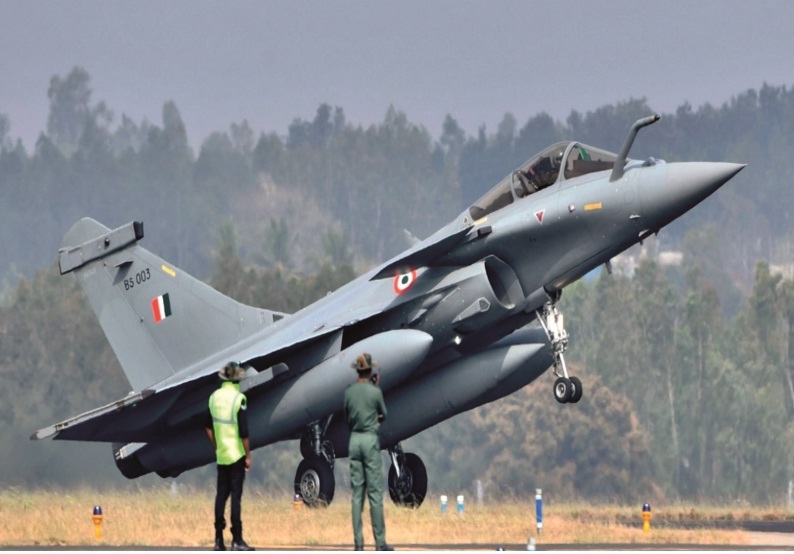
Against a sanctioned fighter squadron strength of 42, the IAF currently has only 31 squadrons. These are two squadrons of Rafale (the last aircraft arrived in December 2022), 12 of Su-30 MKI, three each of MiG-21, MiG-29 and Mirage 2000, six of Jaguar and two of Tejas (which are of limited operational capability and lack a trainer). Of these, the three MiG-21 squadrons are planned to be phased out over the next three years, the last in 2025. The Jagaurs, MIG-29s and Mirage 2000s are already operating on extended lifecycles. The Jaguar fleet would be phased out between 2025 and 2032, following the First In First Out norm. By then, the MiG-29 and Mirage 2000 squadrons, whose induction began in the 1980s, would be finishing their lives and being retired from service, unless of course, the IAF is forced to flog them beyond their useful lives. The MiG 29s and Mirage 2000s would be out of service by 2040. The current squadron strength (and that projected over the next decade) is inadequate to the IAF’s envisaged roles and tasks. The CAS is on record as having stated (during Exercise GARUDA VII in Jodhpur) that IAF requires five to six new squadrons of 4½ generation aircraft to meet its immediate requirements. How this urgent shortfall is met would decide how much further the figure of 31 falls before it starts rising again.
There is a process going on to purchase 114 Multi Role Fighter Aircraft (MRFA) from one of eight foreign contenders. However, the progress is slow while the IAF’s need is critical.
As far as indigenous fighters are concerned, the IAF already has 40 Light Combat Aircraft (LCA) Tejas Mk1 (in two squadrons) but the Mk1 is not an operational aircraft and is more of a testbed for the improved Tejas Mk 1A. In June 2021, the IAF ordered 73 Mk1As along with 10 Mk1 trainers (which were not developed along with the Mk1). Of these, Hindustan Aeronautics Limited (HAL) is to deliver the first three aircraft in 2024 and, thereafter, 16 every year for the next five years, thus taking the total to 83. Speaking to media on September 13 after taking over IAF’s first C295 in Spain, the CAS announced that the IAF was processing a case for 100 more Tejas Mk1As. The projected induction of 73 Mk1As is expected to stretch from 2025 to 2029 after which the next 100 (if sanctioned by the government) would be manufactured.
The Tejas Mk2 (hopefully a 4½ generation fighter) is expected to be flight tested soon and be a Medium Weight Fighter (MWF) (although sharing the common name of Tejas with the LCA) with an increased Maximum Take Off Weight (MTOW) of 17.5 tons compared to Mk1a’s 13.5 tons, a more powerful engine (although still a General Electric engine as the future of India’s aeroengine is uncertain), a larger payload of 6.5 tons compared to a little over 4 tons for Mk1/Mk1A. The CAS has reportedly said the IAF has committed to acquiring six squadrons of Tejas Mk2 and that it will decide on further numbers once production commences. At the time of writing this, the Mk2’s future is uncertain.
While the Tejas Mk1 and Mk1A are LCAs and the Tejas Mk2, an MWF, are both single engine, 4th to 4½th generation fighters, the Advanced Medium Combat Aircraft (AMCA) is planned to be a twin engine, fifth generation aircraft. It was originally envisaged as a Medium Combat Aircraft (MCA) with an MTOW of 15 tons but subsequently its nomenclature was changed to AMCA and its MTOW upped significantly to 25 tons. Reportedly, the design has been frozen and metal cutting began on 13 July 2022 and the GE F414 deal would provide the power plant for it. The IAF plans to procure seven squadrons of AMCA, the first two squadrons in Mark1 configuration, equipped with a GE engine, and the remaining five squadrons in Mark2 configuration with an indigenous engine.
Gas Turbine Research Institute (GTRE), a sprawling infrastructure in Bangalore has not been able to produce an engine for indigenous aircraft programmes during more than six decades since its inception in 1959. This is a weak area in inidgenisation for aerospace industry and needs to be boosted if India is to get a totally indigenous fighter in the future.
Transport Aircraft
On September 13 this year, the Chief of Air Staff (CAS), Air Chief Marshal VR Chaudhari, accepted the Indian Air Force’s (IAF’s) first C295 from an Airbus facility in Spain. This was a momentous event, not only for the IAF but for the nation’s aerospace and defence industry. The deal is for 56 aircraft; 16 are planned to be built in Spain by Airbus and delivered in a fly away state, while the rest 40 are to be manufactured indigenously in a Tata facility in Vadodara. This deal with Airbus to manufacture the complete C295 in India is thus a huge boost for private industry.
The immediate significance for the Indian military is that the C295 represents a sizeable step up from the Avro HS748 that it replaces. The Avro (of which IAF has 57) first flew in 1960 while the C295 incorporates late 1990s technology and is a versatile, new generation tactical airlift aircraft specialised for air transport missions under all weather conditions by day and night. The long run military benefit is that the C295 could also replace IAF’s 103 AN-32s which need to be phased out starting 2030. The Vadodara production line could be tasked to produce more C295s after the first 40 have been delivered (last delivery expected by 2031). Having a single type (C295) to replace two (Avro HS748 and AN-32) makes perfect sense on account of the attendant advantages of economy of scale, ease of logistics, lower cost of training, ground equipment and maintenance.
The deal serves to reinforce the Make In India and Atmanirbhar planks of the government. While inaugurating the Vadodara facility, Prime Minister Modi had said that India would soon produce big passenger aircraft that will proudly bear the words ‘Made in India’. How long that takes is open to conjecture because, despite the iteration that 90% of the aircraft will be produced indigenously, critical components like engines, landing gear and avionics will continue to be provided by Airbus. Nonetheless, according to Ministry of Defence (MoD), manufacturing of more than 13,400 components, 4,600 sub-assemblies and most major component assemblies will eventually be carried out in the country. There is also a 30% offset woven into the deal which should bring lucrative business to Indian entities, especially in the aerospace manufacturing arena. The Tata consortium has identified more than 125 domestic Micro, Small & Medium Enterprises (MSME) suppliers spread across the country. Thus, the project will generate thousands of skilled and semi-skilled jobs. Another boost to Atmanirbhar is the establishment of a D-level Maintenance, Repair And Overhaul (MRO) facility in India. This facility will act as a regional MRO hub for all C295 variants.
The deal is of great consequence in the civil domain too. Transport aircraft, unlike fighters, are essentially dual use and the Avro and the C295 were originally designed for civil use and later modified into military versions. The C295 deal bodes well for India’s pursuit --- so far fruitless --- of an indigenous civil transport aircraft despite HALs experience of license producing Avro and Dornier Do-228. HAL is working on Hindustan-228, a civil use design based on the Dornier Do-228. In the past, HAL had entered into a joint venture with Antonov to design a new aircraft but did not get very far with it. The Tata-Airbus C295 deal could well prove to be a catalyst in the emergence of an indigenous commercial aircraft design.
The deal will render India the world’s largest C295 user and catapult it into an elite band of nations that can produce complete military transport aircraft. Besides the tangible military benefit and the potential civil industry advantages, it also serves the Atmanirbhar and Make In India agendas by boosting indigenous industrial production directly and through offsets.
Helicopters
HAL has been able to do produce indigenous helicopters for the services and even managed to export some. However, a leading edge helicopter with an offensive capability matching the AH64 Apache has eluded HAL and the IAF and Army have inducted imported AH64 Apaches. One hopes that HAL will develop more and more advanced rotary wing aircraft in the future.
Conclusion
Despite the push for self reliance and the constant refrains of ‘Make In India’ and ‘Atmanirbhar’, attention to R&D in aerospace and defence remains inadequate. India spends just 0.7 per cent of its Gross Domestic Product (GDP) on R&D and holds the 53rd rank globally in terms of the percentage spending on R&D. A higher R&D spend will not only help in developing leading edge products to modernise our defence services but also open up export markets for the indigenous industry. There is a need to increase it to at least 2% of GDP for India to innovate in aerospace to the extent that it approaches the leading edge of technology. It might be a good idea to include this as an expenditure head of R&D in annual budgets to ensure it is used accordingly.

By Gp Capt AK Sachdev (Retd)
(The content of this article reflects the views of writers and contributors, not necessarily those of the publisher and editor. All disputes are subject to the exclusive jurisdiction of competent courts and forums in Delhi/New Delhi only)














Leave Your Comment