


Nestled amidst the breathtaking panorama of snow-capped peaks and emerald valleys, Jammu and Kashmir, in India, presents a picture of serene beauty. However, traversing its winding roads can be a different story. The region is notorious for treacherous hairpin bends, often shrouded in mist and prone to landslides. These perilous curves, once silent witnesses to countless accidents, have now found a unique voice - in the form of "Roads that Honk."
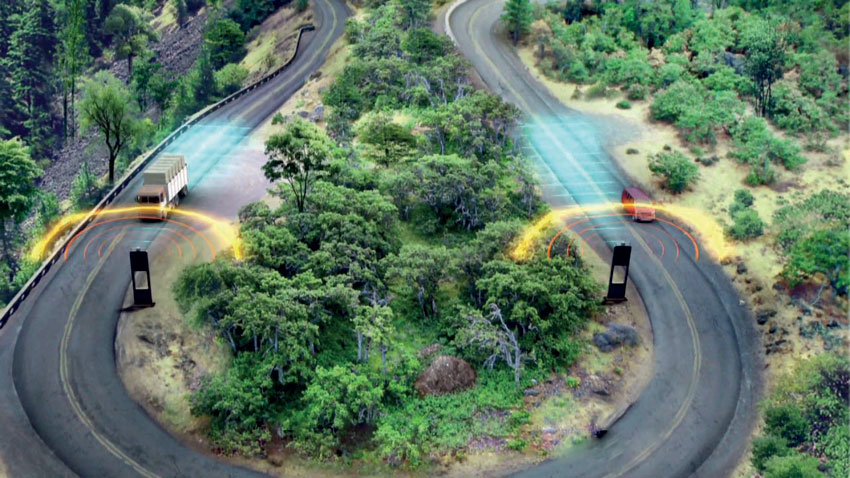
This innovative project, conceptualized by HP Lubricants and Leo Burnett India, is not about magical, sentient roads honking at will. Rather, it employs a network of smart poles strategically positioned along these dangerous bends. These poles, equipped with radar sensors, act as silent guardians, monitoring approaching vehicles' speed. When a vehicle exceeds the safe speed limit for the curve, the poles communicate with each other, triggering a loud horn alert at the next bend. This unexpected auditory warning serves as a jolt, prompting drivers to slow down and navigate the turn safely.
The project employs a network of smart poles, strategically positioned along these treacherous curves. These poles, armed with sophisticated sensors and communication systems, act as silent guardians, ensuring the safety of travelers on these challenging roads. Here's a breakdown of the technology involved:
1. Radar Guardians: At the heart of each pole lies a Doppler radar sensor. This sensor transmits radio waves at a specific frequency and monitors the reflected waves bouncing off approaching vehicles. As a vehicle gets closer, the frequency of the reflected waves shifts due to the Doppler effect (think of the ambulance siren changing pitch as it passes by). By analyzing this shift, the radar accurately calculates the vehicle's speed.

2. The Silent Conversation: Once the vehicle's speed is determined, the pole communicates with its "partner" at the next bend through a wireless network. This communication can be achieved through various technologies, depending on the specific implementation. Some possibilities include:
• Cellular networks: Using existing cellular infrastructure for data transmission offers wide coverage but might incur recurring costs.
• Mesh networks: These self-organizing networks, where poles act as relays, provide a cost-effective option for isolated areas but might have limited range.
• Line-of-sight communication: Direct communication between poles using lasers or radio waves is highly reliable but might be hampered by terrain or weather conditions.
3. The Voice of Caution: Upon receiving information about an approaching speeding vehicle, the "receiving" pole triggers a loud horn. This well-timed warning alert serves as a wake-up call for the driver, urging them to slow down and safely navigate the treacherous bend. The horn itself can be strategically positioned to direct the sound towards the approaching vehicle, minimizing noise pollution for others.
4. Powering the Guardians: These smart poles operate in remote locations, often far from traditional power grids. To ensure uninterrupted operation, they rely on solar panels mounted on top. These panels convert sunlight into electricity, stored in batteries within the pole, powering the radar, communication modules, and the horn.
5. Weatherproofing the Sentinels: The harsh Himalayan environment, with its extreme weather conditions, demands robust technology. The poles are constructed from weatherproof materials to withstand snow, rain, wind, and even landslides. Additionally, internal heating systems can prevent snow accumulation and ensure optimal sensor performance in freezing temperatures.
The inspiration for this initiative stemmed from a grim reality. The Jammu-Srinagar National Highway, a vital artery connecting the region, was dubbed one of the "deadliest roads in the world." A staggering 80 per cent of accidents on this stretch occurred at blind corners and hairpin bends. Recognizing the need for intervention, HP Lubricants and Leo Burnett India sought a non-traditional solution that addressed the root cause of accidents - excessive speed on challenging terrain.
"Roads that Honk" was not just an ingenious technological feat; it was a cultural intervention. Honking, despite its negative connotations in urban traffic, is often used in the mountains as a safety measure, a way to alert oncoming vehicles around blind corners. This project capitalized on this existing awareness, transforming the act of honking from a nuisance to a life-saving signal.
The results have been promising. Since its initial pilot phase in 2017, the project has witnessed a significant reduction in accidents on the targeted stretches. Studies report a 40 per cent decrease in collisions along the Jammu-Srinagar highway, leading to a dramatic drop in fatalities and injuries. The once dreaded curves, now equipped with their watchful sentinels, have become safer for locals and tourists alike.
However, "Roads that Honk" is not without its challenges. The rugged terrain and harsh weather conditions pose logistical hurdles in maintaining the network of smart poles. Additionally, the long winding roads necessitate a complex communication system to ensure accurate real-time data exchange and timely warnings. Despite these challenges, the project's success has spurred initiatives to replicate it across India, adapting it to various terrains and traffic patterns.
But the impact of "Roads that Honk" transcends mere statistics. It is a testament to the power of collaborative innovation, combining technological ingenuity with an understanding of local culture and driving practices. It demonstrates how simple yet effective solutions can transform even the most daunting landscapes into safer pathways, offering hope and reassurance to countless travellers navigating the breath taking yet treacherous curves of Kashmir.
In conclusion, while the phrase "honking roads" might conjure up whimsical images of vocal asphalt, the project in Jammu and Kashmir offers a practical, culturally-sensitive solution to a dangerous reality. It is a beacon of hope, proof that innovation, driven by compassion and an understanding of local contexts, can turn even the most treacherous roads into highways of safety. As the echoes of the "Roads that Honk" resonate through the valleys of Kashmir, they serve as a reminder that sometimes, the quietest revolutions pave the way for the loudest celebrations of life.
By Nilabh krishna
(The content of this article reflects the views of writers and contributors, not necessarily those of the publisher and editor. All disputes are subject to the exclusive jurisdiction of competent courts and forums in Delhi/New Delhi only)















Leave Your Comment