


Despite the large dependence of the increasing population on Himalayan lakes, information on the lakes continues to be limited thus hindering their sustainable management.
Freshwater lakes in the Indian North Western Himalayan region (INWH) are unique and an important source of water for the growing population in the region. The INWH region covers the two states of Uttarakhand and Himachal Pradesh and two union territories of Jammu and Kashmir, and Ladakh in India.
Variable topographies expose the lakes in the region to different climatic conditions making each lake unique
The topography of the Himalayas is characterised by multiple levels of highly elevated mountain ranges extending up to a maximum elevation of 8848 m above mean sea level (MSL). The lakes at different elevations are exposed to different climatic conditions.
In the eastern parts of the Lesser Himalayas, the Nainital and Renuka lakes receive rainfall during monsoon months while those in the western parts receive most of the annual rainfall during the winter season and those in central parts remain relatively dry during the monsoon season. Rainfall in the monsoon season is 2–3 times higher than the winter rainfall and is responsible for a relatively drier climate in western and northern parts of INWH.
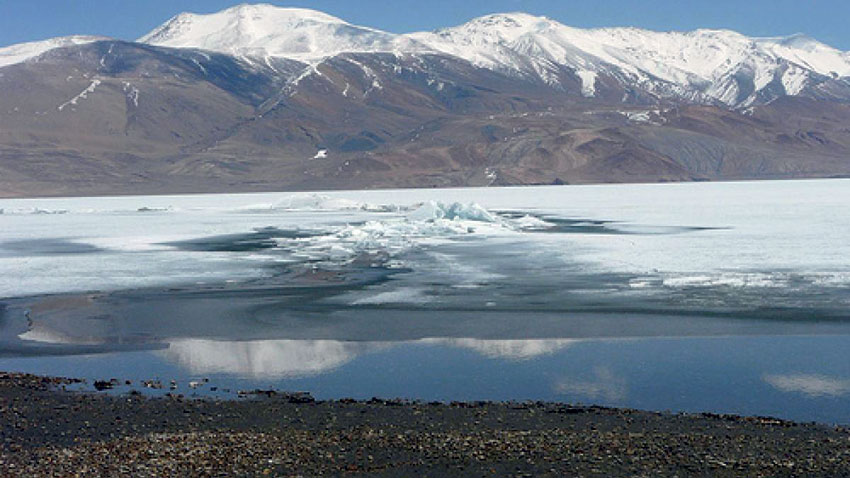
The seasonal temperature range also varies for lakes in different regions with warmer temperatures for lakes in the Lesser Himalayas i.e., Renuka and Nainital Lake, and cold to subfreezing temperatures for lakes at a higher elevation such as Wular, Dal, Tso Moriri, Tso Kar, and Chandratal Lake.
There is a limited understanding of hydrological processes of the lakes
Lakes are dynamic systems, store water and are sensitive indicators of changes in rainfall, surface and groundwater inflows, and water outflows in different forms such as evaporation, seepage, and surface outflows. However, studies focused on understanding the hydrological processes in Himalayan lakes are limited.
Water quality of the lakes is deteriorating
Himalayan freshwater lakes are important sources of water for local communities and the quality of water plays a major role in the health and spread of diseases in the population. Lakes in the INWH region are largely alkaline with a pH value of 7.2 to 8.8 while slightly acidic to slightly alkaline waters are found in a few high-altitude lakes such as Beni Tal , Deoria Tal and Nachiketa Tal.
High-altitude lakes in INWH are in an oligotrophic state (Hemkund, Prashar), while the rest of the lakes exhibit either eutrophic (e.g., Surinsar, Tso Moriri, Ahansar, Anchar, Sattal, and Wular) or hypereutrophic (Mansar, Tso Kar, Renuka, Dal, Nainital, and Rewalsar) state.
The lakes are highly prone to sedimentation
Steep topography and substantially high catchment erosion, potentially driven by high precipitation, deforestation by anthropogenic activities, and highly unpredictable climatic conditions make Himalayan lakes highly prone to sedimentation.
Land use land cover (LULC) changes are shrinking the lakes
For example, intensive urbanisation in Dal Lake has resulted in decreased lake area and gradual deterioration in the water quality of the lake. In Nainital Lake, intense construction in the geologically fragile catchment due to increasing tourist influx is leading to shrinking forest cover, enhanced sedimentation rate, and lake pollution. In the Manasbal Lake catchment, stone quarrying has led to land cover changes and subsequent nutrient and silt load leading to death of fish and disturbances in the lake ecosystem.

Population growth and tourism are damaging lakes
Several human settlements in the INWH have undergone a huge spike in population over the last half century, including settlements around freshwater lakes in the region, which are presenting multiple challenges to lakes due to increase in anthropogenic activities, urbannisation, catchment alterations and increased stress on available water resources and the biodiversity of the lakes.
Climate change is taking its toll
Global warming has resulted in rising lake water temperatures leading to eutrophication, decline in oxygen levels of the lakes leading to algal blooms. In addition, global warming-induced shifts in rainfall patterns in terms of magnitude, frequency, and occurrence have led to decline in water levels, which combined with pollution and lower oxygen levels can be detrimental to lake ecosystems.
Climate change has been found to alter lake surface conditions such as surface temperature, ice cover, water level, and evaporation. Reduced and delayed winter ice cover and increased lake surface temperatures have resulted in modified lake mixing regimes and a spike in evaporation leading to a drop in water levels and lake areal extent.
The study makes the following recommendations to deal with different sustainability challenges in Himalayan lakes
• Establish a monitoring network for hydrologic and water quality parameters in important freshwater lakes.
• Explore and develop a thorough understanding of hydro-ecological dynamics and their drivers in different lake systems.
• Decisive actions from the municipal authorities and water managers to reduce and reroute the human waste, and enforcement of laws to prevent future encroachment and illegal dumping into the lakes
• An integrated watershed management considering hydrology and water quality with best management practices to help strategise long-term action plans for lake water management
• Afforestation of hill slopes and installation of sediment traps along the main inflow channel can control sedimentation and nutrient loading to lakes bodies.
• District authorities need to revisit the construction laws and by-laws to limit effluents from construction sites, especially for densely populated lakes.
• Limiting the use of farm fertilizers and manure, and encouragement to practice agroforestry would help reduce the nutrient loading to the lakes.
• The development of a buffer zone around the lake would supplement the reduction of nutrient inputs from direct and indirect sources to the lake
• Prohibition of activities such as bathing, use of detergents, and washing utensils in the lake water
• Spread public awareness of the ecological and cultural importance of lakes, especially among the tourists and to promote
• Active participation of state and local governments is required to establish proper legislation for lake conservation and ensure its implementation.
By Stuti Shah, Sumit Sen, Debabrata Sahoo
(https://www.indiawaterportal.org/articles/himalayan-lakes-under-stress)
(The content of this article reflects the views of writers and contributors, not necessarily those of the publisher and editor. All disputes are subject to the exclusive jurisdiction of competent courts and forums in Delhi/New Delhi only)














Leave Your Comment