



Dr. Padmalochan Dash
Every age has been defined by the strategic resource that determined prosperity, influence and leadership. The agricultural age revolved around land; the industrial age turned machines and capital into the engines of national power; the information age elevated knowledge, data and connectivity. Today artificial intelligence is reshaping production, governance, research, defence and commerce at a pace unprecedented in history, and beneath that revolution another transformation is quietly unfolding. The next great competition among nations will not merely be for artificial intelligence, semiconductors or global markets. It will increasingly be for something far less visible, yet strategically more valuable - human attention.
For nearly two decades the world has misunderstood the attention economy, reading it through the narrow lens of platforms, advertising, clicks and screen time. Technology companies demonstrated that capturing human attention could become an immensely profitable business model, out of which an entire industry of monetisation followed. That interpretation treated attention as a commodity to be captured rather than a strategic asset to be earned. The attention economy of the future will turn not on who commands the largest audience but on who earns the world's confidence through credible knowledge, responsible innovation and practical solutions to pressing challenges.
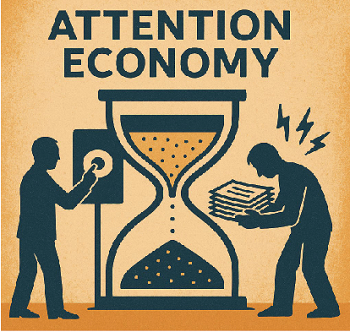
Artificial intelligence accelerates the shift. As machines generate information and perform tasks that once required human intelligence, information grows abundant. Abundance of information, however, does not produce wisdom. It does not create trust. It does not establish legitimacy. The easier it becomes to generate content, the more valuable authenticity becomes, in that credibility grows scarce exactly as information grows cheap. Attention will therefore shift towards those who demonstrate competence and the capacity to solve problems that matter. What emerges is a new strategic paradigm, an Attention Economy understood not in its digital sense but as a civilizational phenomenon, in which nations and individuals compete to become trusted contributors rather than visible participants. Attention of that kind is a form of national capital.
Beyond the Platform Economy
Every major economic transformation changes what societies value most. Productivity determined strength in the industrial era; data became the resource of the information age; artificial intelligence is now reducing the scarcity of knowledge. Machines already generate reports, interpret medical images, write code and support policy decisions. The future will reward not the possession of
knowledge but the ability to apply it responsibly, ethically and in ways that improve the human condition.
This marks the transition from the Platform Attention Economy to the Strategic Attention Economy. The former measures visibility and rewards popularity, creating temporary influence; the latter measures trust and rewards contribution, building enduring partnerships. Digital platforms distribute attention; civilizations earn it. Algorithms amplify messages; character sustains influence. Markets can purchase visibility; they cannot purchase legitimacy, which is conferred and never bought. Lasting attention is reserved for those whose institutions and values demonstrate reliability under uncertainty.
The future attention economy will be built upon outputs rather than communication. Scientific discovery, resilient critical infrastructure, sustainable manufacturing and environmental stewardship become the generators of global attention. Attention becomes, by keeping this at centrality, a measurable outcome of contribution rather than an objective of publicity. Visibility without value gradually fades; contribution generates enduring attention.
Bharat and the Civilizational Shift
If the future attention economy is driven by trust, a question follows. Which societies possess the intellectual resources, cultural resilience and institutional capability to become trusted contributors? The answer cannot be settled by measuring Gross Domestic Product, military expenditure or patents, which remain indicators of capability and no longer a complete picture of strategic relevance. In this transition Bharat occupies a distinctive position, not because it seeks attention, but because it possesses the potential to earn it through sustained contribution.
The rise of Bharat is usually explained through its expanding economy, demographic dividend and growing geopolitical influence. Beneath these visible dimensions lies a cultural continuity that has survived centuries of upheaval. The Sanatan civilizational worldview continues to shape everyday life through its understanding of duty, family, knowledge, coexistence, respect for nature and the harmony between material prosperity and inner well-being. Such values are not abstractions preserved in ancient texts. They influence social behaviour, institutional relationships and community resilience, and constitute an invisible strategic asset rarely measured by economists.
The century is witnessing an unprecedented convergence of crises. Climate instability, resource insecurity, cyber threats, fragile supply chains and the vulnerability of critical infrastructure are exposing the limits of development models built upon consumption and short-term growth. Such challenges cannot be resolved through technology alone. They require ethical leadership, institutional resilience and philosophies capable of balancing economic ambition with human well-being, for so the questions now put to development are not technical ones alone.
None of this is a claim of civilizational superiority. Every civilization has contributed to the advancement of humanity, and the future will require cooperation among knowledge systems rather than competition between them. The Sanatan worldview offers a complementary perspective for an age searching for balance, in its emphasis on Dharma as responsibility, on harmony between humanity and nature and on the integration of material progress with ethical conduct. The objective is neither to replace modern science nor to romanticise tradition; their convergence may define the next stage of human progress.
Philosophy alone does not generate attention. Tradition by itself does not create influence. Attention is earned when ideas become institutions, when values become innovation and when cultural confidence produces measurable improvements in human life; the record, and not the claim, becomes the basis of recognition. Prosperity can coexist with sustainability, technological advancement with ethical responsibility, and artificial intelligence with human wisdom. Such a model does not reject modernity. It seeks to humanise it.
Introducing the Bharat Attention Economy Framework (BAEF)
The Bharat Attention Economy Framework begins with a simple but transformative proposition. The defining strategic resource of the coming decades will not merely be technology, capital, information or even artificial intelligence. It will increasingly be trusted attention earned through sustained contributions to humanity. Unlike the platform-based attention economy, wherein attention is measured through clicks and engagement, the Bharat Attention Economy views attention as the cumulative confidence that the world places in individuals, institutions and nations that consistently create value for society.
Attention so understood is neither a marketing outcome nor a communication strategy. It is a strategic national asset, accumulated through scientific excellence, responsible innovation, ethical governance and resilient institutions. It attracts investment because investors trust stable systems, partnerships because collaborators seek reliable institutions, talent because knowledge flows towards opportunity, and influence because credibility commands respect.
Humanity first competed for land, then for industrial capacity, later for information, and now for superiority in artificial intelligence. The next transition moves beyond production and computation towards trust. Artificial intelligence will reduce the scarcity of information, and it cannot eliminate the need for ethical judgement, responsible leadership or civilizational wisdom. As these qualities become scarce they become strategically valuable. The framework therefore establishes a simple but powerful progression.
Values create Character. Character shapes Knowledge. Knowledge generates Innovation. Innovation creates Products, Institutions and Solutions. Trusted Solutions earn Global Attention. Global Attention attracts Partnerships, Investment and Influence. Together, these strengthen National Resilience and contribute to Human Progress.
Attention is redefined here not as visibility but as earned global trust transformed into strategic influence. Future leadership will belong to nations capable of producing trusted citizens, trusted institutions and trusted solutions. Instead of asking, “How large is your economy?” the world may increasingly ask, “What enduring value do your people create for humanity?”
The Sanatan Growth Model: From Chaos to Sustainable Order
The attention economy also compels a deeper question. What kind of growth will deserve the world's attention in this century? For nearly two centuries progress has been measured through production, consumption and Gross Domestic Product. These indicators lifted millions out of poverty, and they also exposed significant limitations, in that growth frequently came at the cost of environmental degradation, social fragmentation and widening inequalities. Growth without balance creates instability, and prosperity without responsibility becomes unsustainable. As machines take over routine work, the economy will reward the quality of growth rather than its quantity.
The Sanatan Growth Model assumes contemporary relevance within that recognition. The model is not a religious proposition, nor an attempt to revive historical institutions. It is a developmental philosophy that seeks harmony between human beings, society, nature and technology. Prosperity becomes durable only when it strengthens ethical conduct, environmental stewardship, social cohesion and institutional responsibility together, which makes growth not an isolated economic objective but a process nurturing the character of civilization.
The most significant contribution of the Sanatan worldview is its emphasis on order over chaos. Contemporary societies are confronted with many forms of disorder, from environmental imbalance and geopolitical instability to technological misuse and declining institutional trust. The response cannot simply be greater regulation or better technology. Sustainable order requires responsible individuals, resilient families, ethical institutions, accountable markets and governance guided by long-term responsibility rather than immediate expediency. Order of that kind is not imposed externally. It is cultivated internally, and the Sanatan understanding of Dharma offers precisely such an organising principle, wherein individual conduct contributes to social stability and social stability to national resilience.
The distinction matters in the age of artificial intelligence. Machines can optimise systems, and they cannot define the purpose of those systems. Algorithms recommend decisions; they do not determine what is morally desirable, and efficiency alone guarantees neither justice nor human dignity. The model therefore proposes that technology should amplify human potential rather than replace human purpose, that markets should serve society rather than dominate it, and that innovation should strengthen humanity rather than accelerate consumption.
Sustainability, understood this way, extends beyond environmental protection to institutions capable of maintaining public trust, manufacturing systems that strengthen national resilience and supply chains that ensure continuity during crises. The model therefore represents a transition from extraction to regeneration, from excessive consumption to responsible prosperity, and ultimately from disorder to sustainable order. It provides the ethical foundation of the Bharat Attention Economy Framework, since enduring global attention cannot be earned through technological superiority or economic scale alone.
Indian Youth: The World's Next Strategic Human Capital
If trusted attention is the defining strategic resource of the coming decades, then who will generate it? Neither governments nor corporations alone. The primary generators will be people, and more specifically young individuals who possess the knowledge, competence, ethical judgment and global outlook required to solve problems that transcend national boundaries. Human capital evolves here into strategic human capital, influencing not only economic productivity but international trust and institutional credibility.
Indian youth occupy a uniquely significant position within it. India possesses one of the world's largest youth populations at precisely the moment when the global economy is entering the age of artificial intelligence, automation and geopolitical restructuring, and that demographic reality is not merely a labour advantage. Millions of young Indians are connected to world-class education, digital technologies, entrepreneurial ecosystems and international markets, and their sphere of
influence has ceased to be confined within national borders. They will become architects of resilient critical infrastructure, designers of secure digital ecosystems, researchers in climate adaptation and contributors to humanitarian missions across the global commons. The future prosperity of nations will depend, keeping this in consideration, upon the quality of the people they produce rather than the quantity of the goods they manufacture.
The meaning of education changes accordingly. Education can no longer be understood as the acquisition of employable skills. It must prepare individuals capable of independent thought, ethical leadership, scientific inquiry and lifelong learning. A technically skilled individual without ethical judgement may create efficiency and instability together, where a generation capable of integrating excellence with integrity becomes a trusted global resource. The central question therefore is not whether Indian youth are acquiring digital skills, which are essential and insufficient. It is whether they are preparing themselves as complete individuals, capable of sovereign judgement, grounded in confidence rather than imitation, and inspired by service rather than entitlement. The attention economy of the future will not reward those who seek recognition. It will reward those whose knowledge, character and contribution make recognition inevitable.
The Century of Global Responsibility: Are Indian Youth Prepared to Become the World's Most Trusted Generation?
Every generation inherits a defining historical responsibility. Some rebuilt nations after war; others led industrial revolutions. The present generation stands at the threshold of an equally profound transition, in which artificial intelligence, biotechnology, climate change and demographic shifts are reshaping every dimension of human life at once. It will require individuals capable of exercising wisdom under uncertainty, leading institutions through disruption and building systems that strengthen both national resilience and the global commons. Among the youth of the world, Indian youth may occupy an increasingly significant position as Bharat assumes a larger role.
Indian professionals, researchers, scientists, educators and humanitarian workers will participate across almost every domain of global activity, from critical infrastructure resilience to climate adaptation and space technologies. The world will pay increasing attention to the quality of India's human capital, for so that capital will influence the quality of global solutions. Each Indian youth entering the global ecosystem becomes a representative of a nation and an ambassador of a heritage that has always sought to balance knowledge with responsibility. Reputation is built through millions of daily interactions in laboratories, universities, hospitals and industries. Attention accumulates. It is earned through countless acts of competence, integrity and service performed over generations.
The questions before this generation are accordingly sharper than employability. Are they preparing merely to compete, or to contribute? Are they acquiring information, or cultivating wisdom? Are they seeking individual success alone, or building institutions capable of serving future generations? Preparing for that economy requires a reorientation of education, leadership and national aspiration. Education must move beyond examination systems towards curiosity, critical thinking and ethical reasoning; leadership towards institution building and public trust; entrepreneurship towards value creation rather than valuation alone. The greatest strategic asset of any nation is not its natural resources or its financial capital, but the quality of its citizens; and citizens are formed slowly, or they are not formed at all.
The Sanatan worldview reminds throughout that external progress remains incomplete without inner development. Knowledge without humility becomes arrogance. Power without responsibility becomes domination. Innovation without ethics becomes disruption. Freedom without discipline becomes disorder. The defining challenge before Bharat is therefore not whether it can participate in the artificial intelligence revolution, which is already underway. It is whether Bharat can shape the moral, intellectual and institutional architecture of the age that follows it.
The hierarchy of global influence will shift accordingly. The defining question may no longer be which nation is the richest, but which consistently produces trusted people capable of solving humanity's most complex problems. Are Indian youth prepared for that economy? The answer will not be settled by demographic statistics or employment numbers, but by the quality of the individuals that Bharat produces. If they prepare themselves as complete human beings, intellectually rigorous, ethically grounded and inspired by the civilizational values of service, harmony and duty, they will not merely participate in the future. They will help define it. The world's attention will then turn towards Bharat, not because it demands recognition, but because it consistently earns trust through the character of its people. Attention is not captured, manufactured or purchased. It is earned through contributions that advance humanity, strengthen national resilience and turn civilizational values into global public good.
(The content of this article reflects the views of writer and contributor, not necessarily those of the publisher and editor. All disputes are subject to the exclusive jurisdiction of competent courts and forums in Delhi/New Delhi only)






















Leave Your Comment