


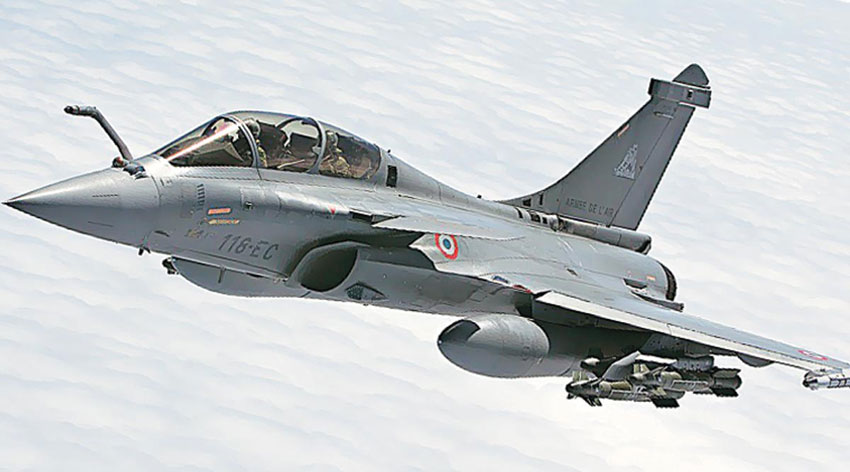
The Indian Air Force (IAF) was established on 8th October 1932, as an auxiliary air force of the British Empire. On 1st April 1933, IAF commissioned its first tiny squadron with a fleet of four Westland Wapiti biplanes, five Indian pilots, a British Commanding Officer and nineteen Havai Sepoys. The IAF actively supported the RAF to halt Japanese army’s advances and targeted Japanese base in Burma in the 2nd World War. In 1945, King George VI bestowed the prefix ‘Royal’ in recognition of its accomplishments and it became the Royal Indian Air Force (RIAF). After India became republic in 1950, this honorary title was abolished, and it evolved into the Indian Air Force. Its motto is ‘Touch The Sky With Glory’, taken from the Bhagavad Gita. In 1954, Air Marshal Subroto Mukherjee, one of the founders of the Air Force took over as the first Indian Chief of the IAF. The President of India is the supreme commander of the IAF. Its Chief, known as the Air Chief Marshal, is a four-star military officer. The rank of Marshal of the Air Force was conferred to Arjan Singh to become the first and the only five-star officer of the Air Force. India purchased British Vampire aircraft in 1954. The IAF has never been without a French aircraft, starting in 1953 with Ouragan. In the 1964 movie Sangam, Raj Kapoor was shown flying an Ouragan which etched that image in public memory. India purchased Mystere in 1957, French-British Sepecat Jaguar in 1979, Mirage 2000 in 1986 and the latest Rafale in 2021. From Russia, we started MiG series with Mig 21 in 1963 and carried on with Mig 23, MiG 25, MiG 27 and MiG 29. Also, from Russia we purchased Sukhoi series of aircraft like Su-7 and Su-30MKI.
The instrument of accession was signed for the princely state of Jammu and Kashmir to accede to India between Maharaja Hari Singh and PM Nehru. Conflict broke out between India and Pakistan in 1947, known as the first War of Kashmir. The RIAF transported the troops to the war zone and provided close air support to Indian troops. Ceasefire was declared in 1948 and the matter referred to the UN. This is regarded as the monumental blunder by PM Nehru and the Kashmir issue remains unresolved till today. In 1961, the Govt. of India liberated Goa, Daman and Diu from the Portuguese control through operation Vijay. The IAF actively participated using British aircrafts Canberra, Hunters, Vampires, and French aircrafts Mysteres and Ouragans. In 1962, Sino-Indian War, the Govt. of India did not deploy and effectively use the IAF against the invading Chinese forces. India lost the War and ceded huge territory to China. In 1965, Pakistan launched operation Gibraltar, referred to as the second Kashmir War. This was the first time the IAF actively engaged enemy Air Force. The small and nimble (British) Folland Gnats proved effective against the American Sabre jets of PAF. IAF proved its superiority and India won the war.
Hindustan Aeronautics Limited (HAL) is a public sector aerospace and defence manufacturing company established in 1940. It has R&D centres and manufacturing divisions spread across India. It is involved in manufacturing of fighter jets, helicopters, jet engines, avionics, systems accessories, and upgrading Indian military aircrafts. It has the policy of Indigenization of components, accessories and systems required for manufacturing as well as repair and overhaul of aircrafts, engines and equipment. This is being done as per the policy of ‘Make in India’, lowering the dependence on foreign countries. Presently the HAL is manufacturing aircrafts like Hawk, Tejas (LCA), SU-30 MKI, Dornier etc. and helicopters Cheetah, Chetak, Prachanda (LCH), Dhruv (ALH) etc. The HAL is also exporting equipment to Boeing of USA, Airbus of France and IAI of Israel.
After 1965 war, the IAF underwent a series of changes to improve its capabilities. In 1966, the para commandos regiment was created. The IAF inducted 72 HS 748 aircrafts built by HAL under the licence from AVRO. The HAL HF 24 Marut was the first Indian fighter bomber aircraft developed by HAL with Kurt Tank, German aeronautical engineer. HAL developed the improved version of Folland Gnat, known as HAL Ajeet. IAF also started inducting Mach 2 capable Soviet MiG 21 and Sukhoi Su-7 fighters.

In 1971 war, India defeated Pakistan and liberated Bangladesh (East Pakistan). The IAF effectively used MiG 21, Hawker Hunter, Folland Gnat, Canberra, Sukhoi Su-7 etc to prove its superiority over the PAF. In 1984, India launched ‘Operation Meghdoot’ and positioned troops in the Siachen Glacier, an area of about 3000 square km. IAF’s Mi-8, Cheetah and Chetak helicopters airlifted hundreds of Indian troops to Siachen. In 1999, during the Kargil War, IAF provided close support to the Army with helicopters and fighter aircrafts The IAF named it ‘Operation Safed Sagar’. MiG 21, Mig 27, MiG 29 and Mirage 2000 participated and the Indian forces repulsed the Pakistani Forces from Kargil. In 2019, after the Pulwama attack, a group of Mirage 2000 carried out air strikes on Balakot, Pakistan and destroyed JeM training camp killing large number of terrorists.
The IAF participated in UN peace keeping operations in Congo, in 1961. Under Operation Sanjeevani, IAF delivered medical and hospital consumables to Maldives as assistance in fight against Covid 19. It also supported Indian Peace Keeping Force (IPKF) in Sri Lanka from 1987 to 1990. IAF evacuated thousands of Indians from various war-stricken countries like Yemen, Ukraine etc using transport aircraft like C-17 and C-130. The IAF started inducting women as transport and Helicopter pilots in 1994. These officers performed well and in 2015, it was decided to induct women as fighter pilots and they are doing exceedingly well and flying the fighter planes including the Rafale.
Indian Air Force is the fourth most powerful and largest Air Force in the world which is supported by very strong missile system. It has aircraft and equipment of Russian, British, French, US and Indian origin, with Russian aircraft dominating its inventory. HAL produces some of the Russian, British and French aircrafts in India under licence. HAL has indigenously developed LCA Tejas which has become part of the IAF. There was a time when India was totally importing its defence equipment. After ‘Make in India’ initiative of the PM, the situation is changing and not only our dependence on other countries is reducing, we have started exporting and expecting big orders in future.
By Manoj Dubey
Principal (Retd.), Delhi Public Schools
(The content of this article reflects the views of writers and contributors, not necessarily those of the publisher and editor. All disputes are subject to the exclusive jurisdiction of competent courts and forums in Delhi/New Delhi only)














Comments (3)
M
Very nice article with in depth knowledge on subject. Really very good to read such articles and helps us to improve our knowledge on subjects.
S
Very nice write up. Good to know diversity of aircrafts in India. The language is very easy to understand. And flow is superb. Congratulations
S
How indian air force came into existence and what duties it has performed , is well described by the author . HAL has been contributing for the growth and development of Air force