



Nilabh Krishna
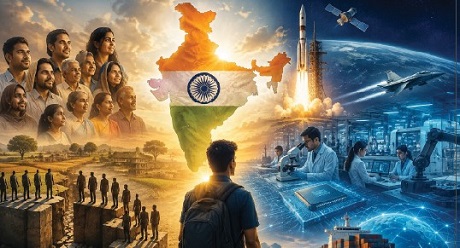
India stands at a peculiar political crossroads. At a moment when the nation is attempting to transform itself into a technologically advanced, economically powerful and globally consequential Viksit Bharat, politics is once again being invited to look backward—not to recover history, but to reactivate social divisions. The demand for an open-ended national caste census is increasingly being presented not merely as an instrument of social measurement, but as the foundation for a new politics of entitlement: count every caste, quantify its population, and then distribute political power and state resources accordingly.
The language sounds egalitarian. The political consequence can be profoundly fragmenting.
The danger lies not in understanding India's social composition. A modern state requires reliable data, and social realities should never be hidden behind political convenience. The danger begins when census becomes calculus, calculus becomes competition, and competition becomes the organising principle of citizenship. Once every community is encouraged to ask, “What is my numerical share?”, the Republic risks replacing fraternity with arithmetic.
The slogan <“Jitni Aabadi, Utna Haq”>—as a political proposition—captures this transformation. It converts citizenship into a contest over demographic weight. The individual is first converted into a member of a caste bloc, the caste bloc into a political constituency, and the constituency into a bargaining unit. The result is not social justice in its highest sense, but the institutionalisation of social fragmentation.
India's civilisation has never been merely a collection of watertight communities. It has been a vast and complicated civilisational continuum in which identities have overlapped, evolved and interacted across centuries. Jati, Varna, region, language, occupation, sect, village and family have historically constituted multiple layers of identity. To reduce this extraordinarily complex social fabric to a permanent electoral matrix of competing caste factions is to flatten India itself.
And at precisely the moment when India needs to think in terms of productivity, innovation, human capital, technological capability and global competitiveness, the political discourse risks becoming trapped in the question of demographic shares.
That is not the road to Viksit Bharat.
Reclaiming Ambedkar from the Left
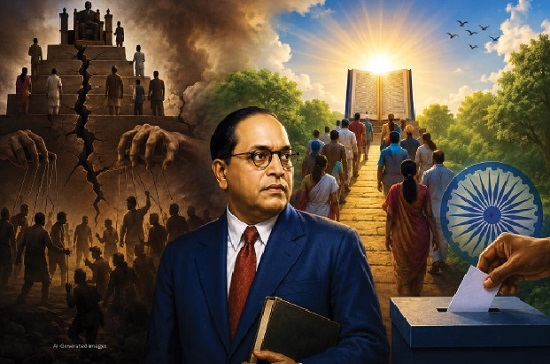
Few intellectual figures have been more selectively appropriated in contemporary India than Dr. B.R. Ambedkar. His portrait is displayed across political platforms, his name invoked in parliamentary speeches and his quotations circulated whenever caste politics requires moral legitimacy. Yet the Ambedkar who emerges from much of contemporary political discourse is often radically different from the Ambedkar who wrote, argued and fought.
The Left-liberal interpretation frequently presents Ambedkar primarily as an icon of identity-based mobilisation. But Ambedkar's intellectual project was considerably more ambitious. He did not seek to freeze Indians permanently inside their caste identities and then organise the Republic around competing caste claims. His central concern was how to destroy the social structures that prevented Indians from becoming a genuine fraternity of equals.
This is the essential message of Annihilation of Caste.
Ambedkar's argument was not that caste should become a more efficient mechanism for distributing political privileges. His challenge was much more fundamental: caste itself had to be destroyed as a system of graded inequality. He understood that political democracy could not survive indefinitely without social democracy.
For Ambedkar, liberty, equality and fraternity were not decorative constitutional words. They were mutually dependent principles. Equality without fraternity could produce resentment; liberty without equality could reproduce domination; and neither could endure without a sense of common belonging.
This is precisely where the contemporary politics of permanent caste arithmetic deserves scrutiny.
If the ultimate objective is to annihilate caste, then political mobilisation that continually reinforces caste consciousness creates a profound contradiction. If citizens are repeatedly instructed to see themselves primarily as members of caste blocs competing for a predetermined share of power, how does society ever transcend caste?
There is a difference between recognising historical disadvantage and perpetuating historical identity.
A compassionate and constitutional state must identify deprivation, discrimination and exclusion. It must create pathways for those who have been denied opportunity. But the objective of affirmative action should ultimately be emancipation—the expansion of capability and dignity—not the permanent reproduction of the categories through which disadvantage was once measured.
Ambedkar's vision was revolutionary precisely because it imagined a society in which caste would lose its capacity to determine human worth.
The political slogan “Jitni Aabadi, Utna Haq” risks moving in the opposite direction. It asks Indians to remain conscious of their caste location because that consciousness becomes the currency of political negotiation.
Ambedkar wanted caste to cease determining destiny.
The politics of caste arithmetic can inadvertently make caste the permanent passport to power.
The Perils of Weaponised Tribalism
There is another danger in converting social identities into political instruments: every demand for representation generates a corresponding demand for sub-representation.
Once caste becomes the primary political unit, communities begin competing not only against other castes but also against neighbouring groups within their own broad category. Sub-categorisation, internal quotas and competing claims of relative deprivation can become an endless chain. The political incentive is obvious. Every group has a reason to argue that someone else has received more.
The social consequences are less benign. India requires institutions capable of selecting talent, encouraging excellence and deploying human capital efficiently. A state that becomes excessively preoccupied with distributing positions according to increasingly granular social categories risks turning public institutions into arenas of permanent demographic negotiation.
This does not mean that merit exists in a social vacuum. Historical deprivation unquestionably affects educational access, nutrition, social capital, networks and economic opportunity. A sophisticated understanding of merit must therefore recognise unequal starting points. But the answer cannot be to create a political architecture in which every institution is evaluated primarily through demographic representation.
The real challenge is to expand the pool of merit. That means better schools, nutrition, healthcare, scholarships, digital access, vocational training, entrepreneurship and capital availability. The objective should be to ensure that a child born in a poor household does not remain disadvantaged because of the circumstances of birth.
The distinction is critical: social justice should expand opportunity rather than institutionalise identity. There is also a national-security dimension to this debate. A country of India's scale cannot afford to allow every social fault line to become an instrument of political mobilisation. External actors have historically exploited internal divisions, and a fragmented society is inevitably more vulnerable to manipulation. A nation aspiring to shape global institutions, supply chains, technology standards and geopolitical outcomes must possess not only economic strength but also social cohesion.
India's adversaries do not need to defeat a billion-plus people militarily if Indians can be persuaded to see one another primarily as competing communities. National power ultimately rests on national confidence. A society that constantly asks which group deserves more than another risks losing sight of the larger question: what can all Indians build together?
The Nationalist Blueprint: From Competition to Samarasata
The alternative is not the denial of social inequality. It is Samarasata—a vision of social harmony in which dignity, opportunity and fraternity progressively weaken the importance of inherited divisions. Indian civilisation possesses an extraordinary internal tradition for this project.
Cultural and Spiritual Unity
Long before modern political parties discovered the vocabulary of social justice, India's spiritual traditions repeatedly challenged the arrogance of birth-based hierarchy.
The Bhakti movement created powerful channels of spiritual democratisation. Ramanuja emphasised the accessibility of devotion; Kabir challenged religious and social pretensions through uncompromising spiritual criticism; Ravidas articulated a vision of dignity and a society free from inherited humiliation.
Their significance lies not merely in their historical biographies but in the civilisational principle they represented: spiritual worth cannot be monopolised by birth. Indian society possesses the intellectual and spiritual resources to confront caste prejudice from within its own traditions.
Modern social reform organisations have carried forward aspects of this endeavour by opposing untouchability, encouraging inter-caste social interaction and promoting the idea that Hindu society cannot remain internally divided if it wishes to preserve its civilisational unity.
Samarasata therefore does not mean pretending that differences never existed. It means refusing to convert historical differences into permanent hierarchies. It is the movement from Jati consciousness toward civilisational fraternity.
Economic De-linking: Making Birth Irrelevant in the Marketplace
The most powerful destroyer of inherited economic identity is productive opportunity. A modern economy can accomplish what political slogans cannot: it can make birth progressively less relevant to economic destiny.
Digital Public Infrastructure has created new possibilities for individuals to participate in formal economic systems without requiring traditional social networks. Digital payments, identity infrastructure and formal financial channels can reduce the historical advantages enjoyed by those possessing established economic connections.
The democratisation of capital is equally important. Initiatives such as MUDRA have sought to expand access to institutional credit for small entrepreneurs and micro-enterprises. The significance of such interventions goes beyond the number of loans disbursed. They challenge the old assumption that entrepreneurship belongs primarily to families possessing inherited capital.
A street vendor, artisan, small manufacturer, service provider or first-generation entrepreneur should be able to access finance because of the viability of an economic activity—not because of the social identity of the family into which he or she was born.
This is where the market, when embedded within a framework of social opportunity, becomes an instrument of social transformation. A caste identity may remain culturally meaningful. It should not remain economically determinative.
The ultimate success of economic reform will be visible when a young Indian is judged increasingly by skills, creativity, reliability and enterprise rather than surname or Jati.
Saturation Welfare: The State as an Equaliser
The third pillar is welfare that reaches the deprived without converting every beneficiary into a permanent political constituency. Housing, sanitation, healthcare, financial inclusion, clean cooking fuel, electricity, drinking water and social security address conditions of deprivation directly. Their transformative power lies partly in their universality.
When a poor household receives a house because it needs shelter, rather than because its members belong to a politically useful caste bloc, the relationship between citizen and state changes. This is the promise of saturation-based welfare: the state attempts to reach every eligible beneficiary rather than designing welfare primarily as a mechanism of political brokerage. Such schemes do not make social inequalities disappear overnight. But they can weaken the economic conditions that reproduce them across generations.
The objective should be straightforward: make poverty transient, not hereditary; make opportunity universal, not identity-dependent. That is a more durable form of social justice than perpetual political mobilisation around deprivation.
Beyond the Politics of Fragmentation
India cannot build a 21st-century civilisation while remaining intellectually imprisoned by the social categories of the past.
The answer is not to deny Varna, Jati or the historical realities of discrimination. Nor is it to dismiss the legitimate demand for data, representation or corrective justice. The challenge is to ensure that instruments designed to correct inequality do not become mechanisms for reproducing the identities that created the political demand in the first place.
There must be a destination beyond reservation, beyond caste census, beyond political representation and beyond welfare. That destination is fraternity.
Ambedkar's greatest contribution was to insist that constitutional democracy cannot survive without social democracy. His answer to India's divisions was not an eternal federation of antagonistic identities, but a society in which liberty, equality and fraternity become lived realities. The political question before India today is therefore larger than who gets what percentage. It is whether India will become a nation of competing demographic blocs or a civilisation confident enough to transcend them.
The road to Viksit Bharat cannot be built on the permanent excavation of social fault lines. It must be built on education that liberates, markets that reward ability, welfare that reaches the deprived, institutions that uphold fairness and a culture that rejects humiliation. India needs not a politics that constantly counts its divisions, but a national project that makes those divisions progressively less consequential.
The final measure of social transformation will not be how successfully political parties mobilise caste identities. It will be how irrelevant those identities become to a citizen's opportunities, dignity and aspirations. A child must be able to dream without first asking which Jati the dream belongs to. An entrepreneur must be able to build without asking which caste controls capital. A student must be able to compete without believing that birth has already written the final chapter of his life. And every citizen must ultimately be able to look beyond the boundaries of Jati, region and sect and say, with confidence and without qualification:
I am Bharatiya.
That is not the erasure of diversity. It is its higher synthesis. That is Samarasata. And that is the Ambedkarite destination that India must reclaim—not a Republic permanently divided into vote-banks, but a civilisation reunited through fraternity, dignity and a shared national consciousness.
From Varna to citizenship. From Jati to fraternity. From vote-bank arithmetic to Bharatiya consciousness. From inherited divisions to Viksit Bharat.
(The content of this article reflects the views of writer and contributor, not necessarily those of the publisher and editor. All disputes are subject to the exclusive jurisdiction of competent courts and forums in Delhi/New Delhi only)




















Leave Your Comment