



Dr. Vikas Bhardwaj
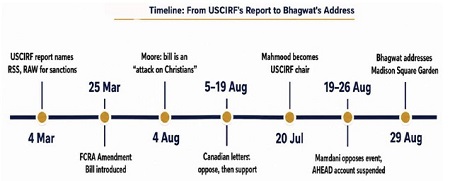
On Saturday, 29 August, Mohan Bhagwat is scheduled to address roughly five thousand people at Madison Square Garden, the marquee stop on a centenary tour marking a hundred years since the RSS's founding. He arrives, if he arrives as planned, having survived a sitting mayor's public opposition, a Hindu-American nonprofit's X account being suspended and restored, and a US commission chair questioning why he should be received at all. None of it has stopped the event. That is the story this paper follows: an organisation that keeps drawing fresh objections and keeps outlasting the filing of each one. Three explanations compete for why a funding law, a sanctions recommendation, a mayor's press conference, and a platform suspension converged on one visit: coincidence, internationalisation of a domestic Indian argument, or coordination. The evidence assembled here, checked against primary sources through 28 August 2026, sustains the second far more securely than the third.
The Law, and the Narrative Around It
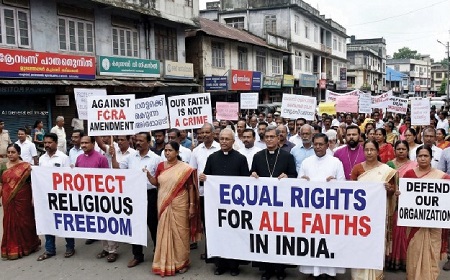
Nothing in India's Foreign Contribution (Regulation) Amendment Bill, 2026, names a religion. It creates a "Designated Authority" empowered to take custody of an organisation's foreign-funded assets once registration lapses or is cancelled — and, in the detail foreign coverage keeps missing, cuts the maximum prison term for a violation from five years to one. On 4 August, Congressman Riley Moore called it "a clear attack against Christians." The harder reaction to dismiss was India's own: church councils marched in Aizawl, Kerala organisations objected, and the Tamil Nadu Assembly passed a resolution against the bill — pressure that pushed the Lok Sabha toward a joint committee before Washington said a word that month.
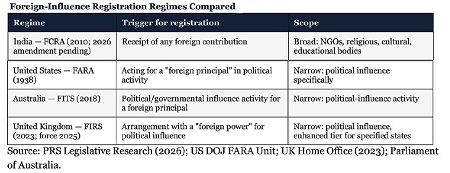
Supporters call FCRA "India's FARA." Set beside Table 1, the comparison understates India's case rather than flattering it: FARA, FITS, and FIRS all register a narrower thing than FCRA does, meaning Washington, Canberra, and London have each already conceded the underlying principle — regulating foreign money into domestic civil society — that India now invokes at greater scale.
An Institution That Doesn't Believe Its Own Recommendation
USCIRF's 2026 Annual Report — recommending sanctions against the RSS and India's intelligence agency for "tolerance of severe violations of religious freedom" — was released 4 March 2026, three weeks before the FCRA bill existed. It cannot have been a reaction to it.
Nor is it Asif Mahmood's doing. USCIRF's nine commissioners are appointed by the US president and congressional leaders of both parties; the chair of record when the March report was written was Vicky Hartzler, not Mahmood, who was then vice chair and took the gavel only on 20 July. What can be dated to the days before the visit is a second round — Mahmood's statement that Modi "is a member of the RSS," Commissioner Gene Mills's call for no high-level meetings with RSS figures — timed to the tour, not new in substance. India's Ministry of External Affairs has answered nearly every USCIRF report the same way since 2025: "it is the USCIRF that should be designated as an entity of concern," spokesperson Randhir Jaiswal said of an earlier report, arguing a nation of 1.4 billion people practising every faith on earth owed the commission no deference it had not earned.
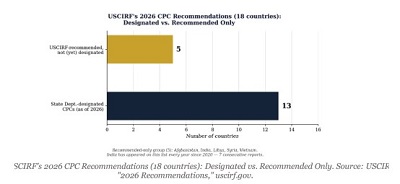
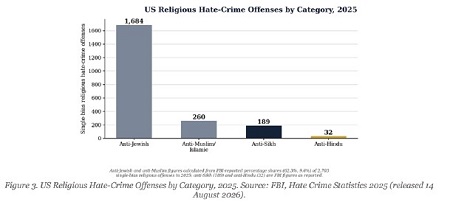
Of eighteen countries USCIRF named for CPC status in 2026, thirteen actually carry the designation; India sits, unactioned for a seventh year, beside Afghanistan, Libya, Syria, and Vietnam. Even Justice For All, which welcomed the RSS recommendation, has asked USCIRF to name individuals rather than indict the organisation wholesale — conceding the finding does not itself tie the RSS to a specific act. And the commission auditing India's record has an uneven one at home: FBI data released 14 August 2026 recorded 189 anti-Sikh and 32 anti-Hindu hate-crime offences in the US for 2025, both rising even as total hate crime fell roughly seven percent nationally.
A Century of Service, Outlasting Every Attempt to End It
K. B. Hedgewar founded the RSS in Nagpur in 1925 as a daily volunteer discipline, not a political party. A century on, it is the platform's staying power, not any single controversy, that its own leadership treats as the real argument: every government attempt to outlaw the organisation has failed, and each ban — 1948, 1975, 1992 — was eventually lifted, restoring an organisation that kept operating rather than one that had to be rebuilt from nothing.
Bhagwat's own reading of that history turns the charge on its head: an organisation banned three times and reinstated three times is not a fugitive from the Indian state's judgment, it is an organisation the Indian state has repeatedly examined and repeatedly allowed to continue — a point his critics rarely engage on its own terms. The RSS was never legally required to register in the first place, which is a genuine legal fact beneath the rhetorical one. What the organisation has built in the meantime is harder to dismiss than any single controversy: by its own 2025 centenary count it ran 83,129 daily shakhas, and its service wing, Seva Bharati, remains a first responder at scale — in July 2026 alone, Seva Bharati and RSS volunteers rescued more than 200 people by boat from flood-hit villages in Assam's Sivasagar and Jorhat districts, part of a disaster-response record that also includes the 2025 Punjab floods, the 2025 Ramban landslides in Jammu and Kashmir, and mobile medical units serving remote communities in Tamil Nadu — work independently reported, not merely self-described.
Independent scholarship remains split on how to weigh this record against the organisation's ideological project — Jaffrelot treats the shakha network as an instrument of ethnic-nationalist consolidation; his critics, including a pointed 2021 review in The Tribune, accuse him of building arguments toward a predetermined conclusion. That a serious scholarly disagreement exists at all is itself telling: the institutional case against the RSS has never been strong enough to settle the argument, only to keep it open. Nor is an organisation's legal character shifting at the border unique to the RSS: the Muslim Brotherhood is banned as a terrorist entity in Egypt and operates as a registered civil-society presence in Britain. Borders read movements differently; that reflects how sovereignty works, not any failing in the movement itself. What is beyond dispute is the RSS's proximity to power: it is the BJP's ideological parent, and Modi's own public life began inside it as a full-time pracharak, a lineage the organisation has never hidden and its critics cannot credibly claim to have discovered.
Canada and New York
Canadian NDP MPs and a rights coalition sought Bhagwat's exclusion in early August, citing "associations with... listed terrorist organizations." Canada's actual Criminal Code list includes Babbar Khalsa International and the International Sikh Youth Federation — not the RSS, in any form. A hundred-plus Canadian Hindu and civil-liberties groups said as much twelve days later, asking for "credible evidence and due process" instead. HinduPACT, an American Hindu advocacy group, went further, accusing USCIRF's leadership of sounding "less like the head of a pluralistic American commission and more like an advocate for a hardened anti-Hindu narrative" — a serious institutional charge that rests on what the commission has and has not scrutinised with equal rigor, not on who holds its chair.
New York arrived last. Mayor Zohran Mamdani, who has previously called Modi a "war criminal" over the 2002 Gujarat riots, told reporters the RSS event was "incredibly troubling" and "exclusionary" — while acknowledging he had no authority to cancel a private gathering, which is exactly what happened: nothing. Walter Andersen, the American scholar who has studied the RSS for five decades, called the timing unsurprising given the organisation's centenary and a six-million-strong Indian-American diaspora, and noted the irony directly: Bhagwat's address is built around Vasudhaiva Kutumbakam — "the world is one family," a line from the Upanishads — with Christian, Muslim, and Jewish speakers sharing the stage, addressed to a mayor who calls the same event exclusionary. In the same fortnight, X suspended the account of AHEAD, the event's Hindu-American organiser, calling it an error, then restored it within days — a fourth, separate front, on the same pattern as the rest: no document reviewed here ties Moore, USCIRF, Ottawa, Mamdani, or X into one operation. Each found the same season useful for reasons of its own. This follows an earlier, unrelated dispute in which Meta briefly removed a Modi video from Facebook in July, also later called an error and reversed.
Conclusion
FCRA 2026 is faith-neutral on its face. The USCIRF recommendation blamed on it preceded the bill by three weeks and its own current chair by nearly five months. The case against the RSS is thin enough that the groups who welcomed it have asked USCIRF to strengthen it. The commission demanding accountability abroad presides over rising anti-Sikh and anti-Hindu hate crime at home. Canada's campaign rests on a "listed terrorist" designation that does not exist. And New York's mayor said what he had the power to do and did nothing beyond it. Sovereignty is a claim about who decides these questions, not a verdict that the underlying conduct is beyond criticism — but on the specific claims this paper set out to test, the evidence, followed on its own dates, keeps arriving a step behind the objection it was supposed to justify.
(The content of this article reflects the views of writer and contributor, not necessarily those of the publisher and editor. All disputes are subject to the exclusive jurisdiction of competent courts and forums in Delhi/New Delhi only)





















Leave Your Comment