


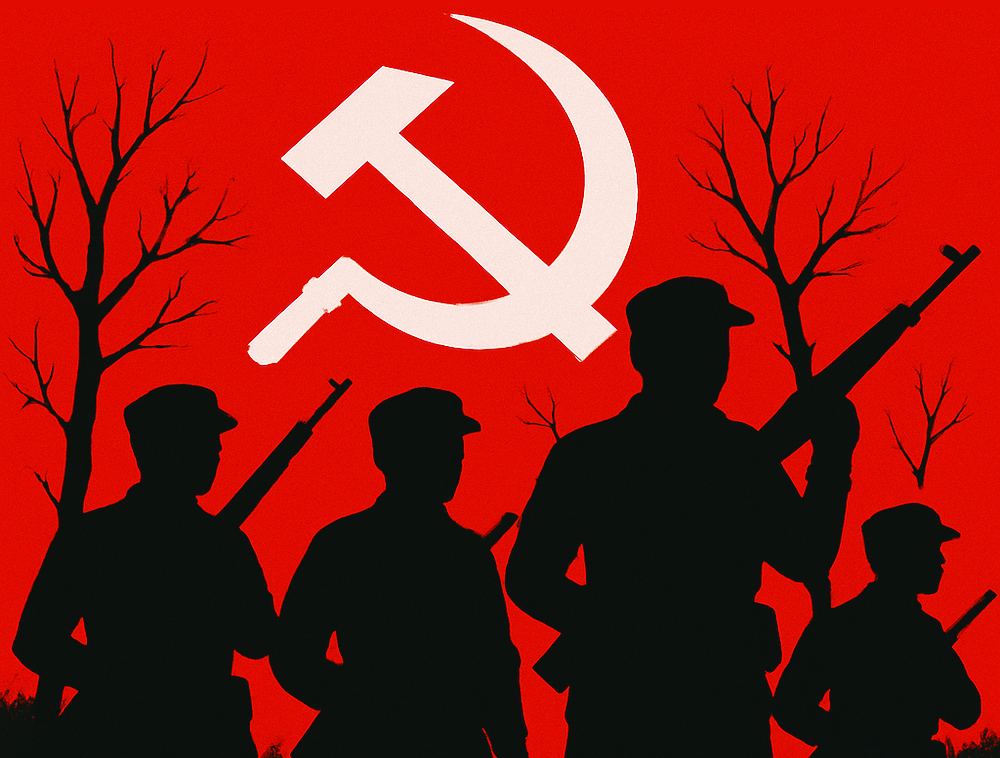
India’s prolonged struggle against Left-Wing Extremism stands among the most consequential internal security challenges faced by the Republic since Independence in 1947. Emerging from the Naxalbari uprising of 1967, the Maoist insurgency evolved into a sustained armed movement inspired by Mao Zedong’s doctrine of protracted people’s war, seeking to overthrow democratic institutions through violence. For decades, Naxalism claimed ideological legitimacy as a revolutionary struggle on behalf of tribal communities and marginalized populations. Yet the historical trajectory of the movement reveals a fundamental contradiction: while invoking social justice, it entrenched violence, obstructed development, and prolonged deprivation in precisely those regions it claimed to liberate.
The origins of Naxalism lay in agrarian unrest in northern West Bengal, where leaders such as Charu Mazumdar, Kanu Sanyal, and Jangal Santhal advocated armed revolution against the constitutional order. What began as a localized peasant rebellion soon transformed into one of the world’s longest-running insurgencies. Over time, Maoist influence expanded across eastern and central India, forming the so-called “Red Corridor,” at one stage spanning 12 states and affecting nearly 20 crore citizens. By the late 2000s, Left-Wing Extremism severely affected 76 districts and influenced over 200 districts to varying degrees, demonstrating how ideological insurgency could exploit governance gaps even within a functioning democracy.
The consolidation of insurgent groups in 2004 into the Communist Party of India (Maoist), through the merger of the People’s War Group and the Maoist Communist Centre, marked a decisive turning point. The unified organization developed structured military formations, intelligence networks, extortion systems, and ideological indoctrination mechanisms. Over decades, Naxalite violence claimed more than 20,000 lives, including over 5,000 security personnel, alongside thousands of civilians, tribal leaders, contractors, teachers, and elected representatives. Major incidents such as the 2005 Jehanabad jailbreak, where nearly 1,000 armed cadres freed 389 prisoners, and the April 2010 Dantewada ambush that killed 76 CRPF personnel demonstrated the insurgency’s operational sophistication and its reliance on terror tactics rather than mass democratic mobilization.
A defining feature of Maoist strategy was the systematic targeting of development infrastructure. Schools were destroyed to prevent their use by security forces; roads and bridges were blown up to maintain geographic isolation; telecom towers were attacked to block state outreach. Thousands of infrastructure projects faced delays or destruction due to insurgent violence. This produced a revealing paradox: regions under Maoist dominance remained economically stagnant not merely because of historical neglect but because insurgent survival depended upon preserving underdevelopment as a recruitment ecosystem.
The ideological claims of Naxalism increasingly clashed with lived realities. While professing empowerment of tribal communities, Maoist cadres imposed parallel taxation regimes, recruited minors, conducted executions through so-called “people’s courts,” and punished villagers who engaged with democratic institutions. Panchayati Raj structures were frequently targeted, undermining grassroots democracy. Economic and operational reality with evidence of Maoist networks generating nearly ₹240 crore annually through extortion and sourcing 92% of weapons from looted police armouries underscores the coercive and unsustainable nature of the insurgent ecosystem rather than genuine mass mobilisation. Rather than expanding political agency, the insurgency replaced democratic participation with coercive authoritarian control enforced through armed intimidation.
For many years, public discourse interpreted Naxalism primarily as a consequence of poverty. However, evolving policy assessments emphasized ideology as a central driver alongside socio-economic grievances. Parliamentary discussions highlighted that several early Naxalite regions recorded relatively higher per-capita incomes than poorer districts unaffected by insurgency, suggesting that ideological mobilization and revolutionary narratives played a decisive role. This reassessment reshaped policy thinking: insurgency required neither purely welfare-based solutions nor force alone, but an integrated doctrine combining security enforcement, governance penetration, and socio-economic integration. The Parliamentary & Policy Doctrine of 30 March 2026 declared framing a “Naxal-Free India” after a 56-year conflict reflecting an evolution in which security operations were integrated with governance expansion across formerly alienated regions.
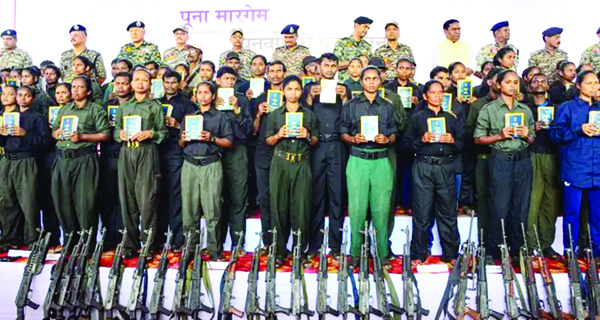
A strategic shift became visible after 2014, when India adopted a calibrated “security plus development” approach. Intelligence-led operations, inter-agency coordination, and technological modernization strengthened counter-insurgency capabilities. Between 2014 and 2026, official data indicates a dramatic contraction in Maoist influence: districts categorized as Left-Wing Extremism-affected reportedly declined from 126 to just two, while the number of “most affected” districts fell from 35 to zero.
Security modernization played a decisive role. The deployment of 400 blast-proof vehicles, construction of 596 fortified police stations, establishment of 68 night-landing helipads, and expanded use of UAV surveillance and satellite-based intelligence significantly enhanced operational reach in remote forested terrain long dominated by insurgents. Leadership attrition through arrests, neutralizations, and surrenders weakened the organizational hierarchy of the CPI (Maoist).
Equally transformative was the integration of development policy into counter-insurgency strategy. Rather than treating development as a post-conflict reward, the Indian state deployed infrastructure expansion as an active stabilization instrument. Over 12,000 kilometres of roads were constructed in remote tribal regions, supported by investments exceeding ₹20,815 crore. Telecommunications expansion included more than 5,000 mobile towers, with 8,000 additional towers planned, ending communication isolation that had historically enabled insurgent dominance. Financial inclusion expanded through 1,804 bank branches, 1,321 ATMs, and over 6,000 post offices, enabling direct benefit transfers and integrating previously excluded populations into formal economic systems.
Rehabilitation policies reflected a mature understanding of insurgency resolution. Surrendered cadres received ₹50,000 immediate assistance, monthly stipends for three years, housing benefits, and educational support for children up to Class XII. Employment loans of ₹2 lakh for women and ₹5 lakh for men aimed to facilitate long-term livelihood transitions. Incentives such as ₹1 crore development grants for Panchayats declared Naxal-free aligned community interests with peacebuilding efforts. Educational expansion through 259 Eklavya Model Residential Schools and new skill development centres addressed structural vulnerabilities that had historically enabled recruitment.
Cultural reintegration initiatives further reinforced normalization. Programmes such as the Bastar Olympics, involving more than 5.5 lakh participants, and regional cultural festivals engaging over 1.2 lakh artists sought to rebuild civic confidence and restore social cohesion. These initiatives symbolized a broader transition, from fear-based control to participatory citizenship.
The sharp decline of Left-Wing Extremism marks a major internal security achievement for India, achieved through a combination of calibrated security operations, democratic participation, welfare expansion, and infrastructure development. Former insurgency-affected regions have witnessed rising electoral engagement, improved connectivity, and growing integration into national economic systems, weakening the appeal of armed revolution. Rather than relying solely on coercive measures, India’s approach demonstrated how constitutional governance and development can gradually erode the social base of insurgency while reaffirming democratic resilience.
As armed Maoist activity receded, debates emerged about the persistence of ideological mobilisation within urban intellectual and cultural spaces, often described in political discourse as “Urban Naxalism.” Urban Naxalism is the ideological extension of Left-Wing Extremism into urban intellectual space, where influence replaces armed struggle as the primary method of mobilisation. Its modus operandi includes shaping narratives through academia, media discourse, cultural activism, legal advocacy, and digital platforms to portray democratic institutions as inherently oppressive through social binaries and identity politics, thereby creating intellectual sympathy for radical resistance. By influencing sections of youth and opinion-makers, such ecosystems normalise revolutionary rhetoric, weaken trust in constitutional processes, and deepen social polarisation without direct violence. The long-term danger lies in the gradual erosion of institutional legitimacy and national cohesion, where ideological radicalisation can indirectly sustain extremism, disrupt social harmony, and obstruct development by fostering alienation rather than democratic engagement.
International post-insurgency experiences demonstrate that security success alone does not guarantee lasting peace. Cases such as Sri Lanka, Nepal, and Colombia show that unresolved grievances, uneven development, or governance deficits can allow instability to re-emerge in new forms. India’s post-conflict phase therefore requires sustained inclusive governance, community participation, protection of tribal rights, environmental balance, and expanded access to education and employment. Long-term stability depends on transforming former conflict zones into regions of opportunity rather than allowing developmental gaps to recreate conditions for renewed mobilisation.
Ultimately, the decline of Naxal violence represents not only the weakening of an armed movement but the broader affirmation of democratic evolution over revolutionary extremism. The central challenge ahead lies in strengthening institutional trust while preserving open debate, academic pluralism, and civil liberties. By promoting civic education, media literacy, and transparent governance, India can ensure that ideological contestation strengthens democratic confidence instead of eroding it. The true measure of success will be the emergence of once-affected regions as enduring symbols of inclusion, stability, and national integration within a vibrant democratic framework.
Dr Sunil Mohanty
(The author holds PhD from School of International Studies, JNU; was Assistant Professor at University of Delhi, and presently, serving as a Northeast Kshetra Prachar Pramukh of Rashtriya Swayamsevak Sangh)
(The content of this article reflects the views of writer and contributor, not necessarily those of the publisher and editor. All disputes are subject to the exclusive jurisdiction of competent courts and forums in Delhi/New Delhi only)



















Leave Your Comment