


The journey of sewage treatment standards and the challenge of treating India’s growing wastewater
Inadequate sanitation facilities result in environmental degradation and public health risks. A survey by the British Medical Journal in 2006 found access to water and sanitation crucial for health and longevity. The UN estimates that for every dollar spent on sanitation, society benefits by $5.5. Access to safe water and sanitation is a fundamental human right. The UN General Assembly declared this in 2009. Sustainable Development Goal 6 aims to halve untreated wastewater and increase recycling by 2030.
Increasing population and urbanisation have led to a significant generation of wastewater in the last few decades in India. By 2035, India will have the second-largest urban population globally.
Current status of sewage treatment in India
India faces a significant unmet need for wastewater treatment, with potential environmental and public health consequences. Rapid urbanisation will increase wastewater generation, requiring substantial government investment.
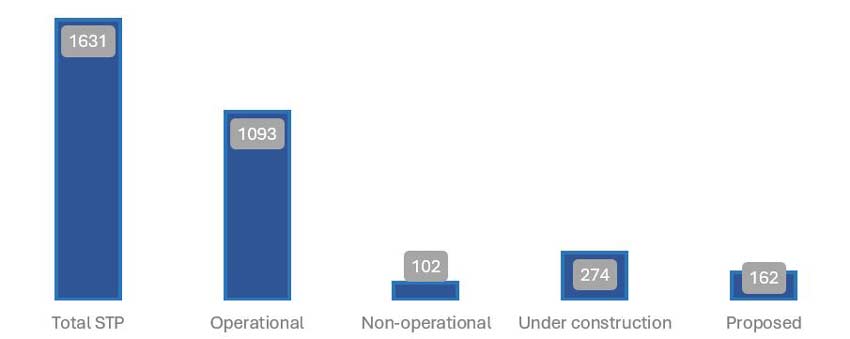
Chart 1: Total number of STPs in India
Chart 2: Sewage generation vs total STP capacity in MLD
Setting up of conventional sewage treatment systems is highly expensive in terms of capital and operational expenditure. Wastewater treatment plants are also highly energy intensive. In addition, both energy consumption and expenses (both fixed and variable) increase exponentially as the effluent standards are made stricter. As per the NSS report in 2018, only about 40 percent of the Indian urban population is connected to a sewage system, and the present budgetary allocation is highly insufficient to ensure universal coverage for a hugely expanding urban population.

Effluent quality norms for wastewater treatment
While an ideal environment would be free of pollution, eliminating all pollution would require sacrificing modern transportation, industry, and traditional cooking practices. This would be impractical for our current civilization. Hence, governments need to legislate discharge standards for air and water which strike a balance between practicability, affordability, public health and environmental needs.
Mandating strict standards can be self-defeating, as it may discourage construction and operation of STPs. This can lead to increased untreated wastewater discharge and environmental risks. Additionally, strict standards may increase opportunities for rent-seeking by residential complexes and private entities.
Given the huge unmet requirement of wastewater treatment, there is an urgent need of feasible and financially viable wastewater treatment systems in India. However, India’s efforts to treat its municipal wastewater is getting hindered due to inconsistencies in the approaches of various government entities, institutional overreach, variations in policy at the state level, and a failure to distinguish between reuse and wastewater discharge.
Meanwhile, National Green Tribunal (NGT) in its order and various State Pollution Control Boards have been mandating expensive tertiary treatment in recent years. Even if governments somehow arrange finance for creating this expensive infrastructure, the justification for spending this huge capital expenditure and operation and maintenance (O&M) costs to meet these stringent standards needs to be debated, as ultimately, the burden of financing these expensive interventions will largely fall on citizens and public resources. Additionally, the greenhouse gas emissions from these advanced wastewater treatment systems may create more problems than they solve (Dongmei et al., 2023; Lambiasia et al., 2024).
Unlike the US and EU, which recommend secondary treatment and permit location-specific stringent standards as exceptions, India is being pushed towards tougher discharge standards. The US and EU have set goals for secondary treatment by 2035 and advanced tertiary treatment by 2045. India, however, struggles to treat 15% of its wastewater to secondary standards.
Evolution of sewage discharge standards across the globe
In addition, conclusive proof regarding linkages between outbreaks of major epidemics like cholera and typhoid and contaminated water was also firmly established at the same time. These developments conclusively proved the linkages between water pollution, major epidemics, and huge loss of human lives.
Alarmed by the increasing pollution in water bodies, the British Parliament legislated the River (Prevention of Pollution) Act in 1876. The Act prohibited any discharge of pollution into the rivers and regulated pollution caused by the dumping of refuse, the discharge or deposit of sewage matter, industrial waste, and mining in the rivers. The Act, however, allowed discharge if the “best means that are practicable”, had been adopted before the discharge into water bodies. It is to be observed that, from the very beginning, environmental legislation was based on the premise of what was "practicable.”
In the beginning, the cities managed their wastewater by discharging sewage over land. Hence, sewage treatment plants are also often called sewage farms. However, dearth of large parcels of land near cities led to waste getting discharged into rivers. Consequently, there were a number of court cases between citizens and the cities regarding deterioration of water quality in rivers. As a result, there was a felt need to fix wastewater effluent standards so that treated wastewater could be legally discharged into the rivers.
The rationale behind dilution is the self-purification abilities of rivers. Rivers can treat themselves if pollution loads are not excessive, but human activities can overwhelm this ability. However, they can also treat themselves if the pollution load is not unmanageable. Similarly, soil can treat wastewater, a process that nature has been performing for millions of years. It’s important to note that “all waste is not waste,” and the presence of some form of nutrients in water bodies is also necessary to support life processes.
Harsh Vardhan is the Chief Executive Officer of CDD India
(https://www.indiawaterportal.org/articles/pollution-solutions)
(The content of this article reflects the views of writers and contributors, not necessarily those of the publisher and editor. All disputes are subject to the exclusive jurisdiction of competent courts and forums in Delhi/New Delhi only)
By Harsh Vardhan, CDD














Leave Your Comment