


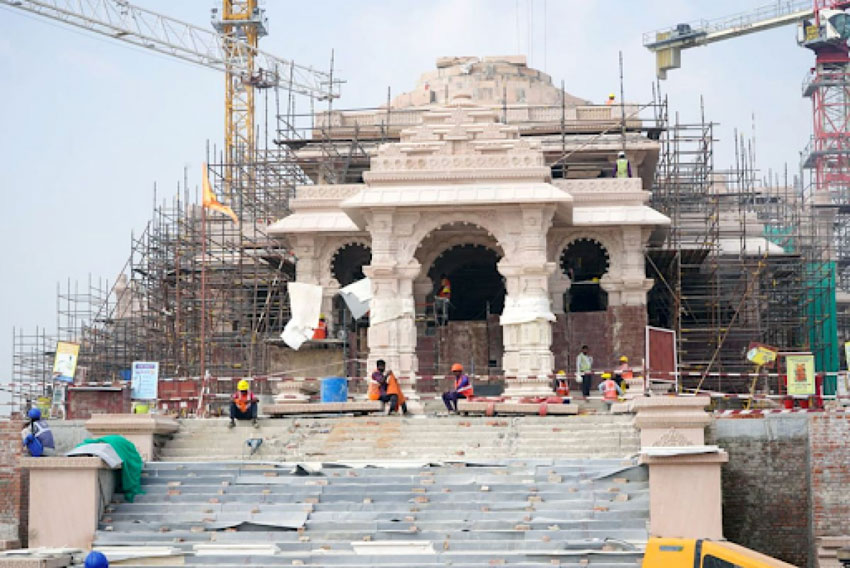
After 550 years of struggle, we will finally have a magnanimous temple in Ayodhya. That temple, which is being built after laying the foundation stones of the lives sacrificed by millions, must be revered by everybody in this country. But alas, this country has gone to dogs. Every other day, one or more INDI alliance leader is making fun of the temple or saying bad things about the temple or the deity Shree Ram. Having an idea different from the government is not a bad thing, but in the process when one start attacking the faith of people and the nation as a whole, then that’s problematic.
Temples are not Just Temples
India's temples are a reflection of its deep religious and spiritual legacy. There are more than two million temples in India, many of which are revered as centres of great faith and miracles that draw pilgrims from all over the world. In this modern era, we Bharatiyas know how to embrace and protect our culture, customs, and Dharma. Temples have never been just that in Bharat. They have served as hubs for trade, social life, education, and the arts throughout antiquity. The community's hub was the nearby temple. Here, people would pray to the Gods and Goddesses for things like health, riches, children, the removal of a particular difficulty, or even the acquisition of something expensive.

Here people gathered, discussed ideas and news, shared experiences and challenges, asked for and gave advice to one another, and made plans for their everyday lives. Every State in the nation possesses unique customs and a rich past, accompanied by a multitude of temples that function as hubs for culture. Rather than religion, dharma has been crucial to the formation of nations, influencing their worldviews and fostering spiritual development. But today, people like Akhilesh Yadav, Tejashvi Yaddav, Swami Prasad Maurya, Sitaram Yechury, and Sam Pitroda are questioning the need for building a temple in Ayodhya. They are making fun of the temple and the deity and say unemployment, hospital, education…blah blah are the issues and not temple.
Ayodhya: Showing the Way
In India, temples are not merely Dharmik locations. India is home to several of the richest temples in the world, drawing millions of visitors annually from all over the globe. The National Sample Survey Office (NSSO) recently released data showing that 55 per cent of Hindu pilgrims stay in mid-sized and small-sized hotels. The daily cost of religious travel is Rs 2,717 per person, the daily cost of social travel is Rs 1,068 per person, and the daily cost of educational travel is Rs 2,286 per person. This translates to Rs 1.316 crores spent per day and Rs 4.74 lakh crores spent annually on religious travel. The temple economy is estimated by that survey to be worth Rs 3.02 lakh crore, or almost $40 billion and 2.32 per cent of the GDP.

This is just a sample data. Now think about this. Preliminary estimates from the Confederation of All India Traders (CAIT) place the economic impact of the Ram Temple opening at over Rs 50,000 crore, which is likely to stimulate local manufacturers and traders.
Ayodhya is poised for a surge in religious tourism in the days and years to come, even as Prime Minister Narendra Modi is busily getting ready to dedicate the Ram temple there on January 22. Numerous travel agencies and lodging providers report a sharp increase in Ayodhya-related internet searches. Over the course of the previous year, they had consistently observed a spike in Ayodhya hotel bookings and searches. In Ayodhya, on New Year's Eve, there was an increase of more than 70 per cent, outpacing even well-known locations like Goa and Nainital.
According to industry insiders with knowledge, several other hotel chains, both large and small, such as Taj, IHCL (a division of the Tata Group), Raddisson, and ITC, are planning to develop several properties in the area at different price points. Midscale and upscale builders are particularly interested in developing in this area. In the past three years, the value of land in Ayodhya has tripled, and residents are profiting from the small number of available land parcels by either holding onto their holdings or charging outrageous prices.
India is witnessing a boom in religious tourism, with a high demand for lodging. This demand was once centred in Southern India, but it has since spread to other areas. This increasing trend is expected to be strengthened and maintained by the building of the Ayodhya temple. Industry insiders predict that by 2024, religious tourism will generate 15 per cent more money annually throughout all of India. While income in 2022 was Rs 1.35 lakh crore, for 2023 it is still being worked out. Enhanced accessibility due to better infrastructure, government initiatives to revitalise and promote more recent spiritual destinations, and enhanced digitization that integrates these locations into regular travel itineraries are some of the factors driving this surge.
Without a doubt, the temple and the economy it supports will have a big impact on India's economy, generating millions of jobs across several industries. This needs to be reinforced in large part by methodical management. Integrating Temple, its administration, and its economy into curricula for higher education would be a prudent course of action. Youths might focus their energies and energy on growing the temple economy and its associated industries.
Spiritual Significance
For centuries, Ayodhya resonated with spiritual significance, its name synonymous with the epic Ramayana and a pilgrimage destination for millions. Today, however, a new narrative is etching itself into the ancient city's story - Ayodhya's meteoric rise as a global investment magnet. What factors are propelling this transformation, and is it merely a fleeting boom or a sustainable trajectory toward economic prosperity?

The catalyst for this shift undoubtedly lies in the historic Supreme Court verdict regarding the Ram Janmabhoomi dispute. The subsequent construction of the grand Ram Mandir has ignited a surge of both religious fervor and economic optimism. Millions of devotees are expected to visit the temple upon completion, fueling a tourism boom with ripple effects across various sectors. The projected 200 million annual visitors would dwarf the numbers recorded by existing popular pilgrimage sites like Tirupati, indicating unprecedented potential.
However, Ayodhya's growth aspirations extend beyond pilgrimage-driven tourism. The Indian government, recognizing the opportunity, has embarked on a multi-pronged strategy to woo global investors. Large-scale infrastructure projects like the redevelopment of the Ayodhya railway station and airport aim to enhance connectivity and accessibility. The planned creation of a "smart city" with a focus on sustainable development adds another layer of attractiveness for investors seeking long-term growth.
Beyond infrastructure, a slew of policy initiatives like tax breaks, simplified procedures, and special economic zones further sweeten the deal for businesses. The state government of Uttar Pradesh, in which Ayodhya is located, has been particularly proactive, aiming to shed its image of bureaucratic hurdles and embrace investor-friendly regulations. This concerted effort to create a conducive environment is resonating with diverse industries.
One of the most significant developments is the influx of defence manufacturing giants. British conglomerate Trafalgar Square Capital's colossal Rs 75,000 crore investments in setting up cutting-edge defence units marks a paradigm shift. This signals Ayodhya's potential as a hub for the burgeoning Indian defence sector, attracting other players and fostering ancillary industries.
Challenges Ahead
Apart from defence, sectors like hospitality, retail, and healthcare are also witnessing growth. Hotel chains are scrambling to secure prime locations, anticipating the tourism boom. Retail giants are setting up shop to cater to the burgeoning consumer base. And with improved healthcare infrastructure and an influx of qualified medical professionals, Ayodhya aspires to become a regional healthcare hub.

However, it's crucial to acknowledge the challenges accompanying this rapid ascent. Skill development needs to be prioritized to ensure local communities reap the benefits of economic growth. Sustainable tourism practices must be implemented to safeguard the city's cultural heritage and ecological balance. Additionally, transparent governance and responsible infrastructure development are vital to avoid pitfalls associated with unplanned urban expansion.
Ultimately, Ayodhya's success as a global investment destination hinges on its ability to strike a delicate balance between preserving its spiritual essence and embracing economic modernization. The city must not lose sight of its core identity while diligently addressing infrastructure, environmental, and social concerns.
Conclusion
In conclusion, Ayodhya's emergence as a global investment destination is not merely a passing fad but a testament to the confluence of religious fervor, proactive government policies, and strategic infrastructure development. By navigating the challenges and prioritizing inclusivity, Ayodhya can transform itself from a pilgrimage town into a thriving economic powerhouse, securing its place as a beacon of prosperity while retaining its spiritual core.

By NILABH KRISHNA
(The content of this article reflects the views of writers and contributors, not necessarily those of the publisher and editor. All disputes are subject to the exclusive jurisdiction of competent courts and forums in Delhi/New Delhi only)














Leave Your Comment