


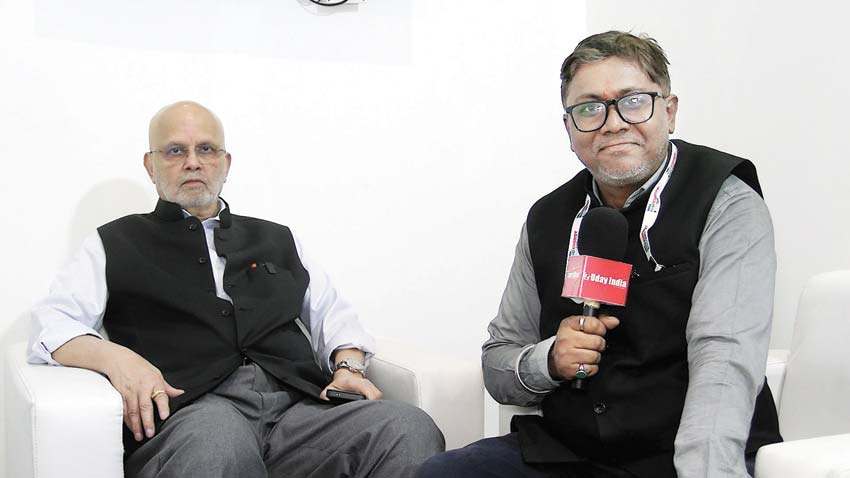
Our visionary Prime Minister, Narendra Modi has set a decisive goal: to take our energy sources from the mines and bring them to the fields. This means converting the carbon from crops in our fields into energy. To accomplish this monumental task, the organization Praj is working on it, and its Executive Chairman, Pramod Chaudhari, is with me, and I, Anshuman Anand, will ask him how he is executing this grand vision set by the Prime Minister. Excerpts of the interview:
The PM has given the vision to bring energy sources from the mines to the fields, and you are working on this. How are you accomplishing such a massive task?
This is a very interesting mission. We are carrying it out in the true national spirit, and our technology is quite successful in this field. So, we are moving the work forward. We have a setup in Pune. There is an R&D centre there. There are many facilities. So, if you ever visit, we will show you and your viewers. Right now, this conference by the IFGE, the Indian Federation of Green Energy, is ongoing. We are a member; I am the President, and it started this morning. This entire program will run for three days. In this, the sources of energy will take many forms.
For instance, for mixing with petrol, there is Ethanol. For blending with diesel, preparations for Bio-diesel are underway. For blending with CNG, there is Bio-CNG, complex biogas. So, in every conventional fuel, we are striving to incorporate this blend. This blending achieves two things: First, its carbon loading is reduced, and second, it is homegrown for farmers. So, the foreign exchange that would otherwise go out will remain here in India. In terms of self-reliance, this is a very important thing. So, in our view, this is a matter of national interest, and indirectly, it also serves the nation.
You are operating in over 100 countries. But an important point is that the technology for creating biofuel needs to become cheaper. You work on the technology itself. What are your plans for this?
Our R&D centre is based on all homegrown technology. We are not importing it from outside, and we are achieving complete self-sufficiency there. There is self-reliance, as I mentioned. And our technology is ready, but the raw material... its cost is significant. We don't grow that; it comes ready-made, and the farmer benefits from it. So, instead of that money going to the Middle East, it is going into our farmers' pockets. Regarding the cost or price, we are trying, but it is not as necessary. There are two key aspects: one is the recycling of carbon, which uses less carbon and results in lower external carbon, and the other is that the money goes into the farmer's pocket. So, by that account, I think this is a very important thing.
Please tell us about Praj's journey, from scratch to the top. How did the journey begin? How can people draw inspiration from you?
That's a good question. I come from a small village, and as far as this connection is concerned, we started it 40 years ago. Now I have become old. But our next generation is working quite hard on this. And regarding my experience, we have been to many places. America, South America, Europe, Africa, Thailand, and Indonesia—practically everywhere we have gone with our technology, and we have made a name for India. So, this is earning a significant name for India. And now, the government has started an organization called the Global Biofuel Alliance from Delhi, through which we will also give this technology to underdeveloped countries and small nations.
Sir, as you mentioned, the journey began 40 years ago, but in the last 11 years, we have seen tremendous acceleration in all this work. What has been the reason for this?
As people become convinced... it's becoming complete. The policy for biofuel came to India 18 years ago. Before that, it existed but wasn't major; it wasn't that big. Some work was done from 2008 to 2018, so that was 10 years. Now, from 2018 to 2025—seven years—its full scope has arrived. And work was already starting abroad as well, so this work is happening everywhere.
My question was, you have business in many countries, and you also have 80% of the market in India. What difference have you noticed between working in foreign countries and working in India over the last 11 years?
When working in foreign countries, you get a little more money, don't you? For Indian customers, there is a special price. There is a specialty. That is the only difference. There's nothing else.
Has red-tapism reduced or not?
Currently, the government has done a lot in that regard. There is efficiency... there is ease now. With Modi Ji's government, work is progressing very quickly. They make a policy, and red-tapism is coming down these days.
EMy precise question for you was this. You have 40 years of experience. What difference do you see in the government system between the previous 29 years and the last 11 years?
That is a very tricky question. A very delicate question. It's not like that, but... but there is definitely a difference. You can see it everywhere now. You see it in Delhi, everywhere, that the nationalist spirit, the homegrown spirit, is given more emphasis. And this government supports new techniques.
Are you satisfied with your journey so far? And what are your future plans?
There are many plans for the future. Right now, we are bringing in aviation fuel. This will be connected to farming; the farmer will be involved. The aircraft that are flying are using fuel that I am producing here. That is a very important feeling. This is happening in many places. And there is also development in diesel. Then there is value addition. We are working on Bitumen. We have developed that. Bioplastic... well, we said many chemicals will be made from it. Because the waste that comes from it, all of that will be replaced by bioplastic.
Plastic is becoming a threat to the entire world. You are inventing bioplastic. Please tell the viewers about it so they can understand how you will control this demon called plastic that is consuming our Earth.
There are two things. Our normal plastic, from petrochemicals, never decomposes; its life continues. And if you look in the ocean, its load in the ocean is significant, in the seas, or it adds to the landfills. But this bioplastic, it will compost and degrade, and it will be made from a renewable source again. So that is good; it's good for everyone.
Biofuel is made from many types of things—from paddy straw, maize, corn, and sugarcane. So, the technology you provide for the conversion of these three, are they different technologies or is it the same technology applied to all?
No, they are different. First, it is made from sugarcane juice. That is different. Then, it is made from grains, which are starchy. And the third is from waste, from agricultural waste. There are three different processes. The technology for each one is different.

So, which is the easiest thing to convert?
Juice (sheera) is easier. Juice contains sugar, so the sugar converts easily. It ferments, so juice is easily converted. Then grains, etc., after that. And then parali (stubble).

By Anshuman Anand














Leave Your Comment