


The Group of 20 (G20) is an intergovernmental forum, founded in 1999, after the Asian financial crisis as a forum for the Finance Ministers and Central Bank Governors to discuss global economic and financial issues, it comprises of 19 countries and the European Union (EU).The EU is a supranational political and economic union of 27 member states mainly located in Europe having a population of about 450 million. The EU is often described as sui generis (unique) political entity having characteristics of both federation and confederation.
G20 works to address major issues related to the global economy, climate change mitigation and sustainable development. It is composed of world’s largest economies including both developed and developing nations, accounting for about 85% of Gross World Product (GWP), 75% of global trade, 60% of global land area and two thirds of global population. The G20 is the latest in the series of post-World War 2 initiatives aimed at international co-ordination of economic policies, including the International Monetary Fund (IMF), World Bank (WB) and the World Trade Organization (WTO). It was upgraded to the level of heads of state/govt.in the wake of the global economic and financial crisis of 2007-2008. After 2008 debut summit in Washington DC, it has convened summits at least once a year, involving each member’s head of the government or state, finance minister or foreign minister and other high-ranking officials. The EU is represented by the European Commission and the European Central Bank (ECB). Other countries, international organizations, nongovernmental organizations are invited to attend the summit. G20 leaders met twice at London and Pittsburgh in 2009 and in Toronto and Seoul in 2010. Since 2011, when France chaired and hosted the G20, the summits have been held once a year. It is a premier forum for international economic co-operation playing an important role in shaping and strengthening global architecture and governance on all economic issues. The summit is held under the leadership of a rotating Presidency. It initially focussed largely on broad macroeconomic issues but extended its agenda to inter include trade, health, agriculture, energy, environment, climate change, sustainable development and anti-corruption issues. The last summit in 2022 was held in Bali, Indonesia.
India took the Presidency from 1st Dec. 2022 to 30th Nov. 2023. This 18th G20 Presidency also marks the beginning of the ‘Amritkaal’, the 25th year period beginning from 75th anniversary of India's independence on 15th Aug 2022, leading up to the centenary of its independence towards a futuristic, prosperous, inclusive and developed nation with human centric approach at its core.
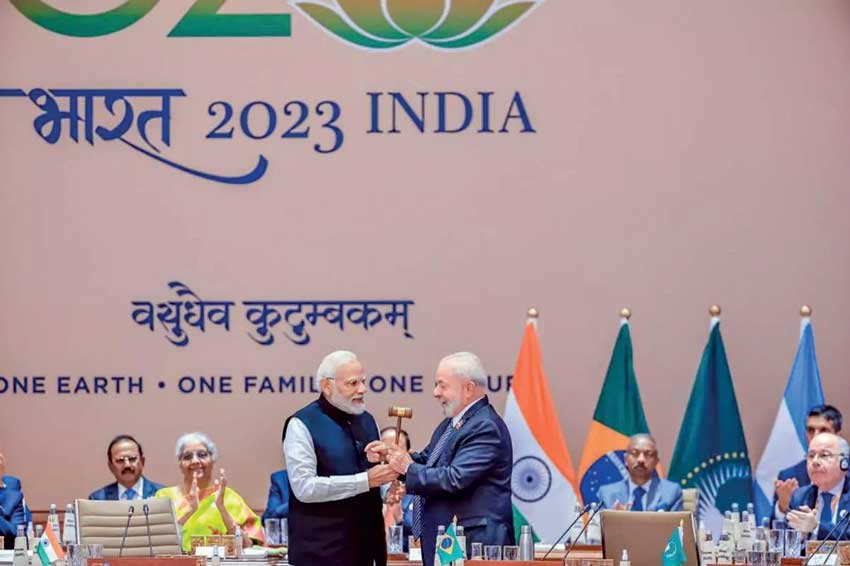
The theme of India’s G20 Presidency is ‘Vasudhaiva Kutumbkam’ meaning ‘One Earth. One Family. One Future,’ drawn from the Maha Upanishad. The theme affirms the value of the life of human, animal, plant and microorganisms, and their interconnectedness on the planet Earth and in the universe. The theme also spotlights LifE (Lifestyle for Environment), with its associated environmentally sustainable choices leading to a cleaner, greener and bluer future. One session was on ‘One Earth’ to discuss the issues related to climate change concerning all the countries and the other was on ‘One Family’ and the issues linked to equitable growth and sustainable growth were discussed.
Its logo draws its inspiration from the colours of India’s national flag (saffron, white, green and blue). It juxtaposes Earth with India’s national flower Lotus, showing the planet atop the lotus symbolizing the growth amid challenges. The Earth reflects India’s pro planet approach to life in perfect harmony with nature. Below the logo is Bharat (in Devnagari script) 2023 India. The group does not have a permanent secretariat. The Presidency is supported by the Troika, comprising of the previous, present and the incoming Presidency. This time the Troika is comprising of Indonesia, India and Brazil. Other than the group members the invitees are Bangladesh, Egypt, Mauritius, Nigeria, Oman, Netherlands, Singapore, Spain and UAE. The invited organizations include the UN, IMF, WB, WHO, WTO, ILO, FSB, ASEAN, ADB, etc. The G20 steers its agenda for one year and hosts the summit. It consists of two parallel tracks namely the Finance Track and the Sherpa Track. The finance ministers and the central bank governors of the member countries lead the finance track. The process from the Sherpa side is co-ordinated by the Sherpas of member countries who are the personal emissaries of the leaders within the two tracks. There are thematically oriented working groups in which the representatives from various ministries of the members as well as from the guest countries and various international organizations participate. These working groups meet regularly throughout the term of Presidency. The Sherpas oversee the negotiations over the course of the year, discussing the agenda items for the summit. In addition, there are engagement groups to bring together civil societies, parliamentarians, thinktanks, women, youth, businesses and researchers of G20 countries. The first (Sherpa) meeting was held from 4th to 7th Dec 2022 in Udaipur and the last on 5th and 6th September 2023 in Delhi before the summit on 9th and 10th September 2023 in New Delhi. The B20 (Business20) summit was held in New Delhi from 25th to 27th Aug 2023 with the theme Responsible, Accelerated, Innovative, Sustainable, Equitable (R.A.I.S.E.) businesses. The venue for the summit is ‘Bharat Mandapam’ constructed at the cost of about Rs 2700 crores. During its Presidency India hosted over 200 meetings across 60 cities in all 28 states and 8 UTs, over 1.5 crore people were involved. Meetings were also held at Srinagar, Tripura, Arunachal Pradesh and Nuh. Over one lakh participants from around 125 nationalities witnessed various parts of India to interact with the people of different regions. The decentralisation of G20 events is actually the democratisation of diplomacy. The entire nation has a sense of participation. No country has hosted G20 on such a large scale. The Russian President Putin skipped the summit and sent his foreign minister, the Chinese President Xi Jinping deputed his PM to attend the summit.
In the inaugural speech of PM Modi, African Union (AU) was inducted unanimously as the permanent member of G20. This indeed became a historic day for Africa and India both and a rich tribute to Mahatma Gandhi. AU is a continental body consisting of 55 countries of Africa, it will increase the voice of the global south in G20. Now onwards the group will be called as G21. Fifteen bilateral meetings also took place including the one between PM Modi and President Biden. PM Modi launched the Global Biofuel Alliance (GBA) along with the leaders of Singapore, Bangladesh, Italy, USA, Brazil, Argentina and UAE, on the sidelines of the summit. The GBA intends to expedite the global uptake of biofuel to reduce carbon-based fuel. The leaders from India, USA, Saudi Arabia, UAE, France, Germany, Italy and UAE unveiled a Memorandum of Understanding (MoU) for India – Middle East – Europe Economic Corridor (IMEC). It is expected to stimulate economic development through enhanced connectivity and economic development between Asia, Gulf countries and Europe. IMEC will be a challenge to China’s Belt and Road Initiative (BRI).
The biggest success of the Indian Presidency is the Delhi Declaration, adopted with consensus. This is a 34-page document having 83 sections, with the Preamble- We are One Earth, One Family and we share One Future. Some of the points mentioned are to work on countering terrorism and money laundering, gender equality and women empowerment, harnessing Artificial Intelligence, digital economy, ending plastic pollution, conserving and protecting ecosystem, quality education, zero tolerance for corruption, sustainable growth, etc. The delegates also visited Raj Ghat to pay homage to Mahatma Gandhi, who showed the world the path of truth and non-violence.
This one-year international event became a mega festival of India and a celebration of diversity by taking it to different parts of the country and entire nation has a sense of participation. India’s relations with the member nations will certainly strengthen. This will improve tourism (already seen in Srinagar), trade, besides creating better infrastructure. Bilateral meetings will see technology transfer and improved flow of FDI to the country. By hosting such huge summit successfully, where all five permanent member countries of UNSC, along with many other heads of the state/govt. participated, has certainly enhanced its stature. The delegates have gone back with a sense of satisfaction and the message of peace and prosperity for all. The good work done by India will be carried forward by Brazil. Indian diplomacy, culture, hospitality and managing China will always be remembered. Our recent success of Chandrayaan3, the nation on way to becoming the third largest economy of the world and the mega success of G20, give us the pride of becoming the global leader.
By Manoj Dubey
Principal (Retd.) Delhi Public Schools
(The content of this article reflects the views of writers and contributors, not necessarily those of the publisher and editor. All disputes are subject to the exclusive jurisdiction of competent courts and forums in Delhi/New Delhi only)


















Comments (4)
D
As usual, Mr Dubey has provided an excellent information about G20, its constituents, its working and its significance. No doubt the joint declaration at New Delhi was a triumph of Indian diplomacy. Elaborate arrangements made at different venues in the country, will, hopefully, help create a positive image of India in the world. But expecting some great outcomes is futile because like so many other international groupings, G20 is also has more symbolic importance than actual.
N
Wonderfully articulated by Shri Manoj Dubey. There is no doubt that the G20 Presidency proved India's strength on the world stage. Despite objections from China and Pakistan, we hosted events in Arunachal and Kashmir. Dubey Ji has covered all aspects of this year long mega event. Unanimous Joint Declaration and inclusion of Global South are the heights. Once again Mr. Dubey at his best.
N
Wonderfully articulated by Shri Manoj Dubey. There is no doubt that the G20 Presidency proved India's strength on the world stage. Despite objections from China and Pakistan, we hosted events in Arunachal and Kashmir. Dubey Ji has covered all aspects of this year long mega event. Unanimous Joint Declaration and inclusion of Global South are the heights. Once again Mr. Dubey at his best.
S
The author put his best efforts in defining the objectives in India it was a great successful event and joint declaration with consensus was the credit of Indian diplomacy