


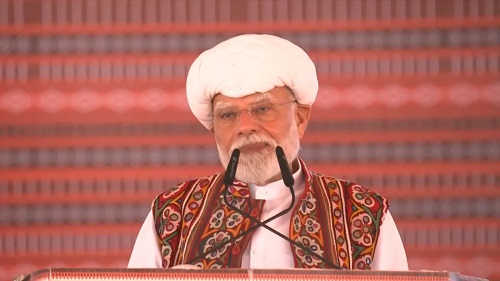
Amid continuing tensions in West Asia and their potential impact on India's economy, Prime Minister Narendra Modi has accused opposition parties of exploiting the international crisis for political gains. Addressing a public gathering in Banaskantha, Gujarat, on Friday, he alleged that instead of standing together during a challenging period, opposition leaders were spreading misinformation about possible shortages of cooking gas and fertilisers to create public anxiety and discredit his government. At the same time, Modi sought to reassure farmers that the Centre was absorbing the impact of rising international fertiliser prices and would not allow global uncertainties to become an additional burden on the agricultural community. His address also highlighted the government's efforts to modernise agriculture through scientific research, technology and climate-resilient farming.
Prime Minister Narendra Modi on Friday launched a sharp attack on the Opposition, accusing it of turning an international crisis into an opportunity for political confrontation. Referring to the ongoing war in Iran and the resulting uncertainty in the Gulf region, he alleged that opposition parties were spreading rumours about shortages of essential commodities, particularly fertilisers and cooking gas, with the intention of creating panic among ordinary citizens.
Addressing a public meeting in Banaskantha, Modi said the country was passing through a difficult international situation that demanded responsibility and collective strength. However, he alleged that certain political leaders were more interested in damaging the government's image than supporting national efforts to manage the crisis. According to the Prime Minister, while millions of Indians were contributing towards the larger ambition of building a developed nation, some political groups appeared uncomfortable with India's achievements and progress.
"They want to defame Modi," was the thrust of his criticism as he accused the Opposition of deliberately circulating misleading information about the availability of essential supplies. He maintained that rumours surrounding fertiliser and cooking gas shortages could unnecessarily frighten people at a time when international developments were already creating uncertainty.
The Prime Minister's remarks reflected the government's concern that geopolitical tensions could influence public sentiment and economic confidence. The conflict involving Iran has raised questions about energy supplies, international trade and the stability of important supply routes. For India, which depends significantly on overseas sources for several energy and industrial requirements, developments in the Gulf region have considerable economic implications. Modi sought to counter public concerns by emphasising that the government was closely monitoring the situation and taking steps to protect domestic consumers and producers.
Farmers protected from global fertiliser price pressures
A significant part of the Prime Minister's address focused on the agricultural community and the government's response to rising international fertiliser prices. He said that despite continuing tensions in the Gulf, the Centre had ensured that increases in global prices did not translate into a corresponding financial burden for Indian farmers.
Recalling his commitment to the farming community, Modi said his government had stood by farmers during difficult circumstances and would continue to protect their interests. He emphasised that agricultural production was essential not only for rural livelihoods but also for the country's food security and economic stability.
The assurance carries particular importance because fertilisers are a major component of agricultural expenditure. Any substantial increase in their prices can affect cultivation costs, especially for small and marginal farmers. By insulating farmers from international price fluctuations, the government aims to maintain affordability and prevent external economic pressures from disrupting domestic agricultural activity.
Modi also underlined that India's approach to agriculture had gradually moved beyond traditional cultivation practices. Over the past 12 years, the government has sought to bring scientific research, modern technology and improved farming methods into agriculture, animal husbandry and dairy production.
Technology and science transforming agriculture
Highlighting the Soil Health Card initiative, the Prime Minister explained how scientific information could help farmers make better decisions about fertiliser application. Traditionally, many farmers relied on experience or conventional practices to determine which fertilisers their fields required and in what quantities. This sometimes resulted in excessive or inappropriate use of agricultural inputs.
The Soil Health Card scheme was introduced to provide farmers with information about the condition and nutrient composition of their soil. Modi said more than 26 crore Soil Health Cards had been issued across the country, helping farmers understand their land's requirements and make more informed decisions.
The initiative, he suggested, represented an important shift towards evidence-based farming. Better knowledge of soil conditions can improve fertiliser efficiency, reduce unnecessary expenditure and contribute to maintaining long-term soil productivity.
The Prime Minister also highlighted the importance of developing agricultural varieties capable of withstanding changing climatic conditions. Irregular rainfall, rising temperatures and unpredictable weather patterns have increased the challenges confronting farmers. To address these concerns, he said nearly 3,000 new seed varieties had been made available to farmers in recent years.
Climate-resilient seeds can help reduce agricultural vulnerability and provide greater protection against weather-related uncertainties. Their availability, combined with scientific farming practices, can strengthen productivity and improve the capacity of farmers to deal with environmental challenges.
Dairy and animal husbandry as pillars of rural growth
Modi also drew attention to animal husbandry and dairy farming, describing them as important contributors to India's rural economy. He particularly acknowledged the role of women, who form a substantial part of the workforce involved in livestock management and dairy-related activities.
He said the government had increasingly focused on introducing scientific methods and technological improvements into this sector. Better livestock breeds, improved animal care and modern dairy practices can increase milk production and enhance the income potential of rural households.
The Prime Minister's emphasis on women in dairy farming also highlighted the sector's potential to strengthen rural economic participation. For many families, dairy activities provide an additional and relatively regular source of income alongside crop cultivation.
The broader message of Modi's address was that India's agricultural future would depend on combining traditional knowledge with scientific innovation, modern infrastructure and technological intervention. Protecting farmers from international price shocks, improving soil management, developing climate-resistant seeds and strengthening dairy production are interconnected elements of this strategy.
His criticism of the Opposition, meanwhile, brought the political dimension of the international crisis into sharp focus. While the government sought to project stability and preparedness, Modi argued that spreading unverified claims during a period of global uncertainty could undermine public confidence.
Ultimately, the Prime Minister used the Banaskantha gathering to deliver two connected messages: India must remain united in the face of international challenges, and the country's development ambitions must be supported by a stronger, scientifically equipped agricultural sector. The challenge ahead will be to ensure that assurances of protection and technological progress translate into tangible benefits for farmers and ordinary households.





















Leave Your Comment