


Ancient Bengal was the site of several Janapadas (Kingdoms), while the earliest cities date back to the Vedic period. A thalassocracy and entrepot of historic Silk Road, ancient Bengal had strong trade links with Persia, Arabia and the Mediterranean particularly known for its lucrative cotton muslin textile. An independent Bengal Sultanate was formed in 1346, ruling the region for two centuries with Islam as the state religion. Following its decline, Bengal came under suzerainty of Mughal Empire, as its wealthiest province and rose to its global prominence in textile manufacturing and shipbuilding. The East India Company took control of the region following the battle of Plassey in 1757 and battle of Buxar in 1764. A hotbed of Indian independence movement through the 20th century, Bengal was partitioned in 1947 along the religious lines into West Bengal-a state of India and East Bengal a part of newly created Pakistan which later became the independent Bangladesh in 1971.
Bengal has produced many eminent personalities including scientists, writers, poets, freedom fighters, film makers, social reformers etc. The state is renowned for figures like Ravindranath Tagore (Nobel laureate, composer of national anthem), Bankim Chandra Chatterjee (composer of the national song), Swami Vivekananda (proponent of Vedanta and Yoga), Amartya Sen (Nobel laurate, economist), Subhash Chandra Bose (Freedom fighter), Satyajeet Ray (Oscar-winning film maker), Ram Mohan Roy (Reformer) among many others. It was also famous for institutions like Shantiniketan, Presidency University, Jadavpur University. Rich in minerals Bengal also boasts a history of theatres, dance, and classical music.
Praffula Chandra Ghosh of the INC was the first Chief Minister of the state in 1947. In 1967, Naxalbari, a village in Bengal, became a site of revolt leading to the Naxalite-Maoist insurgency led by hardliner CPM (Communist Party of India, Marxist) leaders Charu Majumdar and Kanu Sanyal. Naxals are group of far-left radical communists, inspired by Maoist political ideology, they launched widespread violence against landlords, businessmen, police, politicians. In 1971, Indira Gandhi launched operation steeplechase- a large-scale anti-insurgency operation against the Naxals during the President’s rule in which hundreds were killed and over 20,000 imprisoned. But the movement slowly resurfaced and spread to other areas of the country, the region under the influence of Naxals is known as the Red Corridor.
Jyoti Basu was the longest serving Chief Minister of the state from 1977 to 2000, industrialists were reluctant to invest in West Bengal due to the protest culture injected by the CPM. He was succeeded by Buddhadev Bhattacharjee who attempted to promote industry in the state. In 2007, CPM government decided to establish a Special Economic Zone (SEZ) requiring expropriation of 10,000 acres of land owned by farmers in Nandigram. A chemical hub was to be setup by the Salim Group of Indonesia. Farmers led by Mamata Banerjee protested the land acquisition, leading to violence and police firing resulting in several deaths, and the government was forced to cancel the project. Tata Motors proposed to setup an automobile factory in Singur to manufacture a small car ‘Tata Nano’, scheduled to be rolled out in 2008. The state government allocated 997 acres of farmland for this project. This too was opposed by the farmers and their agitation was supported by Mamata Banerjee and Tata finally decided to shift Tata Nano plant to Sanand, Gujarat. In the 2011 assembly elections, the left front lost power after 34 years. Mamta Banerjee successfully influenced the voters through these violent protests and her slogan ‘Ma, Mati, Manush’ helped her to become the Chief Minister of West Bengal, and she continues in the office till date. Incidents like the one at Sandeshkhali, where Shahjahan Sheikh and his cohorts accused of land grabbing and sexual harassment were protected by the police and the TMC workers, highlight the ongoing issues in the state.
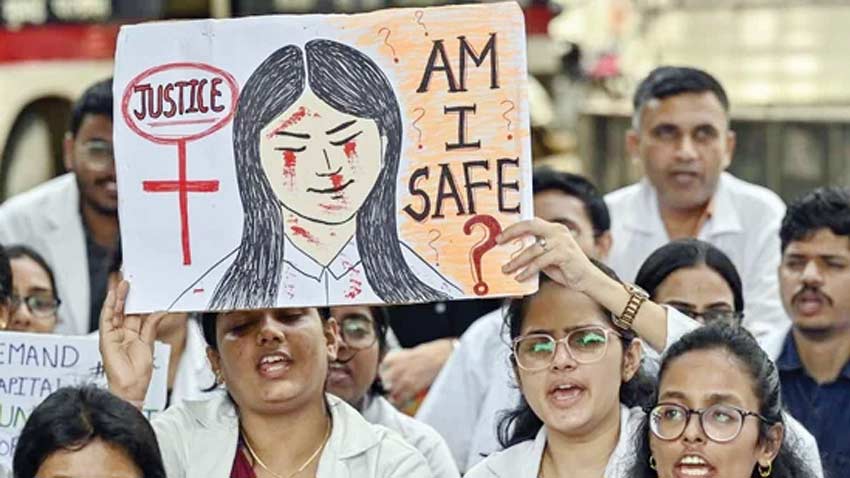
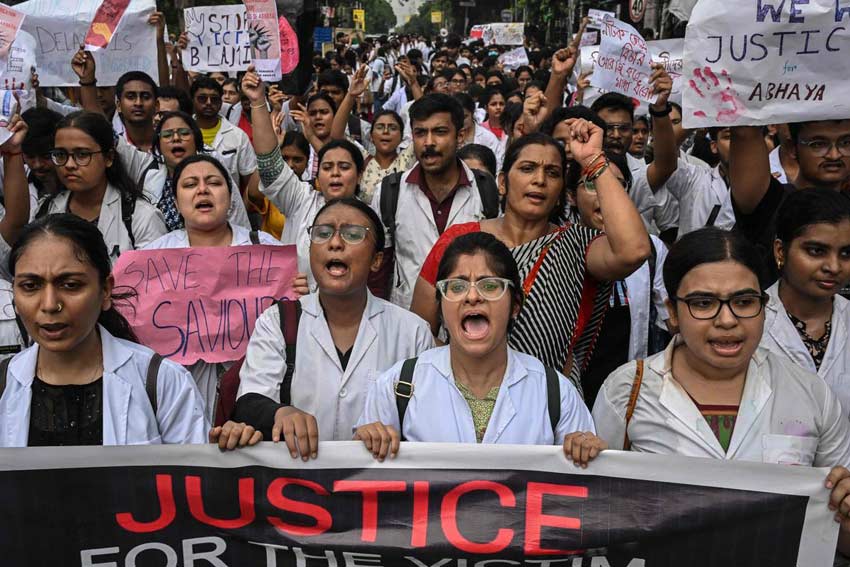
The brutal rape and murder of 31-year-old PG trainee doctor at the seminar room of RG Kar Medical College and Hospital in Calcutta on August 9 sent shockwaves across the nation, igniting widespread protests and bringing to light serious concerns about safety within medical institutions. The body was discovered by a trainee doctor at 9.30 am, police reached the crime scene at 10.10 am but the FIR was lodged at 11.45 pm. Her family was initially informed that by the hospital that she had committed suicide and were made to wait for three hours to see the dead body. The incident has raised troubling questions about institutional negligence, possible evidence tempering and the role of law enforcement. The police arrested the key suspect, Sanjay Roy, a 33-year-old civic volunteer and the Calcutta High Court transferred the case to the CBI. Dr Sandeep Ghosh, the former Principal of the college tendered his resignation, but surprisingly was reinstated as Principal of another government medical college within 24 hours. On the night of August 14, a mob breached the RG Kar Medical College and vandalised the hospital property (an attempt to destroy the evidence). The Supreme Court has taken suo motu cognizance of the case and called it a ‘Horrendous Act’. The CBI has initiated the probe and the truth will emerge. The politicization of the police force is the key reason for the prevailing lawlessness. This began during the Left’s rule and the circle got completed in the TMC rule. If the police administration is allowed to work freely, violence can be controlled. Mamata Banerjee walked on the streets of Calcutta demanding death penalty to the perpetrators of the crime. This is pure politics, as she is the Health Minister, Home Minister and the Chief Minister. It is her responsibility that the police and the hospital staff co-operate in the investigation. She must apprise the nation of the steps being taken to ensure that such heinous crimes are not committed. Moreover, as a society, we need to learn to respect women.
Bengal was once a hub of revolutionary activities during the pre-independence period, with violence during the partition followed by Naxal movement. The turf of war between the Congress and Communists was bloody and widespread. The Left did implement progressive land reforms and enjoyed mass support, it also relied on coercion and violence.
West Bengal, once celebrated for its cultural heritage, eminent educational centres, and brilliant minds, has tragically slid into mediocrity due to misrule of Left and TMC. Gopal Krishna Gokhale once said : “What Bengal thinks today, India thinks tomorrow” and it seems to have become irrelevant today.
By Manoj Dubey
Principal (Retd.)
Delhi Public Schools
(The content of this article reflects the views of writers and contributors, not necessarily those of the publisher and editor. All disputes are subject to the exclusive jurisdiction of competent courts and forums in Delhi/New Delhi only)














Leave Your Comment