


Indian corporate sector has come a full circle! When India got freedom, the Indian corporate world was deeply engaged in building defence capabilities. Both Homi Jehangir Bhabha and Vikram Sarabhai were scientists from elite, industrial families, and they leveraged private philanthropy + national vision to build institutions that later became pillars of India’s strategic and scientific capabilities in space and atomic energy.
Industrialists like Jamsetji Tata and scientists such as Vikram Sarabhai had long recognised that India’s independence would remain incomplete without scientific and technological strength. Their vision went beyond industrial growth alone—they understood that true nation-building required strong research institutions capable of driving innovation and self-reliance.
This idea found one of its earliest expressions in the establishment of the Indian Institute of Science, a landmark institution inspired by the intellectual influence of Swami Vivekananda. The project was made possible through the philanthropic support of Tata, the patronage of the Maharaja of Mysore who donated land, and the crucial liaison efforts of Sister Nivedita, who helped secure British approval during colonial rule.
What emerges from this collaboration is a remarkable convergence of diverse forces—a spiritual thinker, an industrial visionary, a princely patron, and a foreign disciple united by a shared belief in a modern India rooted in science, research, and technological advancement. This early ecosystem of cooperation laid the intellectual and institutional foundation for India’s later strides in strategic and defence capabilities.
The motivations of the Tata and Sarabhai families were a mix of nationalism, philanthropy, and long-term strategic thinking.
The early decades of independent India were strongly influenced by socialist thinking, which prioritised a dominant public sector and led to the evolution of the Licence Raj. In this framework, private industrialists and erstwhile princely states were largely excluded from core areas of strategic and industrial development. This resulted in a limited role for collaborative ecosystems involving state, industry, and research institutions, thereby constraining innovation and slowing the pace of industrial growth. Over time, this excessive reliance on state-led production also affected India’s ability to maintain the momentum it had inherited in certain manufacturing domains during the colonial period, including defence-related production capacities. Research and development cycles became slower, often struggling to meet technological timelines required for modernisation.
These structural weaknesses became evident during crises such as the 1965 war, when India faced acute shortages of critical defence spares due to supply disruptions from countries like the United Kingdom and the United States. The experience highlighted the risks of external dependence in strategic sectors and underscored the need for a more integrated model of development involving both public institutions and private enterprise. In hindsight, the lack of early collaboration between the state and indigenous industry delayed the emergence of a robust defence industrial base and constrained India’s technological self-reliance during a critical phase of nation-building.
India’s approach to industry, innovation, and defence production changed in two major phases—post-1991 economic reforms and a deeper push post-2014 strategic reforms. Together, they mark a shift from a state-dominated system to a more open, innovation-driven, and security-conscious model.
The recent escalation in the US–Iran conflict and disruptions around critical maritime chokepoints such as the Strait of Hormuz have exposed how deeply India’s economic and strategic security is tied to fragile global supply chains. Rising energy risks, shipping uncertainties, and potential defence supply disruptions underline the urgency of reducing external dependence. In this context, India’s corporate sector is increasingly moving beyond traditional assembly-based manufacturing toward higher-value innovation in defence production.
Companies such as Tata Advanced Systems and Larsen & Toubro are gradually integrating into aerospace, naval systems, and missile components, while startups supported through initiatives like ‘iDEX’ are contributing to emerging domains such as drones, AI-based surveillance, and electronic warfare. This shift signals the early contours of a domestic defence industrial ecosystem aligned with the goal of strategic autonomy. However, significant constraints remain, including limited access to critical technologies, dependence on imports for high-end systems, and weak R&D intensity compared to global defence leaders. The post-conflict geopolitical environment therefore acts both as a stress test and an opportunity: it highlights vulnerabilities while accelerating the push for self-reliance. Ultimately, corporate India’s ability to move from low-end manufacturing to deep innovation will determine whether India can truly transition from “assembly dependence” to meaningful defence autonomy.
While it is a pleasant news but it is spoiling the Indian corporates to handle defence sector. Let’s examine;
Most Indian corporates still approach defence procurement like a routine tendering exercise—driven by the logic of lowest cost, minimum risk, and maximum compliance. It is a mindset shaped for efficiency in sectors like FMCG or infrastructure, where predictability matters more than strategic consequence. But in defence, that approach begins to show its limits. National security cannot be treated as a cost-optimisation problem, nor can it be reduced to managing contracts, even when systems feel rigid or misaligned with intent.
At the same time, there are early signals of change. As already mentioned above, Groups like the Tata Advanced Systems and Larsen & Toubro have begun moving beyond assembly roles into more complex domains such as aerospace structures, naval systems, and integrated platforms. These efforts demonstrate a critical truth: India has the industrial base to build serious defence capability. However, capability does not emerge from assembling imported kits or executing subcontracted work. It comes from owning core technologies, investing in design, and building long-term innovation ecosystems.
Policy frameworks like “Make in India” have already opened the doors. The constraint is no longer regulatory—it is behavioural. Defence thinking still needs a shift from transactional execution to strategic vision. A more mature industrial mindset would treat defence not as a procurement opportunity, but as a long-term national capability-building mission; not as a cost centre, but as a platform for innovation and technological sovereignty.
The uncomfortable reality remains clear: continued dependence on imported engines, sensors, and critical systems means India is not fully building defence capacity—it is effectively renting it. And sovereignty built on rented foundations is inherently fragile.
Institutions like the Defence Research and Development Organisation cannot shoulder this transformation alone. They require the speed, scale, and execution discipline of the private sector.
Despite India's ambitious "Atmanirbhar Bharat" (Self-Reliant India) push, high-end defence manufacturing remains a difficult sector for private players to break into.
Private players entering defence face a harsh reality: a sector still dominated by government bodies like Defence Research and Development Organisation and DPSUs, where contracts often bypass open competition.
Long, complex procurement cycles delay decisions and drain investor confidence.
Uncertain and irregular orders make large investments risky and unpredictable.
High capital needs and long gestation periods deter both firms and financiers.
Weak R&D support and limited technology access force dependence on foreign OEMs.
Skill gaps and inadequate infrastructure further restrict capability building.
To fix this, the government must ensure fair competition, faster procurement, and assured demand visibility.
Equally critical are stronger R&D funding, easier regulations, and policies that shift the role of the state from controller to enabler.
Replicate the IT-sector transformation of the 1990s—start small, scale rapidly, and compete globally. The decisive shift will come not when India manufactures more defence products, but when it begins exporting defence technology.
Until then, India risks remaining a large buyer in global defence markets rather than a decisive player shaping them.
The question for industry leadership is therefore simple, but uncomfortable: are we willing to invest in areas where returns are slow, but the strategic impact is irreversible?
A young student builds a drone—not in a lab with massive funding, not inside a large organization, but driven by curiosity, intent, and the courage to try—and eventually finds his way to the Defence Research and Development Organisation. Pause and think about what this really tells us. Innovation in defence is not a resource problem; it is a mindset problem. Large corporates have budgets, teams, and global exposure, yet many hesitate. They wait for perfect clarity, policy stability, and guaranteed returns, while a student simply builds. That is the difference. The “Desi Manager” lesson here is straightforward: start before you are ready, build before you are certain, and learn faster than you plan, because in sectors like defence, the speed of learning matters more than the size of investment. Imagine if corporates absorbed this mindset—replacing five-year discussions with six-month prototypes, swapping risk avoidance for calculated experimentation, and instead of asking “Will this project be profitable?” asking “Will this capability matter in the next 10 years?” India does not lack talent; it lacks platforms that trust talent early. The student found his way—the question is whether corporates will find theirs.
If Indian Corporates Want Defence Capability, Start on Campus: Fund the Idea Before the World Funds the Outcome
We keep discussing billion-dollar defence deals, but innovation rarely begins there—it often starts quietly in a college lab, where a student builds a prototype, a professor refines the idea, and for a brief moment, possibility feels tangible. And then, more often than not, it dies—not because it lacked potential, but because it lacked backing. This is where Indian corporates are missing the plot. Instead of waiting for finished, de-risked products, why not invest when ideas are still fragile, when they need belief more than validation? Partner with institutions, fund incubation hubs, adopt research projects—give wings before asking for results. A deeper collaboration with organizations like Defence Research and Development Organisation could create a powerful triangle: academia driving innovation, corporates enabling scale, and strategic bodies providing direction. That is how real ecosystems are built—not through late-stage acquisition, but through early-stage conviction. A “Desi Manager” would not ask, “Is this idea proven?” but rather, “Can this idea become decisive?” because in defence, early bets often define future dominance. If IT companies could justify building sprawling campuses to hire talent, why can’t defence-focused corporates build ecosystems to create it? The next breakthrough in drones, AI systems, or surveillance technology may already exist in a student’s mind today. The real question is not whether the talent exists—it is who will recognize it, fund it, and back it before the rest of the world catches on.
India’s defence sector stands at a decisive inflection point. Private industry is no longer an auxiliary—it is ready, capable, and willing to build at scale. If India seeks true strategic autonomy, it must recognize corporates as equal partners alongside institutions like the Defence Research and Development Organisation. At the same time, private players must rise to meet national expectations with accountability, innovation, and execution.
The numbers reinforce this shift. India’s defence budget has crossed ₹6.2 lakh crore (FY 2024–25), making it one of the largest in the world, with over 75% of the capital procurement budget earmarked for domestic industry. Defence production has already surpassed ₹1.25 lakh crore annually, with a target of ₹3 lakh crore by 2029. Exports—once negligible—have grown to over ₹21,000 crore, reaching more than 85 countries. The private sector now contributes roughly 20–25% of total defence production, a share that is steadily rising.
This transition calls for faster decision-making, transparent processes, and the confidence to back Indian companies early—before outcomes are certain. It requires a shift from hesitation to intent, and from control to collaboration. In defence, those who invest in capability ahead of the curve don’t just compete—they lead.
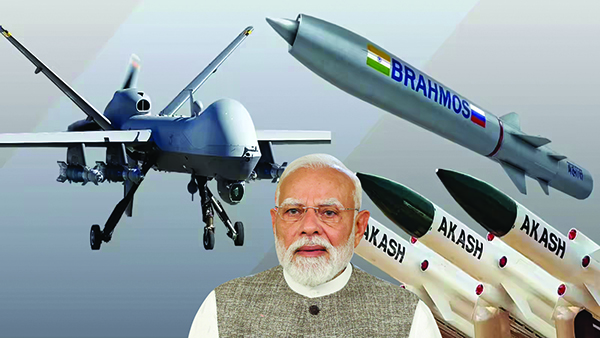
The moment is here. The success of Operation SINDOOR has created fresh momentum and demand for Indian missile systems. Now, the focus must turn to scaling capacity, strengthening quality, and building global credibility.
India has the talent, the ideas, and the urgency. The real question is whether it has the conviction to act boldly. If it does, the sector won’t just expand—it will redefine India’s role in the global defence landscape.

Rakesh Kumar
(The content of this article reflects the views of writer and contributor, not necessarily those of the publisher and editor. All disputes are subject to the exclusive jurisdiction of competent courts and forums in Delhi/New Delhi only)
















_copy.jpg)


Leave Your Comment