



MANOJ DUBEY
The culture of “freebies” in Indian politics refers to political parties promising or distributing goods, subsidies, cash assistance, or free public services to attract voters. Over the decades, freebies have evolved from welfare-oriented support for the poor into a major electoral strategy used by almost all political parties across India. The roots of this culture trace back to the early decades after Independence. During the 1950s and 1960s, governments focused mainly on welfare schemes aimed at reducing poverty and inequality. Subsidised food grains through the Public Distribution System (PDS), free or low-cost education, irrigation support for farmers, and rural employment initiatives were considered part of the state’s social responsibility rather than political giveaways. These measures were largely developmental and aimed at nation-building.
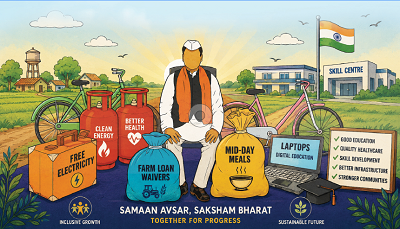
The modern culture of political freebies took shape strongly in Tamil Nadu during the late 1960s and 1970s. Dravidian parties such as the DMK and later the AIADMK pioneered populist electoral promises. In 1967, subsidised rice schemes became highly popular among voters. In the 1980s, leaders like M. G. Ramachandran introduced the Mid-Day Meal Scheme, which significantly improved school attendance among poor children. Although politically beneficial, it also had positive social outcomes. By the 1990s and 2000s, the nature of freebies expanded considerably. Political parties began promising consumer goods such as televisions, mixers, grinders, bicycles, laptops, and even gold for marriage assistance. Tamil Nadu again became the most visible example of competitive populism. Other states gradually adopted similar practices. In many states, promises of free electricity, farm loan waivers, free transport for women, and cash transfer schemes became common.
The rise of coalition politics and intense electoral competition after the 1990s further accelerated the culture of freebies. Political parties increasingly targeted specific social groups, including farmers, women, students, unemployed youth, and economically weaker sections. Welfare politics became closely linked to vote-bank politics. Schemes such as farm loan waivers gained prominence after the 2008 agricultural debt waiver announced by the central government. In recent years, the debate over freebies has intensified. Supporters argue that many so-called freebies are essential welfare measures in a country where large sections of the population still struggle with poverty, unemployment, and social inequality. Free education, healthcare, food security, and targeted subsidies can improve human development and provide economic relief to vulnerable citizens.
However, excessive freebies strain state budgets and foster dependency rather than productivity. Economists warn that unchecked populist spending may widen fiscal deficits and reduce investment in infrastructure, industry, and long-term development. Concerns have also been raised about political parties making unrealistic promises without considering economic sustainability.
The issue gained national attention when the Supreme Court of India examined the impact of freebies on public finances and electoral fairness. The debate now centres on distinguishing between legitimate welfare schemes and politically motivated handouts. Today, the freebies culture is deeply embedded in Indian electoral politics. While welfare measures remain necessary in a developing nation, balancing social justice with fiscal discipline remains one of India’s biggest democratic and economic challenges.
Impact on the Economy
The culture of freebies has a major influence on election results in India. Political parties often use promises of free goods, subsidies, cash transfers, loan waivers, free electricity, and welfare schemes to attract voters, especially among the economically weaker sections. In a country where poverty, unemployment, and income inequality remain significant challenges, such promises can strongly influence voter behaviour. Freebies help parties build direct emotional and economic connections with voters. Beneficiaries of welfare schemes often view governments positively and may reward them with electoral support. Women, farmers, students, senior citizens, and low-income households are frequently targeted through specialised schemes. In many states, welfare-based politics has helped ruling parties retain power or opposition parties gain support.
Competitive populism has also intensified during elections. Parties try to outbid each other by announcing larger benefits, creating what many experts call a “freebie race.” This shifts political campaigns away from debates on governance, economic reforms, employment generation, and infrastructure development towards short-term electoral promises. However, freebies alone do not guarantee victory. Factors such as leadership, caste equations, regional identity, nationalism, governance performance, and public trust also influence election outcomes. In some cases, voters support welfare schemes that directly improve their lives, while rejecting promises seen as unrealistic or financially irresponsible. Thus, freebies have become an important but not the sole factor in determining Indian election results.
Unfulfilled Promises
Several Indian states have struggled to fully implement or sustain populist promises due to financial constraints, administrative challenges, or shifting political priorities. While many welfare schemes are launched with strong publicity, some states struggle to deliver them fully.
Punjab has often faced criticism for fiscal stress stemming from promises such as free electricity, loan waivers, and unemployment allowances. Rising debt and limited revenue have made it difficult to fulfil all commitments effectively. In Andhra Pradesh, large welfare programmes and cash transfer schemes have increased financial pressure on the state budget. Despite implementing many schemes, concerns have repeatedly emerged over mounting debt and delayed payments in some sectors. Questions have been raised about balancing welfare spending with infrastructure and development needs. Similarly, Karnataka, Rajasthan and Himachal Pradesh have faced financial difficulties while attempting to implement expensive welfare commitments. Limited tax revenue and growing public debt have restricted their ability to fully fulfil some promises.
Even economically stronger states sometimes struggle with implementation gaps. In Tamil Nadu, known for welfare politics, some subsidy schemes have faced delays or financial strain. The present TVK government, headed by Vijay, has made promises that are looking difficult to implement. These examples show that while populist promises may help during elections, fulfilling them sustainably requires strong economic growth, efficient governance, and careful fiscal management.

Current Global Crisis
The present global energy crisis has made it increasingly difficult for governments to sustain large-scale populist welfare and subsidy schemes. Rising international prices of crude oil, natural gas, and coal have significantly increased the financial burden on governments, especially in developing countries like India that depend heavily on energy imports. Free or highly subsidised electricity schemes have become particularly challenging. State governments already face major losses in power distribution companies due to unpaid subsidies, transmission losses, and rising fuel costs. As global energy prices rise, governments must spend even more to maintain cheap electricity for households, farmers, and industries. This places heavy pressure on state budgets and widens fiscal deficits.
At the same time, governments must invest in infrastructure, renewable energy, defence, healthcare, and employment generation. Excessive spending on short-term populist schemes may reduce funds available for long-term economic growth and energy security. Economists warn that continuous subsidies without sufficient revenue to cover them can increase public debt and weaken financial stability. However, completely removing welfare schemes is difficult because millions of poor citizens depend on them. Therefore, governments are increasingly shifting from universal freebies to targeted welfare programmes for the genuinely needy. Improving energy efficiency, expanding renewable energy, and strengthening economic growth are essential for sustaining welfare policies in the long run while maintaining fiscal discipline amid global energy uncertainties.
India’s Approach
India has handled the global energy crisis more effectively than many developing and even some developed countries, largely due to its diversified energy strategy, discounted oil imports, and rapid expansion of renewable energy. Unlike several European nations that faced severe gas shortages and inflation after the Russia-Ukraine conflict, India managed to maintain relatively stable fuel supplies and moderate economic growth. One major reason is India’s pragmatic oil-import policy. India increased imports of discounted Russian crude oil while maintaining supplies from the Middle East, the United States, and Africa. This helped control fuel prices and protect industries from major shocks. In contrast, many European countries faced high energy costs after reducing dependence on Russian energy.
India has also accelerated investment in renewable energy, particularly solar and wind power. Reports indicate that India added record levels of clean energy capacity in recent years, reducing dependence on fossil fuels and slowing the growth of carbon emissions. Countries that invested heavily in renewables have generally handled the crisis better.
India currently imports crude oil from around 40 countries and gas from 10 countries worldwide, making its energy supply system one of the most diversified among major economies. Qatar remains the largest gas supplier to India.
Compared to many countries, India’s approach has been more balanced and flexible, combining energy security, economic stability, and renewable energy expansion while avoiding extreme supply disruptions.
Conclusion
India spends a substantial amount of foreign currency every year on imports of essential commodities such as crude oil, gas, gold, and edible oils. These imports are among the biggest contributors to India’s trade deficit. The approximate expenditure for 2025-26 is $ 160 billion for crude oil and petroleum products, $80 billion for gold and silver, and $20 billion for edible oils. Because of the war in the Gulf region, crude oil prices have risen by 50% over the last two and a half months. India imports nearly 90% of its crude oil and 60% of its gas requirements. Supply from the Gulf has almost stopped, and the situation remains uncertain. Rising global oil prices, geopolitical tensions, and sanctions-related pressures continue to pose risks. The major problem is the blockade of the Hormuz Strait by America and Iran; through this route, India imports about half of its oil and gas. India is one of the world’s largest importers of gold, mainly due to strong cultural, religious, and investment demand. Gold plays an important role in Indian weddings, festivals, savings, and jewellery markets. India imports around 700–900 tonnes of gold annually, depending on international prices and domestic demand. India is one of the world’s largest importers of edible oils (palm, soybean, and sunflower) and remains heavily dependent on foreign supplies to meet domestic demand. The country imports nearly half of its edible oil requirements because domestic production is insufficient to meet consumption needs.
Prime Minister Modi has recently urged a reduction in the consumption of petroleum products, gold, and edible oil to conserve foreign currency. The central government and some state governments have begun implementing these austerity measures. This is not the first time the Prime Minister of India has made such an appeal. During the severe food crisis and the 1965 war with Pakistan, Prime Minister Shastri urged citizens to voluntarily skip one meal a week to conserve food. In 2013, Prime Minister Manmohan Singh also urged a reduction in the consumption of petroleum products and gold. In 2015, Prime Minister Modi launched the “Give It Up” campaign, appealing to economically well-off citizens to voluntarily surrender their LPG subsidy. Millions of consumers responded positively to his appeal. Such appeals are in the national interest.
In the current global energy crisis, governments should continue only targeted, economically sustainable welfare schemes rather than excessive freebies. Essential support, such as food security, healthcare, education, and assistance for poor households, remains necessary to protect vulnerable citizens from inflation and rising energy costs. However, large-scale populist subsidies, such as free electricity, loan waivers, and non-essential giveaways, can severely strain public finances during periods of global uncertainty. Governments must balance welfare with fiscal discipline by focusing on job creation, infrastructure, renewable energy, and economic growth. Welfare oriented towards sustainable development is beneficial, but politically motivated freebies may weaken long-term economic stability and energy security.
(The content of this article reflects the views of writer and contributor, not necessarily those of the publisher and editor. All disputes are subject to the exclusive jurisdiction of competent courts and forums in Delhi/New Delhi only)




















Comments (5)
M
Great article with all information and agree this free culture will be dangerous for Indian economy
b
Very well written article. It comprehensively covers all the finer details , from the history of Free bees to the current energy crisis.
S
वैश्विक ऊर्जा संकट का भारतीय अर्थव्यवस्था पर बहुआयामी प्रभाव पड़ता है क्योंकि भारत अपनी ऊर्जा आवश्यकताओं (विशेषकर कच्चे तेल) के लिए आयात पर अत्यधिक निर्भर है। इससे आयात बिल बढ़ता है, मुद्रास्फीति (महंगाई) को बढ़ावा मिलता है, चालू खाता घाटा (CAD) बढ़ता है और नवीकरण ऊर्जा (Energy Transition)की ओर संक्रमण की गति प्रभावित होती है। भारत सरकार द्वारा उठाए गए रणनीति भंडार (Strategic Petroleum Reserves), अंतरराष्ट्रीय सहयोग (मध्य-पूर्व देशों के के साथ दीर्घकालिक और रणनीतिक समझौते) सराहनीय है। लेखक का विश्लेषण प्रभावशाली है।
N
This thought-provoking article provides a timely and incisive analysis of how competitive political populism inadvertently strains India's fiscal health and critical capital expenditure. By masterfully linking domestic spending patterns with global economic and energy pressures, it serves as an urgent, balanced call for sustainable governance and long-term structural development. A perfect academic work.
S
Good Well written