


The war in Ukraine has shown how technology has changed the battlefield. The combined might of the reconnaissance-strike complex has paralyzed both sides by causing immense attrition of men and hardware. It is turning out to be an industrial scale warfare of men, platforms and explosives and the side that demonstrates greater resilience is likely to win.
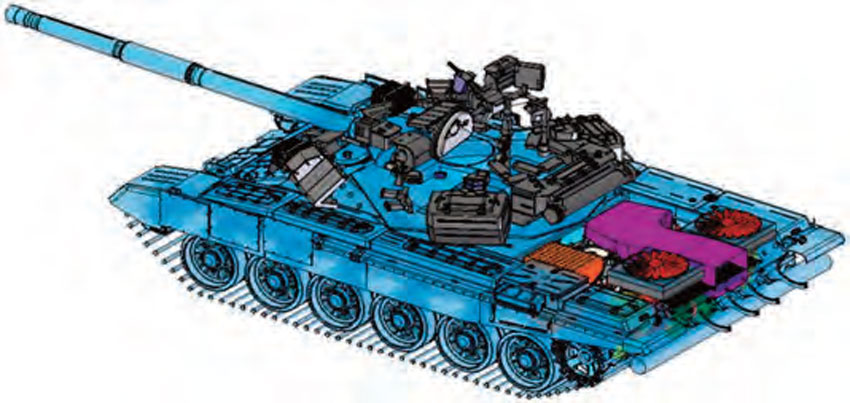
The MoD issued an ‘approval in principle’ to proceed with its Future Ready Combat Vehicle (FRCV) project on 27 April. A questionnaire was dispatched to the industry, with responses due by 31 May. The feedback from industry is to provide inputs on technologies that can be supplied by Indian companies. The FRCV is to be procured under the ‘Make in India’ category. The current AON is for 590 tanks.
The proposed combat weight is around 55t ±5%.Besides generic technologies many unique requirements like a digitized data backbone, software-defined radios, network-enablement, integrated battlefield management system, 360° see-through awareness system, a human-machine interface and ability to employ loitering munitions are sought. A 120mm or higher calibre missile capable main gun is specified. The FRCV is to be propelled by a 1500 hp engine. It is to have a minimum 50% indigenous content.
The FRCV is “to act as a multiple weapon platform, along with infusion of niche technology, to cater for future capability requirements and enhance overall operational effectiveness index of the Indian Army by catering for emerging threats in varied terrain. It should enable execution of operations across the entire continuum of conflict against diverse threat and equipment profile of the adversaries”. A kind of an omnipotent platform — a super weapon. To maintain strategic readiness and military effectiveness, it is essential that a locally evolved, upgradeable (software and hardware) platform is developed that can be supported till the end of this century.
The Future of Tank
The war in Ukraine has shown how technology has changed the battlefield. The combined might of the reconnaissance-strike complex has paralyzed both sides by causing immense attrition of men and hardware. It is turning out to be an industrial scale warfare of men, platforms and explosives and the side that demonstrates greater resilience is likely to win. The predominance of mass has been reinforced. Technology has made munitions disproportionately effective impacting survivability of tanks. However, when one looks at how combat has proceeded in Ukraine, tanks have been very important in enabling control of territory. One will continue to need tanks to pierce well defended front lines as well as to allow infantry to use it for cover or indirect fires. One can foresee tanks being employed possibly till end of this century, paired alongside autonomous and robotic platforms, to enhance mission effectiveness.
Avoiding the Technology Trap
It is critical that the mad rush to incorporate every conceivable feature in the FRCV as evident from the brief of project is avoided, else it could become an illusion. A sensible approach will be to link its development to capability gaps noticed during deployments, likely countermeasures from the adversary and affordability. One needs to draw lessons from the US experience during development of the ground combat vehicle (GCV), designated as the next generation armoured vehicle. In pursuit of all encompassing survivability and hi tech attributes, the weight of GCV shot up to 80 tons and cost over 10 million dollars. The project had to be jettisoned on grounds of affordability, in favour of upgrading Bradley, Abrams, Stryker.
Merely arming the platform with fancy technology suites, developed using COTs items, could be counterproductive, as these could be rendered ineffective by a technologically superior adversary. An important aspect of the current war in Ukraine has been the effectiveness of electronic warfare in diminishing the impact of sensors, networks and precision munitions; 3 pillars of present day combat. Beams have been able to deflect Excalibur rounds, GMLRS rockets, JDAM-ER bombs, disrupt communications, navigation and radars and neutralize drones. It has become the greatest leveler in modern combat. A modern Army can be constrained to fight with technological capital of previous World Wars by employing EW, directed energy and cyber as counters. Designing and fielding an effective fighting vehicle that takes such novel threats into consideration requires a balance between survivability and complexity.
The importance of sustainment readiness has been reinforced. Taking into account the performance of both Russian and Western systems, a point that is getting repeatedly demonstrated is that most key performance parameters (KPPs) claimed by OEMs have not been achieved. Tanks designed for race to the swift, have incurred massive damages of crew and steel. Those designed to stymie this race have nothing much to write home about. Many platforms touted as game changers, are plagued with readiness issues making it difficult to achieve even a 50% readiness rate. A system used in an environment different from that originally considered at design stage, can witness new failure modes. Strong configuration management is essential throughout the life of FRCV for assured combat effectiveness. Such issues requires deeper analysis and need to be left to specialists. Else,it could cost the nation and Army its reputation. From strategic readiness point of view, it is important that FRCV is built ground up using indigenous technologies and foundational systems.
Systems Approach
A systems view is essential to bring the FRCV dream to fruition. First and foremost is the Army’s commitment to take ownership of this project. There is a need to re-assure the industry that their efforts will be supported all along and that the option to change course, as happened with Arjun is closed for good. Capability wise, Arjun has repeatedly demonstrated performance at par with foreign platforms. It has the disadvantage of low sustainability and restricted deployability. Yet it remains the only platform in our fleet that can take hits and continue to fight. It therefore makes sense to consolidate the engineering knowhow acquired on Arjun to engineer the FRCV.
Capability developers could look at developing the FRCV as a genuinely indigenous platform centered around vital operational KPPs as well as RAMD and Sustainability. Reliability, availability, maintainability, and durability (RAM-D) testing in our operating environment will ensure more in-depth durability measurements of reliability characteristics and maintenance intervals. Accelerated durability evaluation with expedited dynamic load exposure, within reasonable mileage covered will give a realistic estimate of how far the FRCV can run and jump. In high tempo operations, in theatre repairs of platforms at matching pace should be possible using basic tools.
The Road to FRCV
It needs to be understood that merely arming the FRCV with all kind of complex, hi tech gadgetry will not make it combat effective. Technological capabilities of the adversary should dictate its development. When operating in an environment of adversary’s technological edge, heavy attrition will be the norm. The ability to be restored quickly to battle worthy condition should be a KPP. The tank must have simplicity and restorability as key strands of development. Complexity will reduce the ability of operator/maintainer to rapidly trouble shoot faults. The aim should be to field a large number of technologically simple yet highly durable platforms that have been customized for operations in our operational environment. A clarity has to be developed on how the platform is intended to be employed. Once such mission engineering has been completed, architecting the FRCV would become much simpler.
Core Areas of Indigenisation
Fire power. Most developed nations have traditionally preferred to integrate their local armament on tanks. Take the case of USA, UK, Germany, Russia, Israel and France. Enigmatically, we are the first to race ahead for foreign ordnance despite the fact that highly reliable guns have been developed locally, like the 105mm Vijayanta or 120mm Arjun main gun. With indigenously designed ammunition and a low failure record, these ordnances have to be preferred over foreign armaments for reasons of strategic readiness, national pride and combat effectiveness. Any limitations like weight, ballistic penetration can be addressed by focused R&D to eliminate drawbacks. A programme for development of 130/140 mm main gun need to be commissioned for upgunning at a later date. The weapons module should provide a mean round between failure of 350 to 400 rounds. The relentless pursuit of defect prone guns from foreign stables needs to end. Enough lives have been lost and many brave soldiers maimed as a consequence.


Methodology
Collaboration is known to enable and inspire creativity and innovation. Critical military design thinking is needed at the QR formulation stage to envision a futuristic tank. If it ends up as a cut and paste exercise from foreign designs without concrete capabilities for operating in our context, it will be a huge national waste akin to the famously tortured development process of Arjun. First and foremost is the need to set up a diverse team of professionals from varying backgrounds, credentials, areas of expertise, roles, to firm up a progressively evolving QR alongside a plan for indigenous development. Developing a tank requires specialized systems engineering and industrial capabilities and has taken more than a decade even in developed nations. FRCV development cycle can become a unique pathway to developing a bespoke platform alongside creation of industrial infrastructure to manufacture the same. The strong dependencies that Arjun and other platforms are having on foreign OEMs has to be avoided. A three stage development cycle could be one of the ways forward:–
Post firming up of QRs and broad technical specifications, development/integration of core and foundational systems like mobility, armament, situational awareness and survivability systems need to commence through IDEX and technology development routes. These locally integrated systems could be evaluated for performance and system maturity by on boarding on Arjun/T90 designated as experimental platforms. This period of foundational work could be up to 2030 after which the integration and testing/retesting of competing prototypes could be carried out. The military could look at equipping itself with the first tranche of 450 to 500 tanks by 2047, the year of completing 100 years of independence.
Conclusion
It is important that an Indian designed tank, developed with locally developed core systems and generic technologies is provided positive credits, hand holding and support as compared to integration of a tank with foreign sub systems. Such a product will forever be placed disadvantageously like Arjun or LCA, as it would spike acquisition and support costs, inhibit readiness and exportability. The FRCV finally should incorporate simplicity, modularity, mission effectiveness and affordability as its USP. It needs to be crafted around abilities to absorb hits and bash on, all guns blazing. An IDDM product will bring in strategic assurance and deepen strategic influence amongst friendly nations by opening up the export option. Time to facilitate our youth to innovate ahead of rest of the world.
(IDR)
By Lt Gen (Dr) NB Singh
(The content of this article reflects the views of writers and contributors, not necessarily those of the publisher and editor. All disputes are subject to the exclusive jurisdiction of competent courts and forums in Delhi/New Delhi only)














Leave Your Comment