


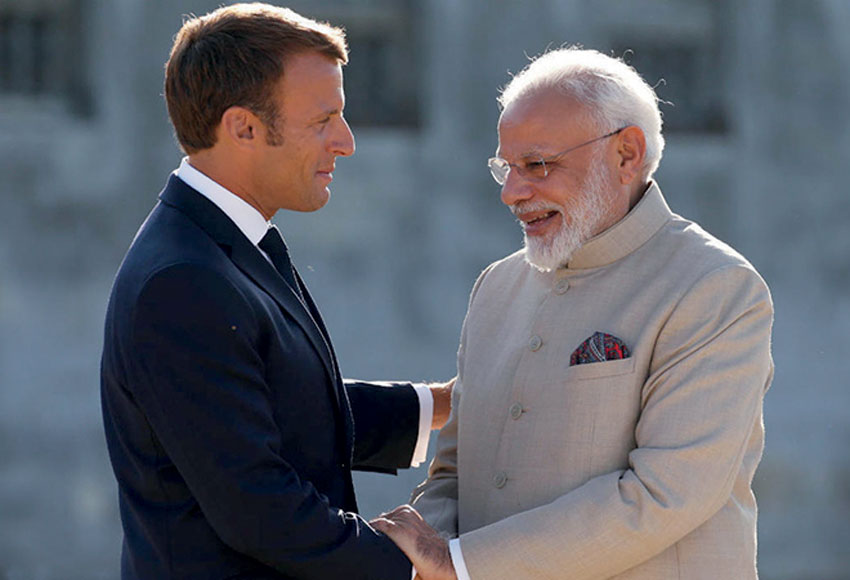
French President Emmanuel Macron is scheduled to arrive in Jaipur on January 25 for a bilateral meeting with Prime Minister Narendra Modi, a day ahead of the 75th Republic Day celebrations where he has been invited as the chief guest this year.
Initially, it was speculated that US President Joe Biden would be this year’s Chief guest at the Republic Day events. But , finally the choice of Macron signifies an important trend. And that is the inescapable fact that it is France, not the United States, which is the most trusted partner of India in the “Western world”.
Macron’s visit to India will be marked by meetings on various sectors in our bilateral spectrum, including defence, space, energy, maritime security, education, indigenous manufacturing of defence equipment, migration and mobility and Indo Pacific. Some announcements are expected to be made by the end of the day and MoUs will be signed.
Prime Minister Modi and President Macron have met a number of times in the recent past - the former's visit to France on Bastille Day, the G20 Summit, COP 28 and the G20 Virtual Summit. It may be recalled that a 269-member Indian contingent took part in Bastille Day. This time , what could be seen in terms of reciprocity, a French contingent will take part in the parade on January 26 on Kartavya Path. parade in France last year.
Incidentally, the Indian Navy has preferred Rafale (M) to the US Boeing’s F/A 18 Super Hornet fighter for its carriers. Macron has also given the green signal to the defense major Safran to jointly design, develop, test, manufacture, and finally certify an engine that will power India’s twin-engine advanced multirole combat aircraft (AMCA) and the twin-engine deck-based fighter for Indian aircraft carriers. France is said to be offering a 100 percent transfer of technology for the co-development of a new 110kN high-thrust jet engine to power the AMCA fifth-generation stealth jet. The French offer is very comprehensive, detailing “a completely new engine, new materials, new architecture, stealth compliance with full supply chains and ancillary manufacturing based in India.”
Besides, Safran, which is building a maintenance, repair, and overhaul (MRO) facility for its LEAP engines in Hyderabad used in the A320 and Boeing 737 aircraft and the M-88 engine that powers the Rafale fighter, is also prepared to set up a center of excellence in gas turbine technology in India with full design and metallurgical precision software tools.
France, unlike other competitors, has always reassured that it will put “no restrictions on stopping any access to sensitive issues” in co-producing this engine. In fact, of all the security partnerships that India has now with other countries, the one with France has been the most enduring.
In 1998, France was the first country with which India established a strategic partnership, which has since been accorded to more than 30 countries. This special relationship has always centered around three crucial areas: Nuclear, Space, and Defense.
Following India’s peaceful nuclear explosion tests in 1974, the United States and Canada terminated their nuclear engagements with India, but France supplied India with fuel for the Tarapur nuclear plant.
Similarly, France proved the exception when the United States and others imposed sanctions on India after the nuclear tests in May 1998. In fact, the then French president Jacques Chirac publicly supported New Delhi and opposed US sanctions.
Soon after the India-specific waiver was granted by the Nuclear Suppliers Group (NSG) in September 2008 to engage in civil nuclear trade, France was the first country to sign a civil nuclear agreement with India, even before the US Senate had approved the India-US nuclear agreement.
When the NSG later declared that it would not supply enrichment and reprocessing technology to countries that were non-signatories to the Non-Proliferation Treaty, France declared that its bilateral nuclear cooperation with India would not be affected.
Although the US played the most important role in granting India the NSG waiver, the French companies outdid their American counterparts when entering India’s nuclear market.
France has also offered to construct six EPR (nuclear reactors) of 1,600 MW each in India. Those things have not moved forward as they should have been, something that concerns India’s domestic politics. But that is a different matter.
India-French cooperation in space technology has not been publicized as it should have been. It began nearly 61 years ago when France provided India with the technology to produce the Centaure-sounding rockets domestically.
The first Indian Satellite Telecommunication Experimental Project (STEP) was undertaken during the 1970s using the French satellite Symphonie; it was followed by Ariane launching the Ariane Passenger Payload Experiment (APPLE).
Arianespace was the preferred agency for launching large Indian satellites, particularly the INSAT and GSAT series. And now that India has developed its independent launch capabilities, French organizations like EADS Astrium and Indian commercial arm Antrix have found it mutually beneficial to work to market Polar Satellite Launch Vehicle capabilities together in the West.
Though defense cooperation between the two countries goes back to the 1950s and 60s — in the 50s, France had provided 104 Ouragan aircraft to the Indian Air Force, rechristened “Toofani” by India — the decision to embark on a strategic partnership in 1998 led to the establishment of a High Committee on Defense Cooperation.
This forum promotes political dialogue and high-level military consultations between officials, cooperation between armed forces through exchanges and joint exercises, and long-term partnerships between Indian and French entities in the field of the armaments industry.
France was the first country with which India conducted a joint naval exercise called ‘Varun’ after the 1998 nuclear tests. The two countries have continued to hold this exercise over the years. Similarly, the IAF’s first bilateral exercise in 2003 with a foreign counterpart, ‘Garuda I,’ was again with the French Air Force.
There is what is called the middle powers congruence between New Delhi and Paris, as both India and France have valued their respective “strategic autonomy.”
As it is, France is a major source of India’s arms imports, the surge coming through the 2016-purchase of the Rafale multirole fighter aircraft, and the reinvigoration of the delayed Project-75 for technology transfer of Scorpene submarines. Then, there have been upgrades of the 51 Mirage-2000s and about Rs 10000-crore acquisition of 490 MICA missile systems.
And here, the noteworthy feature is that unlike the other Western suppliers like the US or Germany, or Great Britain, France has never created problems in technology transfer or imposed sanctions on India.
India has to take into account, for instance, the German laws that prohibit deliveries of weapons and spares during a War. Italian and Spanish laws are not clear on the issue. That explains perhaps the not-talked-about geopolitical reason behind India buying the Rafales.
Even otherwise, France has been the first Western power to have supported India’s claim for permanent membership at the UN Security Council. France, unlike its other partners in the Western alliance, did not impose any sanctions on India after the latter went nuclear in 1998; in fact, it did not even “condemn” the nuclear tests.
France has never been a blind supporter of the United States, even though it is a member of the US-led NATO. The same is the case with India. Despite its vastly improved ties with the United States now, it is unfathomable that India will ever give up its strategic autonomy.
Additionally, apart from France’s keenness to provide nuclear reactors for power generation, there is also the Indo-French initiative that has seen the launch of the International Solar Alliance (ISA) with the aim to promote solar energy in 121 member countries and to mobilize over $1 trillion of investment for the deployment of solar energy at affordable costs by 2030.
In other words, India and France are now strategic partners whose partnership is not limited to just defense ties. As Salvatore Babones, an adjunct scholar at the Centre for Independent Studies in Sydney has argued in Foreign Policy magazine, there are two reasons why the French Indo-Pacific strategy centers on India.
First, the French feel that India is a safe place to invest in big-ticket infrastructure projects such as natural gas, solar energy, nuclear power, space exploration, and high-speed rail, besides defense. Because, unlike the case in China, the French have more confidence and faith in the Indian democratic and legal systems where their intellectual properties will be safe and contractual obligations guaranteed.
Secondly, France is using India to give a second life to its own last-generation technologies. The Rafale jet fighters that France has sold to India were developed in the 1980s and 1990s, and although they are still used as front-line aircraft by the French Air Force, they no longer represent the technological cutting edge. So, by promising to transfer not only production but also know-how to India, France can be said to be trying to establish a new manufacturing base for its products that would otherwise become obsolete.
But then the fact remains that these technologies will remain relevant for quite some time for most of the world. And in developing or co-producing them, India will gain valuable experience developing and designing its own technologies sooner rather than later.
After all, let us not forget that China, which now claims to be self-reliant in producing its fighter jets, first used the Russian–made AL31F engine in its fifth-generation J-20 fighter. Subsequently, it replaced that with WS-10 Taihang, which is still a generation behind modern Western jet-engine technology.
Therefore, seen holistically, I find merits in the argument of Babones that “France’s Indo-Pacific strategy may prove more enduring than the China-containment strategies of the United States, Japan, and Australia. Indigenous capacity-building ( in India) for manufacturing and trade is ultimately the surest guarantee of a free and open Indo-Pacific, and the French strategy is better suited than any of the others for helping the region’s countries help themselves.”

By Prakash Nanda
(prakash.nanda@hotmail.com)














Leave Your Comment