


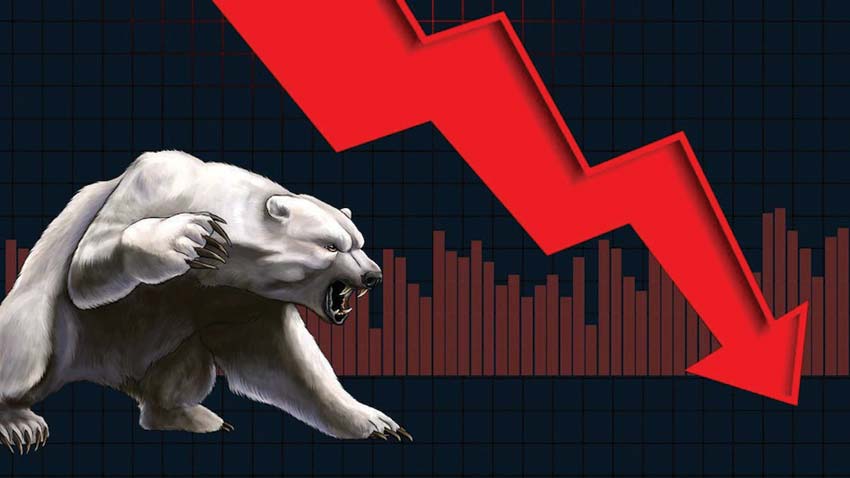
India stock market is crashing again? Possibly it’s on artificial resuscitation and seems to be gasping.
The pressure is building in the Indian market. Recent data shows that India's Buffett indicator, stocks value crossed way past its historical average of 0.83 and is hovering above 1.4, indicating that the market is significantly overvalued. This was estimated almost at the end of the last week. Many columns, including this, had indicated that a bubble was building up. A rise to 85000 plus of the Sensex looked unreal. Total losses in a week may be over Rs 13 lakh crore. The biggest losses were borne by Reliance Industries – 87.37 points; HDFC Bank – 76.36 points; L&T- 38.8; Axis Bank 30.88; and ICICI Bank – 25.97. These five contributed to a loss of 547 points.
In just four trading sessions since October 1, Sensex dropped over 3,300 points as FIIs pulled out nearly Rs 32,000 crore from Dalal-Street. China's market appeal and growing fears over the Iran-Israel conflict have spooked global investors. With concerns over high valuations as retail investors remain confident across price points, there is rising uncertainty about a potential market crash during the festive season.
During the last four months, the Sensex lost 4390 points on June 4, as election results were announced, on August 5, 2223 points, and on October 1, the loss was 1769 points.
The June 4 crash caused Rs 30 lakh crore losses to the stock investors. It lost heavily on August 5 as 2223 points leading to market capitalisation loss of Rs 17 lakh crore. On October 3, Rs 9.5 lakh crore were lost and on October 1, the loss was Rs 3000 crore.
The first week of October, the total losses in four days may be around Rs 13 lakh crore. The Sensex fell steeply by over 1,750 points and Nifty50 dropped to 25,250 due to heightened Middle East tensions. Iran launched missiles at Israel, causing investor worry. Rising oil prices and SEBI's measures also impacted market sentiment. Concern over resurgent Chinese stocks led to significant fund outflows from India.
The market has come down to a three-week low amid Haryana, Jammu and Kashmir elections. Though there is apparently no direct connection, but political uncertainties make investors cling to their purses. The oil surge, from around $ 70 a barrel to 75 and rupee slip by 15 paise, stated to be worst in two months are major shockswwwwwwww, while after the US rate hike, it was expected to strengthen.
The sell-off driven by oil, banking and auto stock slide resulted in a loss of Rs 9.5 lakh crore loss in investor wealth. The slide has not been stemmed. With Dussehara next week it may upset many more.
When in August, the market lost, Mahindra Group Chairman Anand Mahindra suggested using Pranayama to cope with the situation, emphasizing India's long-term growth potential. Social media was flooded with Bollywood-related memes and reactions, reflecting investor anxiety and frustration. The Sensex fell below its Budget-day low, and the Nifty50 slipped below its 20-day moving average, marking its largest single-day decline in over two months then.
This speaks of the fragility of market. For last over two months, its boom-bust continues. The added by loss of deposits in banks though figuratively it is being tried to project that credit level has gone up. It is not replenished by the average depositors.
The market experts say when a government deducts the inflation-related part of income the tax base, real taxable income decreases while nominal taxable income state the same. This leads to higher deficits and reduced government revenue. In turn, this causes investors to lose confidence, which can cause stock prices to drop sharply and potentially cause a stock market crash.
For quite some time, brokerages and analysts have been ramming home the key point that over-exuberance, euphemism for greed, has been driving up Indian equities. All traditional metrics such as the price-earnings ratio and revenue and profitability indicate that prices are blinking red and may snap at the slightest touch.
The latest World Bank Business 2024 report has expressed concern over the principle of “ease of doing business”, which, it says, means dumping of costs on the buyers. The healthy business concept would be in the interest of the consumers and the global business community. In other words, profit earning has its responsibility as well. It asks simple questions whether public utilities like power and water, which go on increasing prices (as in most Indian states, UP or West Bengal), direct or indirect way to bolster profits must “provide public data bases that support transparency and the free flow of information necessary for a healthy business climate”.
The WB avers that a power firm does not provide data on power outage or the average cost to settle a commercial dispute. The WB is trying to create a trove of insights to enable businesses make better decisions and how they operate. In any, a global economy, accuracy will always be a moving target.
The stock markets are no indicator for the health of economy but it is a way to siphon off large funds. Foreign institutional investors are earning huge profits both as they invest and withdraw from the markets. Whether it is bull or bear they are usually is the gainer.
The profit to earning (PE) ratio has reached the highest in Indian markets. It indicates overvaluation. The benchmark Nifty and Sensex logged their biggest decline in two months of over 2 percent as FIIs sold Rs 15,243 crore worth of shares in a single day at the share market guage India Vix surging to close 13.17, the biggest jump in two months. A rise in Vix implies greater uncertainty while a fall suggests confidence.
Rising crude, analysts fear, could force the RBI to hold its key policy rates at which the RBI lends to banks, longer than expected even as US Fed Reserve cut rates last week.
Inflationary trends have been continuing. With the global and domestic uncertainties, imports becoming expensive, India may not be able to check the prices. The October-7-9, Monetary Policy Committee meeting, which was expected to cut rates may have to take harsher decision. It may have to go beyond beyond rate cut to stabilise the domestic market.
The pressure is building in India's stock markets. It has triggered recession fears. One hopes that it does not go to a red alert.
(The content of this article reflects the views of writers and contributors, not necessarily those of the publisher and editor. All disputes are subject to the exclusive jurisdiction of competent courts and forums in Delhi/New Delhi only)
By Shivaji Sarkar














Leave Your Comment