


India’s quest for strategic autonomy has increasingly converged with its ambition to become a global manufacturing powerhouse. At the heart of this transformation lies the indigenisation of defence equipment—an objective that has gained urgency amid evolving geopolitical challenges and the recognition that reliance on foreign arms imports constrains both operational flexibility and national sovereignty. While the Indian state has historically been the primary driver of defence production through public sector undertakings, the last decade has witnessed a decisive shift: the rise of the private corporate sector as a critical pillar in the country’s defence ecosystem.
This transition is not merely a policy adjustment but a structural reimagining of how India equips its armed forces. The entry of corporate players has injected capital, innovation, and efficiency into a domain long characterised by bureaucratic inertia. Today, Indian companies—ranging from established conglomerates to agile startups—are contributing to the design, development, and manufacturing of everything from small arms to advanced missile systems, reshaping the contours of defence indigenisation.
One of the most significant enablers of this shift has been policy reform. The government’s emphasis on “Atmanirbhar Bharat” (self-reliant India) has translated into concrete measures such as higher foreign direct investment (FDI) limits in defence, the introduction of the Defence Acquisition Procedure (DAP), and the creation of positive indigenisation lists that restrict imports of certain categories of equipment. These policies have effectively signaled to the private sector that defence manufacturing is not only viable but strategically essential. By providing a clearer procurement roadmap and prioritising domestically produced systems, the state has reduced uncertainty—one of the biggest deterrents for corporate investment in defence.
The corporate sector’s role is particularly evident in the diversification of India’s defence industrial base. Traditionally dominated by Defence Public Sector Undertakings (DPSUs) and the Ordnance Factory Board, the sector often suffered from limited competition and slow innovation cycles. Private companies, however, operate under market-driven incentives that reward efficiency, technological advancement, and cost competitiveness. This has led to the emergence of indigenous solutions that are not only tailored to the specific needs of the Indian armed forces but are also competitive in global markets.
A key area where corporate involvement has made a tangible difference is in high-technology domains. Indian firms are now actively participating in the development of unmanned aerial vehicles (UAVs), artificial intelligence-driven defence systems, cyber warfare tools, and advanced electronics. These are not peripheral capabilities but central to modern warfare, where information dominance and precision targeting often determine outcomes. By investing in research and development (R&D), private players are helping bridge critical technological gaps that previously necessitated imports.
Equally important is the role of corporate sector partnerships—both domestic and international. Joint ventures between Indian companies and global defence manufacturers have facilitated technology transfer, skill development, and integration into global supply chains. Unlike earlier arrangements that often left India as a passive buyer, these collaborations increasingly involve co-development and co-production, ensuring that knowledge and capabilities are retained within the country. Over time, this has contributed to the creation of a more resilient and self-sustaining defence ecosystem.
The impact of corporate participation is also visible in the supply chain. Defence manufacturing is inherently complex, requiring a network of suppliers for components, subsystems, and raw materials. Indian corporates have played a crucial role in nurturing this ecosystem by engaging small and medium enterprises (SMEs) and startups as partners. This has led to the creation of a multi-tiered industrial base that not only supports defence production but also generates employment and drives regional economic development. The spillover effects into civilian industries—such as aerospace, electronics, and advanced materials—further amplify the benefits of indigenisation.
However, the journey has not been without challenges. Defence manufacturing is capital-intensive, with long gestation periods and uncertain returns. For private companies accustomed to quicker profit cycles, this can be a significant deterrent. Moreover, the procurement process, despite reforms, can still be cumbersome and prone to delays. Issues related to testing, certification, and standardisation often add layers of complexity that slow down project execution. Addressing these bottlenecks is essential to sustain corporate interest and ensure that indigenisation efforts do not lose momentum.
Another critical challenge lies in achieving true technological self-reliance. While assembling or manufacturing under license is a step forward, the ultimate goal is to develop indigenous design capabilities. This requires sustained investment in R&D, a culture of innovation, and close collaboration between industry, academia, and research institutions. The corporate sector has begun to move in this direction, but scaling these efforts to match global leaders will require consistent policy support and financial incentives.
The role of startups deserves special mention in this context. India’s burgeoning startup ecosystem has brought fresh perspectives and disruptive technologies into the defence sector. From developing swarm drone technologies to creating advanced simulation systems, startups are pushing the boundaries of what is possible. Large corporates often collaborate with or invest in these startups, creating a symbiotic relationship that combines agility with scale. This dynamic interplay is crucial for fostering innovation and ensuring that India remains at the cutting edge of defence technology.
Export potential is another dimension where corporate participation is making a difference. As Indian companies enhance their capabilities, they are increasingly looking beyond domestic demand to tap into global markets. Defence exports not only generate revenue but also strengthen diplomatic ties and enhance India’s strategic influence. The government’s push to simplify export procedures and provide financial support has complemented corporate efforts, resulting in a steady rise in defence exports in recent years. Over time, this could position India as a credible alternative to traditional arms exporters.
The indigenisation of defence equipment also has broader strategic implications. In times of conflict or geopolitical tension, access to critical military hardware can be constrained by external factors such as sanctions or supply chain disruptions. By developing domestic capabilities, India reduces its vulnerability to such risks and gains greater control over its defence preparedness. The corporate sector’s contribution in this regard is not just economic but deeply strategic, reinforcing national security in a tangible way.
Furthermore, corporate involvement has introduced a degree of professionalism and accountability that is essential for a sector as sensitive as defence. Adherence to global quality standards, adoption of best practices in project management, and a focus on customer satisfaction—where the “customer” is the armed forces—have improved overall efficiency. This cultural shift is as important as technological advancement, as it ensures that indigenously produced equipment meets the highest standards of performance and reliability.
Looking ahead, the trajectory of India’s defence indigenisation will depend on how effectively the synergy between the state and the corporate sector is sustained. Policy consistency, timely procurement decisions, and continued emphasis on innovation will be key. Equally important is the need to build human capital—engineers, scientists, and skilled workers who can drive the next phase of growth. The corporate sector, with its resources and organisational capabilities, is well positioned to play a leading role in this endeavour.
In conclusion, the role of India’s corporate sector in the indigenisation of defence equipment is both transformative and indispensable. What was once a state-dominated domain is now evolving into a vibrant ecosystem where private enterprise drives innovation, efficiency, and global competitiveness. While challenges remain, the progress made so far underscores the potential of this partnership to redefine India’s defence capabilities. As the country navigates an increasingly complex security landscape, the collaboration between government and industry will be crucial in ensuring that India not only meets its defence needs but also emerges as a global leader in defence manufacturing.

India’s push toward defence indigenisation has increasingly placed the private sector at the center of its strategic transformation. Contributing nearly 23 per cent of total defence production, private industries are no longer peripheral players but critical partners in reducing import dependency and strengthening domestic capability across aerospace, armored systems, weapon platforms, and advanced electronics. This shift reflects a broader structural change in India’s defence ecosystem, where innovation, efficiency, and competition are being driven by non-state actors alongside traditional public sector undertakings.
Major Indian corporations have carved out specialized roles within this evolving landscape. Larsen & Toubro has emerged as a key force in naval and missile systems, contributing to submarine construction and complex weapon platforms. Tata Advanced Systems, along with Tata Power SED, has developed capabilities in aerospace manufacturing, radar technologies, unmanned aerial vehicles, and missile subsystems. Bharat Forge has played a significant role in artillery modernization, particularly through systems like the Advanced Towed Artillery Gun System (ATAGS), while Mahindra Defence Systems has strengthened India’s land warfare capabilities through armored vehicles and naval solutions. Meanwhile, Adani Defence & Aerospace is expanding into drones and small arms, reflecting the growing importance of unmanned and lightweight systems in modern warfare. Emerging players such as Texmaco Defence Systems further diversify the industrial base with focus areas like artillery and armored mobility.
The rise of private industry has been catalyzed by a series of policy reforms aimed at fostering self-reliance. The government’s Positive Indigenisation Lists (PILs) have created a clear demand pipeline by mandating domestic procurement of specific weapons and components. Initiatives like Innovations for Defence Excellence (iDEX) have opened the door for startups and MSMEs, injecting agility and technological experimentation into the sector. Additionally, the establishment of Defence Industrial Corridors in Uttar Pradesh and Tamil Nadu has provided infrastructure and clustering benefits, encouraging collaboration and economies of scale. Liberalized foreign direct investment norms—allowing up to 74 per cent under the automatic route—have also facilitated technology transfer and global partnerships.
Private sector participation is particularly significant in high-end, technology-intensive projects. Contributions to platforms such as the indigenous aircraft carrier INS Vikrant, advanced artillery systems, and missile programs demonstrate the sector’s growing sophistication and reliability. More importantly, these companies are not merely assembling imported kits but are increasingly involved in design, engineering, and system integration—key indicators of true indigenisation.
However, challenges remain. The private sector still faces hurdles such as limited access to long-term contracts, uneven playing fields with public sector units, and bureaucratic procurement processes. Addressing these issues will be essential to fully unlock the sector’s potential.
In sum, the private sector’s expanding footprint signals a decisive shift in India’s defence strategy—from state-dominated production to a more diversified, innovation-driven ecosystem. If sustained with consistent policy support and institutional reforms, this partnership between government and industry could position India not only as self-reliant but also as a competitive global exporter of defence technologies. (NK)
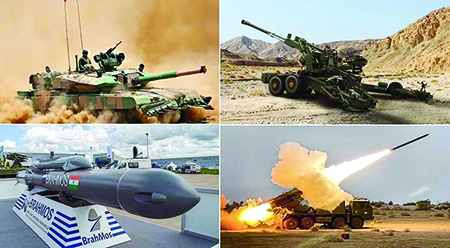
India’s defence landscape is undergoing a structural transformation under the Atmanirbhar Bharat initiative, with a clear shift from import dependence to indigenous design, development, and manufacturing of war equipment. This transition is not merely symbolic; it is reflected in a growing inventory of sophisticated military platforms—ranging from missile systems and artillery guns to aircraft carriers and unmanned systems—that are redefining India’s combat readiness. What makes this shift particularly significant is the deepening involvement of private industry, which has infused speed, innovation, and efficiency into a sector once dominated by public enterprises.
One of the most prominent success stories is the development of indigenous missile systems such as the BrahMos missile and the Akash missile system. These platforms have not only enhanced India’s deterrence capabilities but also reduced reliance on foreign suppliers for critical strike and air defence functions. Their benefits lie in precision targeting, rapid deployment, and adaptability across different terrains. Private players like Larsen & Toubro and Tata Advanced Systems have played crucial roles in manufacturing subsystems, launchers, and integration components, thereby accelerating production timelines and improving quality standards.
In the realm of artillery, the indigenously developed ATAGS stands out as a milestone. Designed to replace outdated imported guns, ATAGS offers extended range, higher firing rates, and advanced fire-control systems. Its deployment strengthens India’s firepower along contested borders, particularly in high-altitude regions. Companies like Bharat Forge have been instrumental in producing critical components, demonstrating how private sector expertise in metallurgy and engineering can be leveraged for defence applications.
Naval indigenisation has also made significant strides, exemplified by the construction of the aircraft carrier INS Vikrant. As India’s first indigenously built carrier, it symbolizes technological maturity and strategic autonomy in maritime defence. The vessel enhances India’s blue-water capabilities, enabling sustained operations across the Indian Ocean Region. Private firms such as Larsen & Toubro contributed to hull construction and complex systems integration, highlighting the collaborative model between public shipyards and private industry.
Another critical area is the rise of unmanned systems and modern infantry equipment. Indigenous drones developed with the participation of companies like Adani Defence & Aerospace and Tata Advanced Systems are increasingly being deployed for surveillance, reconnaissance, and tactical operations. These systems provide real-time intelligence, reduce risks to personnel, and enhance battlefield awareness. Similarly, private sector involvement in small arms manufacturing and protective gear has improved the quality and availability of equipment for frontline soldiers.
The benefits of these indigenously developed war systems extend beyond military capability. Economically, they reduce the outflow of foreign exchange and create a domestic industrial ecosystem that generates employment and fosters innovation. Strategically, they ensure supply chain security during conflicts, when reliance on foreign imports can become a vulnerability. Technologically, they push India up the value chain, enabling it to not just assemble but design and export advanced defence systems.
Crucially, the entry of private players has introduced competition and efficiency into defence production. Unlike traditional models, private firms bring flexibility, faster decision-making, and access to global best practices. Government initiatives such as the Positive Indigenisation Lists, iDEX, and Defence Industrial Corridors have further incentivized their participation, creating a symbiotic relationship between policy and industry.
In essence, the war equipment developed under Atmanirbhar Bharat represents more than a catalogue of indigenous platforms—it marks the emergence of a new defence paradigm. With private industry as a key stakeholder, India is steadily transforming from one of the world’s largest arms importers into a credible hub of defence manufacturing and innovation. (NK)

Nilabh Krishna
(The content of this article reflects the views of writer and contributor, not necessarily those of the publisher and editor. All disputes are subject to the exclusive jurisdiction of competent courts and forums in Delhi/New Delhi only)





















Leave Your Comment