


Deepak Kumar Rath
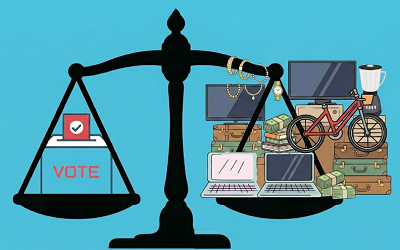
For decades, Indian politics has often revolved around a familiar electoral strategy: promise extensive subsidies, announce generous waivers, expand welfare schemes, and postpone the financial consequences to future governments. While welfare measures remain essential in a country where millions still face economic vulnerability, the growing culture of competitive populism has created a dangerous imbalance between social support and fiscal responsibility. The long-term risks of this trend are becoming increasingly visible, and few examples illustrate this more clearly than Punjab. Once celebrated as one of India’s most prosperous states, Punjab played a historic role in the Green Revolution and emerged as a symbol of agricultural success and industrial promise. However, years of mounting subsidies, excessive dependence on state support, and limited structural reforms have contributed to a deep fiscal crisis. Free electricity to farmers, expanding debt burdens, declining industrial competitiveness, and limited private investment have weakened the state’s economic foundation. Punjab’s debt-to-GSDP ratio has steadily risen over the years, while unemployment and drug abuse concerns have further complicated the socio-economic landscape. The problem is not welfare itself. Every modern democracy requires a strong social safety net to protect vulnerable citizens. Programmes supporting healthcare, education, food security, and rural employment remain indispensable for inclusive growth. The challenge arises when political parties use public finances primarily as tools for electoral gain rather than instruments of long-term development. Loan waivers, unsustainable subsidies, and short-term giveaways may produce immediate political rewards, but they often reduce fiscal space for investment in infrastructure, manufacturing, education, research, and job creation. India today stands at a crucial historical moment. Bharat possesses several structural advantages that could define the 21st century in its favour. It has one of the world’s youngest populations, rapidly expanding digital infrastructure, increasing geopolitical influence, a vast domestic market, and growing manufacturing potential through initiatives such as “Make in India” and production-linked incentive schemes. The country is also emerging as a key player in global supply chain diversification as multinational companies seek alternatives beyond China.
However, it cannot be gainsaid that the demographic and strategic advantages alone cannot guarantee sustained prosperity. Economic strength ultimately depends on productivity, innovation, industrial expansion, and disciplined fiscal management. Excessive populism diverts valuable public resources away from these long-term priorities. When governments spend disproportionately on politically attractive subsidies, they often compromise investments in transport networks, energy systems, urban planning, healthcare capacity, and technological innovation — sectors that generate durable economic growth. The global economic environment further increases the urgency for reform. Rising geopolitical instability, energy insecurity, technological disruption, and global competition demand that nations maintain strong fiscal fundamentals. Countries burdened by uncontrolled debt and persistent fiscal deficits become vulnerable to inflation, slower growth, and reduced investor confidence. India cannot afford complacency if it seeks to emerge as a leading global power. The need of the hour is a national consensus on responsible fiscal governance. Political parties across ideological divides must recognise that unchecked competitive populism threatens India’s long-term stability. Greater transparency in election manifestos could be an important starting point. Voters deserve clear explanations regarding how proposed schemes will be financed and what economic trade-offs they may involve. The direction chosen today will shape not only economic outcomes, but the very future of Bharat as a confident and self-reliant civilisation-state.




















Comments (4)
D
Impressive and well researched
C
Perfect description of the subject of freebies ! We need a law that the freebies shall be paid from the party fund not tax payers money. Unfortunately, our politicians have made a mess of the system since 1947. The first generation was corrupt and thus set the precedence in either ways( money or power).
C
Dear Editor Perfect description of the subject of freebies ! We need a law that the freebies shall be paid from the party fund not tax payers money. Unfortunately, our politicians have made a mess of the system since 1947. The first generation was corrupt and thus set the precedence in either ways( money or power). As an army veteran, one happens to see a very dirty politics in the current environment and questions to oneself whether the service to the nation by uniformed and honest citizens has any meaning??Not that any dictator would have been good to our country ( Pakistan is a live example having similar background), but why is it that the democratic process got so manipulative that the actual concerns for development takes a back seat for power. The educated and hard working masses who earn from 6 lakhs to 18 lakhs PA have no role apart from paying taxes and then lamenting for the same. These people pay taxes , yet can’t avail the medical facilities, subsidies, government education, safe living environment for self and kids. Taxes collected by this category goes in freebies and the voters of this category are responsible but can’t make any impact to change the system. We the common man ( not the AAP ) have no money, power or support to fight elections on actual issues as we are the REAL MINORITY. The minority of taxpayers. The irony of our lives is that we love our nation so much that we can die for it’s territorial integrity but we can’t form a team or group to fight the dirty political system in our motherland ! It’s actually a dead end for the REAL MINORITY.
A
I agree with the above comments that the high-five promises made by any politician or political party should be born by them from their own pockets because they get crores of rupees as donations from various unknown sources. Secondly instead of making high promises they should ask for local problems from the public in writing and meet out those problems in a fixed time with the result the development will be visible.