


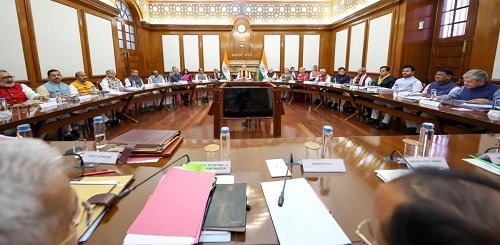
The Cabinet meeting achieved an ahadministrative milestone as it was held at the newly developed Prime Minister’s Office complex, “Seva Teerth,” in New Delhi. During the cabinet briefing, Information and Broadcasting Minister Ashwini Vaishnaw outlined the key decisions taken at the meeting and highlighted the adoption of the “Seva Sankalp Resolution,” presenting it as a guiding framework for governance going forward.
The meeting was viewed not merely as a routine administrative exercise but as an effort to signal a shift in India’s governance culture. The Seva Teerth complex has been envisioned as a modern administrative workspace rooted in the ideals of duty, service, and dedication. According to the government, decisions taken from this new institutional space will reflect a commitment to serving 1.4 billion citizens and advancing national development with a people-first approach.
Through the Seva Sankalp Resolution, the Cabinet reaffirmed its adherence to the constitutional values of justice, equality, and dignity of citizens. Emphasizing the philosophy of “Nagrik Devo Bhava,” the government reiterated its pledge to build a transparent, accountable, and citizen-centric administrative system. The resolution also aligned governance priorities with the national vision of Viksit Bharat 2047, which seeks to transform India into a developed nation by the centenary of independence.
One of the most significant administrative decisions taken during the meeting concerned the proposed renaming of the state of Kerala to “Keralam.” Accepting a long-standing demand, the Union Cabinet approved the proposal in principle. The decision remains at an initial procedural stage and will require approval from the state legislative assembly before the introduction of the Kerala Alteration of Name Bill, 2026, in Parliament. The government stated that the proposed change reflects the linguistic and cultural identity of the region more accurately.
Infrastructure development formed another major focus of the cabinet’s decisions, with multiple railway, metro, and aviation projects receiving approval to strengthen connectivity across the country. Among the key railway initiatives is the doubling of the Jabalpur–Gondia rail line, a roughly 231-kilometre project expected to create a more efficient north–south corridor, reducing travel time and logistics costs. The approval of third and fourth rail lines between Kiul and Punarkasik in Bihar is aimed at increasing capacity on the Kolkata–Prayagraj corridor and enabling the operation of additional passenger trains. Meanwhile, the Gamharia–Chandil line expansion in Jharkhand is expected to improve freight movement and connectivity for major steel clusters such as Tatanagar, Bokaro, and Durgapur. These projects are projected to enhance passenger convenience, accelerate cargo transportation, and generate substantial employment through large-scale infrastructure activity.
The Cabinet also approved other key infrastructure initiatives, including the construction of a new integrated airport terminal in Srinagar with triple the existing passenger handling capacity, and the expansion of the Ahmedabad Metro network to strengthen connectivity with GIFT City and surrounding urban areas. The government believes these developments will stimulate economic activity, tourism, and regional growth.
In the energy sector, a major policy decision was taken to strengthen national power infrastructure by increasing the equity investment limit of Power Grid Corporation of India from ₹5,000 crore to ₹7,500 crore. The move is expected to support the expansion of the national electricity grid and accelerate renewable energy integration across the country.
Farmers also received a policy boost as the Cabinet approved an increase in the Minimum Support Price for raw jute to ₹925 per quintal, representing a ₹275 rise compared to the previous year. The government stated that the decision would particularly benefit jute growers in eastern states such as West Bengal and Assam, improving farm incomes and supporting agricultural sustainability.
The first Cabinet meeting at Seva Teerth thus represented more than the inauguration of a new administrative complex; it signaled the government’s attempt to redefine governance through service-oriented policymaking. By combining infrastructure expansion, energy reforms, agricultural support, and institutional symbolism, the government projected the meeting as a step toward accelerating the Viksit Bharat 2047 vision. Officials emphasized that faster decision-making, transparency, and a spirit of public service would remain central to India’s journey toward becoming one of the world’s leading economies.





















Leave Your Comment