



Rakesh Kumar
The National Inve igation Agency (NIA) conducted raids at 20 locations raised a question does excessive screen time has something to do with it. The path was less travelled and has wide consequences ranging from health to social impact and so on.
Living With My Screens: A Personal Reckoning.
I have always believed that research and lifestyle improvement go hand in hand. As an author, I feel a moral responsibility to write about the choices that shape our lives. One subject kept tugging at me: the ill effects of excessive social media use. But before I could warn others, my researcher’s mind insisted I investigate my own habits. After all, credibility begins at home.
My daily life revolves around four devices — a laptop, an iPad, and two mobile phones. When I finally tracked my usage, the numbers startled me. I was spending 11 hours a day on these gadgets. Much of it was productive — reading books, writing, researching, and answering emails. Yet hidden in those hours was a sobering truth: nearly 3 hours were swallowed by social media.
The Trap of “Just a Few Minutes”
I used to tell myself I was only scrolling for a few minutes. But those “few minutes” stretched into hours, especially when I got pulled into debates — whether about the Indian economy slowing down or heated discussions on territorial disputes with China. What felt like quick engagement was actually prolonged distraction.
Another unique feature was that these profiles were new and despite having tens of posts only the flowing was in thousands. Here we first study the social impact first.
Losing track of time isn’t unique to me. Studies show that people often underestimate their social media use by nearly half, thanks to endless scrolling and algorithm-driven feeds. The global average is 2.5 hours daily, but many of us believe we spend far less.
The Hidden Costs
The consequences of overuse are not abstract; they creep into everyday life:
• Mental health impact — Anxiety and low self-esteem thrive on constant comparison.
• Sleep disruption — Blue light delays melatonin, robbing us of deep rest.
• Productivity loss — Notifications fracture focus, making meaningful work harder.
• Social isolation — Online chatter often replaces real conversations.
I realized I wasn’t immune. My “grey area” was the time I thought I wasn’t spending — the hidden hours that slipped away unnoticed.
My Turning Point
Writing this article became my wake-up call. By confronting the data, I saw the gap between perception and reality. That awareness gave me control. I consciously reduced my social media use to under 30 minutes a day, reclaiming precious hours for writing, reading, and reflection.
The lesson is simple but profound: awareness precedes change. Without measuring, we underestimate. Without confronting, we drift. But once we see the truth, we can investigate the impact clearly.
Mental Health Impact of Social Media Overuse
Developed nations have invested huge resources in investigating the impact of excessive use of social media. The findings are;
• 5.79 billion people use social media worldwide as of April 2026 — nearly 70% of the global population.
• 24% of users meet criteria for problematic use, according to a 32-country meta-analysis using the Bergen Social Media Addiction Scale.
85.5% of Indian households own at least one smartphone, and 86.3% have internet access at home.
India is the largest market for social media platforms, with over 500 million active users across Facebook, Instagram, and WhatsApp.
Low-cost mobile data has accelerated adoption, especially among youth.
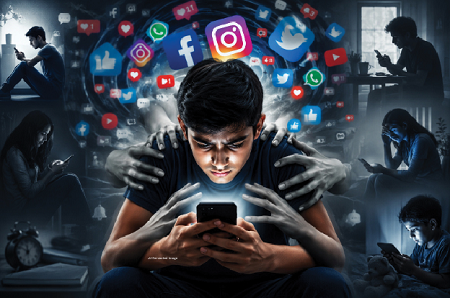
Anxiety & Depression
• A 2025 JAMA Network Open study of 11,876 children found that increases in social media use were prospectively associated with greater depressive symptoms one year later. Depressive symptoms did not predict increased use, suggesting a directional relationship from social media to depression.
• 20–30% of individuals with anxiety or depression also report problematic social media use.
A 2026 cross-sectional study of 779 Indian participants (aged 18–25) found that problematic social media use (PSMU) significantly predicted depression, anxiety, and stress.76.3% of Indian youth demonstrated problematic social media use, highlighting the scale of the issue. Meta-analysis combining global and Indian data shows adolescents in India are more vulnerable to anxiety and depression due to peer comparison and cyberbullying.
Cyberbullying & Emotional Harm.
Cyberbullying has emerged as one of the most damaging consequences of excessive social media use, particularly among young people. Research shows that nearly 37% of teens report being victims of cyberbullying, and the impact is devastating — victims are four times more likely to attempt suicide compared to their peers who have not been bullied online. The problem extends into higher education as well, with 41% of college students who attempted suicide citing social media as a direct trigger. The psychological toll is profound: victims of cyberbullying are 2.5 times more likely to develop anxiety disorders and twice as likely to experience depression within just six months. These figures highlight how online harassment, often dismissed as “virtual,” can have very real and lasting consequences on mental health, eroding self-esteem, disrupting emotional stability, and in severe cases, endangering lives. (sourced from worldmetrics.org)
Sleep & Self-Esteem
Social media’s impact on lifestyle and well-being is far deeper. Surveys reveal that 45% of U.S. teens admit social media reduces their sleep, while an astonishing 93% of Gen Z confess to staying up past bedtime just to keep scrolling. This late-night engagement isn’t harmless — the blue light emitted from screens interferes with melatonin production, disrupting sleep cycles and leaving users fatigued the next day. Beyond sleep, constant exposure to idealized posts and curated lifestyles fosters low self-esteem and body image distress, especially among adolescents. The endless stream of notifications and short-form content overstimulates the brain, fragmenting attention and making it harder to concentrate on studies or meaningful work. The curated images and edited photos create unrealistic expectations, leading to dissatisfaction with one’s own appearance. Paradoxically, while social media promises connection, its overuse often reduces face-to-face interactions, weakening real-world relationships and leaving individuals feeling isolated despite being constantly “online.” Together, these effects paint a sobering picture of how unchecked digital habits can erode both mental health and social bonds.
In India, social media overuse is officially recognized as a public health concern, with government data showing that digital addiction among youth is linked to rising rates of anxiety, depression, sleep disorders, and declining academic performance. More than 250 million Indians aged 10–24 are at risk, making this one of the largest vulnerable populations worldwide. (Indian data sourced from healthandfaimy.in)
Excessive use of social media doesn’t just erode mental health — it has opened the floodgates to fraud and scams on an unprecedented scale. In India cybercrime linked to social media has surged sharply. The National Crime Records Bureau (NCRB) reported a 24% jump in cyber fraud cases in 2025, with a large share involving phishing links, fake investment schemes, and impersonation on WhatsApp, Instagram, and Facebook. The problem is global: the FBI’s Internet Crime Report 2025 documented losses exceeding $12.5 billion from scams originating on social media, underscoring how compulsive scrolling and misplaced trust online have become fertile ground for exploitation. A tool for connection is now increasingly a breeding ground for deception, leaving millions vulnerable to financial and emotional harm.
From romance, honey trap to identity theft!
Victims often fall prey to romance scams, fake job offers, and identity theft, with young adults and the elderly being the most vulnerable groups. In India specifically, nearly 70% of reported online fraud cases originate from social media interactions, underscoring how compulsive scrolling and trust in online connections can make users easy targets. The paradox is clear: while social media connects us, overuse can blur judgment, reduce vigilance, and open the door to financial and emotional exploitation.
Excessive users are vulnerable: The Digital Battlefield of Radicalization
Excessive social media engagement has become a dangerous gateway for jihadist groups to radicalize India’s teenagers and youth, with recent NIA raids across nine states exposing online networks tied to ISIS and Al-Qaeda that actively recruit through encrypted apps and propaganda channels.
The New Frontline
Social media is increasingly weaponized by jihadist organizations to prey on vulnerable minds. Platforms like WhatsApp, Telegram, and Instagram are being used not just for communication but for systematic indoctrination, exploiting the compulsive scrolling habits of teenagers and young adults. Unlike traditional recruitment through physical camps, today’s radicalization thrives in digital ecosystems, where exposure to extremist content is continuous, subtle, and difficult to detect.
Real Incidents in India
• July 2026 NIA Raids: The National Investigation Agency (NIA) conducted raids at 20 locations across 9–10 states including Delhi, Uttar Pradesh, Andhra Pradesh, Maharashtra, and West Bengal, targeting online radicalization modules linked to ISIS and Al-Qaeda in the Indian Subcontinent (AQIS). Investigations revealed that these networks were attempting to establish an “Islamic State” in India by spreading violent jihadist ideology online.
• Kerala Arrest (January 2026): Police arrested Muhammad Adil for allegedly recruiting youth through encrypted platforms, demonstrating how local actors can sustain outreach without direct organizational contact.
• Hybrid Networks: Arrests in Assam, Tamil Nadu, and Tripura exposed small online-linked modules using messaging apps to circulate propaganda, showing how radicalization is shifting from centralized groups to diffuse, low-profile cells.
Why Teenagers Are Vulnerable
• Excessive screen time makes youth more susceptible to persuasive narratives.
• Algorithm-driven feeds amplify extremist content once initial engagement occurs.
• Isolation and identity struggles among adolescents create fertile ground for manipulation.
• Encrypted platforms provide anonymity, making it harder for families and authorities to intervene.
Are we ready to take on this challenge?
Indian security agencies face a daunting challenge in countering jihadist influence online, and the problem is compounded by being ill-equipped and undertrained to handle the scale of this digital onslaught. Most agencies still rely on traditional policing methods that are inadequate against encrypted apps, algorithm-driven propaganda, and cross-border digital recruitment. The lack of specialized cyber units, limited training in psychological profiling, and insufficient collaboration with tech companies leave dangerous gaps that extremists exploit.
The solution lies in a multi-pronged strategy:
• Specialized cyber cells with advanced AI-driven monitoring tools to detect radical content early.
• Training programs for officers in digital forensics, behavioural psychology, and counter-propaganda.
• Collaboration with social media platforms to flag extremist content and shut down recruitment pipelines.
• Community outreach to build resilience among youth, combining digital literacy with mental health support.
Without these reforms, India risks allowing extremist groups to weaponize social media unchecked, turning compulsive scrolling into a recruitment funnel. But with proactive investment in cyber capacity and youth awareness, the country can transform its vulnerabilities into strengths and reclaim the digital space from radical ideologies.
The Larger Threat
Digital radicalization is less about immediate large-scale attacks and more about the gradual consolidation of extremist ideology. By keeping individuals engaged, jihadist groups normalize violent narratives, erode trust in democratic institutions, and recruit operatives for future actions. The Pahalgam assault in April 2025 and the Red Fort suicide bombing in November 2025 show how online indoctrination can spill into real-world violence. India’s fight against terrorism must extend into the digital realm, as excessive social media engagement is not just a lifestyle issue but a national security risk. Parents, educators, and policymakers must recognize that platforms used for entertainment are being exploited to spread hate and recruit the next generation of extremists. The solution lies in digital literacy, stronger monitoring, and proactive mental health support for youth — without these, a simple scroll could become the first step toward radicalization.
Closing Thought
This isn’t just about screens anymore; it’s about reclaiming life, protecting the society and the nation. Social media can connect us, but unchecked, it consumes us. My journey has taught me that balance is possible — and that the first step is honesty with ourselves. The government has a big role to play.
From sensitising to education, from being proactive to delivering justice we have a long way to go. Engagement with different stake holders and working in harmony will bring hope and success
Even though best time to do it, was yesterday, addressing it now, is better late than never.
(The content of this article reflects the views of writer and contributor, not necessarily those of the publisher and editor. All disputes are subject to the exclusive jurisdiction of competent courts and forums in Delhi/New Delhi only)





















Leave Your Comment