


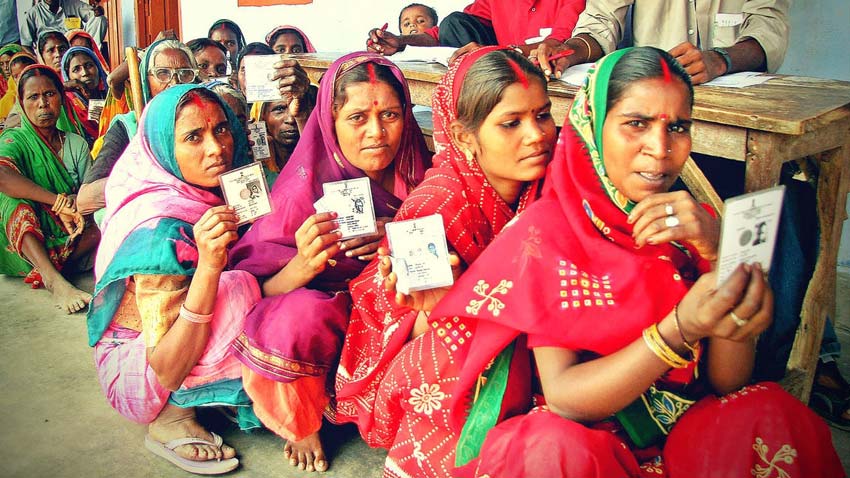
In Bihar, democracy has long worn a distinctly feminine face. As the assembly elections draw closer in the state, political parties are increasingly focused on the women vote bank as it plays a crucial role in deciding their electoral fate. The 3.5 crore women voters of the state will play a major role in deciding whether the NDA candidate Chief Minister Nitish Kumar will continue to rule or the opposition Mahagathbandan’s Tejaswi Yadav will replace him in the state.
Realising that women, who make up around 48% of the population, are a key electoral demographic in Bihar and are credited for the political longevity of Chief Minister Nitish Kumar empowerment of ‘Nari Shakti’ alongwith Yuva Shakti has featured prominently in the NDA’s ‘Sankalp patra’ which was released in Patna today. The document released by JDU leader and Chief Minister Nitish Kumar and BJP President J P Nadda in presence of other senior leaders of the NDA has promised massive employment generation and women-led growth. It pitches for stability and welfare.
The Sankalp Patra said that under the Mukhyamantri Mahila Rozgar Yojana, women will receive financial assistance up to Rs 2 lakh for starting business to promote prosperity and self-reliance. The ruling coalition aims to make one crore women ‘Lakhpati Didis’, or women earning more than Rs 1 lakh a year. It also plans to introduce a ‘Mission Crorepati’ to support successful women entrepreneurs in scaling their ventures to make them millionaires.
Th NDA gives credit to Chief Minister Nitish Kumar for empowering women in the state by giving 50% reservation to them in Panchayati Raj institutions in 2006, 35% reservation to women in police department jobs in 2013, and 35% reservation to women in all government services. Under the latest 'Mahila Rojgar Yojana', the state government has recently released Rs 10,000 as the first instalment of financial assistance to one woman from each family which is having a wider impact on the election campaign strategies of both the NDA and Mahagathbandhan.
Trying not to be left behind, the opposition Mahgathbandan is also making pro-woman poll-promises such as ‘Mai-Behin Maan Scheme’. RJD leader Tejashwi Yadav has announced that women will receive Rs 2,500 per month (amounting to Rs 30,000 per year) starting from December 1 if Mahagathbandhan assumes power in the state. He has also promised to give permanent government job status to 'Jeevika Didis' with monthly salary of Rs Rs 30,000 which has been a long-pending demand of women associated with the scheme.
However, the mega welfare push of Rs 7500 crore outlay for the Mukhyamantri Rozgar yojna has given the NDA a lead as far as luring women voters of the state is concerned. Under the scheme 7.5 million women have already got ₹10,000 each in their bank accounts for starting their venture.
The NDA is also reminding the electorate of the so-called Jangal Raj during the previous RJD regime in Bihar highlighting the rampant crime against women and kidnappings. The Congress is making feeble attempt to criticise the ruling alliance for some recent incidents of crimes, but the people’s memories of incidents during previous RJD rule is not having the desired impact. The NDA points out that during the RJD tenure, women's development was limited to their families whiles others endured pain and sufferings.
Prohibition, which was introduced by the Nitish Government in 2016, has also helped galvanise women’s support in favour of NDA in the past. Prohibition was aimed to reform higher public health and social welfare by curbing alcohol misuse. Women continue to support the ban, citing fewer incidents of domestic violence and lifting living standards. Chief Minister Nitish Kumar is largely credited with initiating women's political participation and launched many schemes that directly benefited girls and women, creating a lasting social base. Over the past 20 years, Nitish has launched several schemes like 50 per cent reservation for women in panchayat bodies, the self-help Jeevika Didi scheme, a cycle scheme that provides incentives to girls who pass matriculation and graduation with first class marks. These also include Hunar Scheme for minority women, Chief Minister's Entrepreneur Scheme that gives interest-free loans to women, and now, the Mukhyamantri Mahila Rojgar Yojana. Also, under the state's Social Security Pension Scheme, Rs 1,263.95 crore is being disbursed monthly to 1.13 crore pensioners, a large number of whom are women.
Women, who constitute 48% of electorates have always shaped poll outcomes in the state. In the 2020 assembly elections, women voter turnout was 59.7%, while men’s was 54.6% – marking the third election in a row where female turnout exceeded male turnout in the state. In the same election, women outpolled men in 167 out of 243 constituencies. This trend indicates that the female vote is no longer "silent," but rather "smart and decisive".
This pattern extends beyond state polls. In the 2024 Lok Sabha elections in Bihar as well, women pulled ahead: their turnout being around 59.45%, compared to men at about 53%. The trend of women leading in electoral participation is not a fluke but a structural feature of Bihar’s recent politics. In fact, over the last five Assembly elections, more women have voted in the state than men, even though they lag behind in terms of representation, ie., ticket allocations and victories.
While every party announces a slew of schemes to woo women voters, they remain miserly when it comes to distributing ticket to women. In the 2020 Bihar Assembly elections, of the 1,270 candidates who contested for 243 seats, only 146 were women, representing around 11.5 per cent of the total. Of these, a mere 26 women won, representing around 10.7 per cent of the total MLAs elected that year.
Bihar was the first state in the country to grant 50 per cent reservation to women in panchayats. Following this, thousands of women entered village politics and became involved in administrative decisions. Yet, the presence of women in the Legislative Assembly has seen a steady decline. Between the first state elections in 1952 and 2020, only 258 women have become MLAs in Bihar. But in the last three Assembly elections, the numbers have grown worse. While 34 women MLAs were elected in 2010, this number dropped to 28 in 2015 and to 26 in 2020.
This time NDA has fielded 34 women, while the Mahagathbandhan has given tickets to 30. Both the BJP and JD(U) have fielded 13 women each, while Chirag’s LJP (Ram Vilas) has given tickets to five. The HAM(S) has fielded two women and the RLM one. The RJD has given tickets to 24 women. The Congress has fielded five women, while the CPI (M-L) Liberation and the VIP have nominated one woman each. The BSP, which is contesting 130 seats, has fielded 26 women, while Jan Suraaj has fielded 25 women.
The question now is: Will the 2025 election prove to be a decisive one for Bihar's women.
By Annapurna Jha
(The content of this article reflects the views of writer and contributor, not necessarily those of the publisher and editor. All disputes are subject to the exclusive jurisdiction of competent courts and forums in Delhi/New Delhi only)














Leave Your Comment