


The state of emergency imposed in 1975 by Mrs Indira Gandhi, is a controversial matter in the Indian context, and its consequences are complex and damaging. The suspension of fundamental rights and abuse of power led to a severe democratic crisis. The political impact was highlighted but subtle damages done to the spirit of the democracy and its major pillars were ignored. 47 years after its demise we have still giving lip sympathy to its ill effect without looking for remedial action.
Road which led to declaration of emergency
June 1975 has become the darkest month of independent India. A convicted politician managed to overturn the decision of the court by holding the position of prime minister, amended the constitution and got the conviction set aside by crafting a ‘committed judiciary’. This did not happen in a day, for a decade the judiciary which was diligently keeping a check on the temptation of the executives to play with the basic spirit of the constitution was pushed to periphery. Let’s analyse few of these cases.
1. The Supreme Court held that the amending power does not enable Parliament to override all express or implied limitations on that power and it could not amend Part III of the Constitution. I. C. Golak Nath & Ors vs State of Punjab & Anrs. ( 27 February, 1967 1967 AIR 1643, 1967 SCR (2) 762.
2. In February 1970, in R.C Cooper (bank nationalization) case, the Supreme Court dealt with a law which nationalized 14 banks. Although the Court laid down that Parliament had the legislative competence to do so, it struck down the law for want of sufficient compensation. The law had to be passed again with higher compensation. Rustom Cavasjee Cooper vs Union Of India on 10 February, 1970 (1970 AIR 564, 1970 SCR (3) 530, AIR 1970 SUPREME COURT 564).
3. One can see that with every time the government lost in court it was becoming more determined to tame the courts. The third case related to privy purses given to the erstwhile rulers is the example where every lacuna was used to get the desired goal. constitutionally guaranteed Privy purses were charged on the Consolidated Fund of India. In 1967, to punish the princely rulers who joined the Swatantra Party led by C Rajagopalachari and emerged victorious. Indira Gandhi introduced the 24th Constitution Amendment Bill. Despite being passed in the Lok Sabha, this Bill failed in the Rajya Sabha. The failure could not stop Mrs Gandhi who advised the President to use powers under Article 366(22) and derecognize the rulers. The President acted on the advice and issued various notifications. The move was challenged before the Supreme Court, which held it to be unconstitutional (Justice AN Ray dissented and ruled in favour of Indira Gandhi).
The inevitable came too abruptly
By now readers can understand that Mrs Gandhi was hell bent to tame the Judiciary and she was getting successful also. A.N. Ray was made chief justice of India from 25 April 1973. This appointment superseded three senior judges of the Supreme Court, Jaishanker Manilal Shelat Jaishankar Manilal Shelat , AN Grover and K.S. Hegde, an attempt to send a message . This unprecedented move had been called the "blackest day in Indian democracy". Widespread protests by bar associations and legal groups across India took place.
But the honest and upright judges were doing their bit and the best was yet to come. The opposition candidate against Mrs Gandhi, Raj Narain, influenced by the rumour of corrupt electoral practices, filed an election petition in April 1971 through advocate Ramesh Chandra Shrivastava before the Allahabad High Court. He engaged Senior advocate Shanti Bhushan to represent him.
Despite rumours of offer of elevation to the Supreme Court to Justice Jag Mohan Sinha, the judgment was pronounced on June 12, 1975. Indira Gandhi was found to have indulged in corrupt practices on account of rostrums constructed by government officers and that her election agent Yashpal Kapoor worked at her instance in the election while being a gazetted officer.
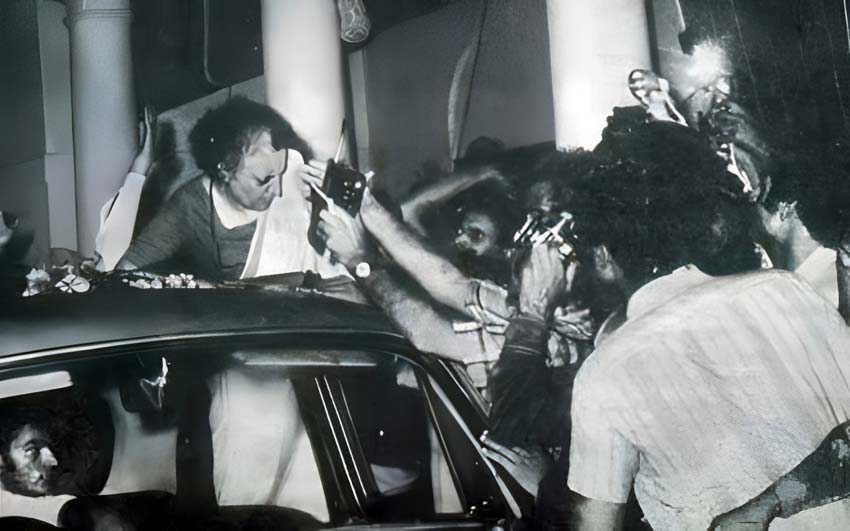
The dooms day Emergency was imposed on 25th June 1975
Mrs Gandhi appealed before the Supreme Court with Justice VR Krishna Iyer the previous day.
Shanti Bhushan argued that there is a practice in the parliamentary system where within the ruling Party a leader is changed or ceases to be available and a new leader is elected, so that the democratic process finds smooth expression.
This was a fact that after the death of prime minister Nehru or that of Lal bahadur Shastri congress took no time in electing the next PM.
Ignoring this justice Iyer, Granted a conditional stay. As a young student I heard my political science teacher saying,” what is restrained in one para was withdrawn in the next para”. I reproduce the relevant paragraphs for the learned reader.
“III. The appellant-petitioner, qua Lok Sabha Member, will be entitled to sign the Register kept in the House for that purpose and attend the Sessions of the Lok Sabha, but she will neither participate in the proceedings in the Lok Sabha nor vote nor draw remuneration in her capacity as Member of the Lok Sabha.”
But the next para was sensational
IV. Independently of the restrictions under para III on her Membership of the Lok Sabha, her rights as Prime Minister or Minister, so long as she fills that office, to speak in and otherwise to take part in the proceedings of either House of Parliament or a joint sitting of the Houses (without right to vote) and to discharge other functions such as are laid down in Articles 74, 75, 78, 88 etc., or under any other law, and to draw her salary as Prime Minister, shall not be affected or detracted from on account of the conditions contained in this stay order. ( AIR 1975, SCC (2) 159).
How a person can perform the duty of prime minister when one is not allowed to perform the duty of a member of parliament? This judgement was the root cause for the dark period of emergency. It empowered Mrs Gandhi to amend the constitution. Change the law, implement it from retrospective date. It is very clear that the amendments were made to accommodate one person for retaining the power.
By November 1975 everything got revoked
What we lost during emergency and not recovered till date.
Emergency might have revoked after 19 months but the damage done was huge and it is worth examining the same:
• Over and above suffering of opposition leaders, press and general public and the culprit going Scot free. The real damage was tasting of the power by autocratic rulers: More and more amendments were made to empower executives, provide them protection from law. As a result, Indian parliament nurtures more tainted leaders than the clean one.
• Vulnerable among Politicians, babus, and judges learnt the art of being corrupt without getting prosecuted.
• Atrocities committed in implementing family planning programme and sensational defeat of Mrs Gandhi in 1977 made family planning a taboo. India never attempted restraining population. It led to population explosion leading to a major setback in poverty alleviation.
• Politics became truly communal. It is irony that inclusion of word secular did not stop the ruling parties from being communal in their actions. Scared of re-election of Mrs Gandhi, newly formed Janta Party did not hesitate in inviting Imam Bukhari of Jama Masjid of Delhi to political rallies to woo Muslim voters. This started a rat race between Congress, Janta party, different Janta Dals, SP, Left Parties and TMC to woo Muslim voters. It led to appeasing the community with Madrasa, Haj subsidy, Haj house, personal law board, unlimited power to waqf board etc, ignoring reforms and education and health services needed to uplift this minority. The meaning of secularism has become more and more appeasement.
• Tamed judiciary failed to protect the constitution, for political atrocities the shah commission was created but nothing was done to free the judicial system which failed to upheld the constitution. Allahabad high court judgement, implicating her for misuse of power, dismissed not by defending the case but by changing the law itself. Changing the law, post adverse decision from the court, became the norm. Shahbano case, Vodafone case are few such examples.
When the 42 amendment was being undone, no action was initiated to strengthen the judiciary which failed to look into the constitutional validity of such acts. Now judiciary has learnt to look the other way and many cases have been decided not on the basis of legal soundness but addressing to the gallery. Judges pass harsh comments but don’t include the same in judgment as these are not legally sound s. The sad part is that the most knowledgeable legal mind Mr Shanti Bhushan who argued the case against Mrs Gandh, was heading the law ministry in Janta Party government. yet no action was taken on the criminal aspect of the declaration of emergency. Janta government failed to hold Mrs Gandhi accountable. As a result, within three year the villain became the hero. In this epilogue of corruption, dictatorship and misuse of law, the people supposed to defend the constitution did not do their job.
It is irony that Mr Shanti Bhushan who missed the opportunity to empower the Judiciary and clean the mess, was forced to submit an Affidavit in supreme court.
“Former Union Law Minister Shanti Bhushan Thursday told the Supreme Court that at least eight of the 16 chief justices of India (CJIs) were "definitely corrupt".
It is unfortunate that supreme court preferred to not to proceed further. It is a pity that it is ruthless in making public the list of donors to political parties using electoral bonds but feels comfortable in not disclosing/investigating the name given in the affidavit. This situation reminds me of former chief justice of India Mohammad Hidayatullah who remarked once,
"this was an attempt of not creating 'forward looking judges' but 'judges looking forward' to the office of Chief Justice". ND TV September 16, 2010
Condemning the emergency without reforming the judicial system will not improve the fate of Indian democracy. Post emergency there is a flood of frauds and scams most of which have either gone undecided or the convicts have misused the legal system to remain free.
A new low has been achieved when supreme court awarded interim bail for campaigning in election. These aberrations have defamed Indian democracy and judiciary equally. Courts in other countries have ed on record about the lack of fair proceedings in India, resourceful criminals take refuge in other countries and avoid extradition, Nadim Shravan, Lalit Mody, Vijay Malya and Nirav MODI are live examples.
way forward
The only remedy democracy has, against a tyrant majority government is the judiciary, a seemingly inefficient judicial system is least competent to do so. It is high time to implement judicial reforms. Minimum expectations are.
• Replacing collegium system with a transparent, objective and impartial system.
• Banning post-retirement lucrative jobs for top judges excluding education and literary work.
• Impeachment procedure for judges should be based on evidences but not to be decided by the votes. Too many corrupt judges have successfully got slipped through.
• To free judiciary from the clutches of senior advocates.
The million-dollar question is, who will bell the cat.
By Rakesh Kumar
(The content of this article reflects the views of writers and contributors, not necessarily those of the publisher and editor. All disputes are subject to the exclusive jurisdiction of competent courts and forums in Delhi/New Delhi only)



















Leave Your Comment