


Political parties have started declaring the list of their probable candidates, star leaders have started campaigning, and rebels are reacting with full vengeance. social, electronic, and print media have started forecasting results. Caste, language, regionalism, and religious emotions are being exploited to the best advantage. Alliances are being made or being deserted for the sake of much greener pastures. The question that comes to mind is whether Indian democracy has helped the nation to elect the best political leadership. An ordinary Indian understands the failure of the present system in encouraging honest and selfless persons to join politics.
A brief history
The heat created by Anna Hazare's India against corruption brought thousands of honest and successful people to the streets who formed the Aam Admi party and many fought the election in 2014. Not a single person could get the approval of voters. The iconic Arvind Kejriwal lost in Varanasi. Most of these people have left politics and the remaining ones have been thrown out by the party to accommodate not-so-honest ones and are licking their wounds in media debates. The party is accused of corruption and facing trials, the highest court has asked,
“Delhi liquor scam: Supreme Court asks probe agency ED why AAP not made accused in case"
“As far as the PMLA is concerned, your whole case is that it (proceeds of crime) went to a political party. That political party is still not an accused. How do you answer that?" The bench asked Additional Solicitor General SV Raju. (India Today October 4).
The Congress and the first 30 years of independence
In the past, great Gandhian philosophy failed to keep the congress politicians honest, the first year of independence itself, ‘the Jeep scam of 1948’ came to the limelight as India's first big-ticket corruption case. The only thing improved with time is the number of zeros in the figures of scams. The same was the fate of the JP movement of 1974. The law has failed to restrain the politicians with tainted images from entering politics, the percentage of the legislature having criminal backgrounds has gone higher with each election.
It is ironic that the prosecution of the then-prime minister Mrs. Indira Gandhi
by Prayag Raj High Court emboldened her to enact the 39th amendment to the constitution on 10 August 1975, placing the election of the President the vice President, the Prime Minister, and the speaker of Lok Sabha beyond the scrutiny of the Indian courts.

The challenge
Under these circumstances, Indian elections are never fought on performances but on invoking the emotions of different powerful groups by offering freebies or local benefits like reservations, etc.
It has resulted in a situation where regional parties perform much better in state elections. NT Ramarao could defeat Congress by sensitizing Telugu pride, Biju Janta Dal did the same in ODISA decades ago DMK and AIDMK parties have decimated Congress in Tamil Nadu. Akali’s in Punjab and the National Conference in J & K had similar records. Jharkhand, Telangana, Andhra, and West Bengal are no exception. Instead of developing themselves in national parties the leadership prefers alliances and extracting their pound of flash. The erstwhile prime minister Man Mohan Singh called it ‘Gath Bandhan ki Majboori’.
Scholars have found that political parties in developing nations do not have a wide base of support, but rather, tend to appeal to a wide variety of social groups (Özbudun 1987). In election results, it becomes difficult to see how the relations between political parties reflect the interests and value systems of the societies.
In the Indian context, these parties have gone further and have started offering freebies. The formulae have worked wonders with the only exception of Gujrat where voters rejected freebies offering political parties and continued their sojourn with the performing party.
Why do state elections fail to demonstrate the mood of voters on national issues?
These state election results are being used to find faults with the central government. The Wire news portal wrote,
“The hard fact is that the strenuously crafted ‘Brand Modi’ is fast losing its novelty and mass appeal”
8 June 2023. The article uses the state election results of Karnataka and Himachal Pradesh to justify this viewpoint.
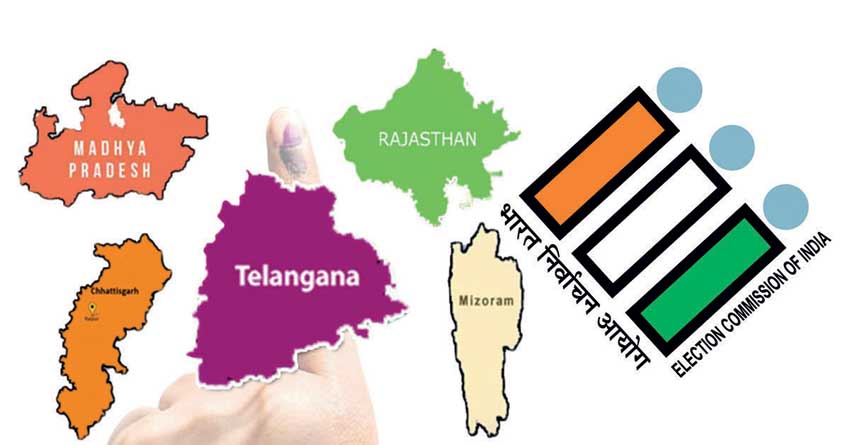
The ongoing election has become important in this limelight only. The results will be used to launch a scathing attack on the central government without giving any consideration to the fact that the BJP the ruling party in the center has little presence in Telangana. Few political pundits have gone to the extent that the win of BRS in Telangana will open the door for K Chandra Shekhar Rao to play a leading role in national politics.
For the ruling party, BJP two states of Rajasthan and Madhya Pradesh are crucial to have stability in Rajya Sabha as it has suffered a loss of few seats in Karnataka. There is enough data to prove that Prime Minister Modi has no big challenge is there when his role as PM is under review. I had a personal experience in Rajasthan in the 2018 election when I heard a voter singing a tagline, “ Modi tujhse vair nahin Vasundhra teri khair Nahi” which meant no anger with Modi but no mercy for Vasundhra and the result of the state election and the general election proved it right while BJP lost the state election yet it won 24 seats out of 25 in general election.
Election in Rajasthan and Madhya Pradesh
The dice are evenly cast for the BJP and Congress as both face incumbency factors in one state and the role of aggressive opposition in the other. The public of Rajasthan had tasted the bitter fruit of Congress's policy of appeasement and deteriorated law and order. The repercussion of the Tasleem Rehmani vs Nupur Sharma debate could take place in Udaipur. Poor tailor, Kanhaiya Lal suffered a horrible fate when two religious fanatics brutally killed him for ‘blasphemy’. The Rajasthan Police failed to save him despite lodging an FIR against the perpetrators well in time. The hometown of CM has met with violence caused by similar elements and the attitude of police remains the same. The people of Rajasthan have not appreciated the power conflict between Gahlot and Sachin Pilot. Voters may provide them ample opportunity to fight freely without having the power to rule the state.
Madhya Pradesh where Congress won the election with a thin margin is now being ruled by BJP thanks to Jyotiraditya Scindiya. This election is a test for Kamalnath of Congress to prove how many seats he can influence without having the support of Scindiya. BJP on the other hand has to translate the good work into votes. Congress is expecting a windfall gain owing to the Bharat yatra taken by Rahul Gandhi and on the strength of the newly formed alliance I.N.D.I.A. Voters have the responsibility to decide what they are comfortable with.
Do they approve of voting for an alliance of parties that are friendly in Madhya Pradesh and are acting as enemies elsewhere? The election results of these two states will define the future course of action for both the ruling party and the opposition.
This election will test the ruling party once again whether it has any remedy to fight the monster of freebies. As mentioned above it succeeded in Gujrat but has failed in Himachal and Karnataka.
Albert Einstein once said: “Sometimes one pays most for the things one gets for nothing.”
The first challenge is, can the common man be trained to understand this hard fact. The second challenge is to impress the common man to bite the bullet by ignoring freebies to have a better future.
The problem becomes complicated as the political parties do not have a wide base of support similar to developed countries, but rather, tend to appeal to a wide variety of social groups (Özbudun 1987). As a result, these parties do not build grassroots-level cadres and fall for appeasing these groups by offering freebies. In the early decades of democracy, it was funded by the candidates but when the freebies became lucrative political parties were using state exchequer to dole out these freebies. The benefit is if they lose nothing is payable and if they win it is the state exchequer that takes the burnt. A live example is the state of Karnataka where Congress has come to power riding on promises to provide freebies but the price the people of Karnataka will pay is that their government has reduced expenditure on primary needs. As per the PRS legislative research:
• Education: Karnataka has allocated 11% of its expenditure on education in 2023-24. This is lower than the average allocation for education by states in 2022-23 (14.8%).
• Health: Karnataka has allocated 4.9% of its total expenditure towards health, which is less than the average allocation for health by states (6.3%).
• Roads and bridges: Karnataka has allocated 3.4% of its total expenditure towards roads and bridges, which is lower than the average allocation by states (4.5%).
The analysis clearly shows that people are being made to pay for freebies by surrendering their right to better education, health care, and transport infrastructure. Freebies given by the government ruin the state finances. Sri Lanka is proof that fiscal profligacy always leads to disaster.
Everybody seems to agree that we've got to bell the cat called ‘Freebies’ but no one in the mice council wants to step forward and volunteer to lead.
This election will be a litmus test for the voters to prove whether they want a bright future through development or freebies now.
Ironically, you don’t get a driving license until you pass a test that examines your competence to drive but you are allowed to cast your vote without understanding the responsibility attached to it. The time has come to issue voter ID cards using a similar system. It is difficult to tame corrupt politicians but it is very easy to train the voters.
By Rakesh Kumar
(The content of this article reflects the views of writers and contributors, not necessarily those of the publisher and editor. All disputes are subject to the exclusive jurisdiction of competent courts and forums in Delhi/New Delhi only)



















Comments (1)
R
What a deep analysis of Indian political system.Very logical article written by Rakesh Kumar