


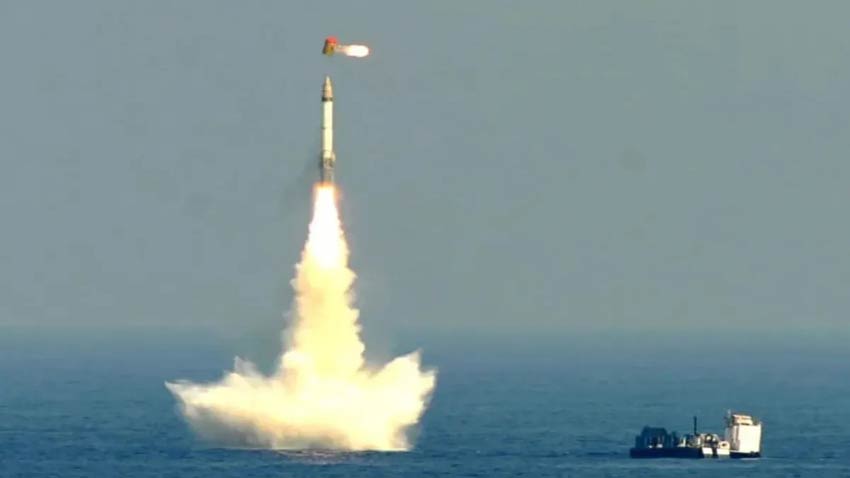
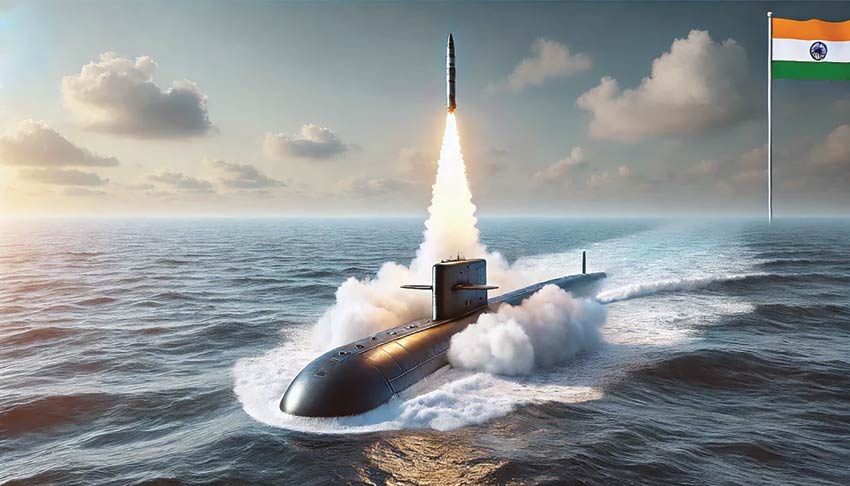
India achieved a significant milestone in its defense capabilities with the successful test firing of the K-4 ballistic missile from the nuclear-powered submarine INS Arighaat. This feat underscores India’s growing prowess in developing indigenous defense technologies and fortifying its nuclear deterrence capabilities. The K-4 missile, with a range of 3,500 kilometers, forms a critical component of India's nuclear triad, ensuring a robust second-strike capability—a cornerstone of credible deterrence. When combined with the stealth and mobility of INS Arighaat, the K-4's deployment substantially enhances India's strategic and tactical advantages in the evolving geopolitical landscape.
K-4 Ballistic Missile: A Game-Changer in Strategic Deterrence
The K-4 is a submarine-launched ballistic missile (SLBM) designed by the Defence Research and Development Organisation (DRDO) as part of India’s Advanced Technology Vehicle (ATV) program. With its ability to deliver nuclear warheads up to 3,500 kilometers away, the K-4 provides India with the capability to strike targets deep within an adversary's territory. Its high accuracy and versatility make it one of the most advanced SLBMs in India's arsenal. The missile is equipped with sophisticated inertial guidance systems and maneuverable re-entry vehicles (MaRV) to counter interception, ensuring its effectiveness against even advanced missile defense systems.
The K-4’s underwater launch capability makes it a critical asset for second-strike capability. Unlike land-based missiles, which are vulnerable to preemptive strikes, SLBMs can be launched from a stealthy and mobile platform like a nuclear submarine. This ensures survivability and the ability to retaliate, even in the event of a crippling first strike by an adversary. The successful integration and test firing of the K-4 from INS Arighaat is a clear demonstration of India's readiness to operationalize this vital component of its nuclear strategy.
Enhancing India's Second-Strike Capability
Second-strike capability is the ability to retaliate with nuclear weapons even after an adversary has launched a first strike. It is a cornerstone of India's nuclear doctrine, which adheres to a "No First Use" (NFU) policy. The K-4 missile, deployed aboard INS Arighaat, significantly bolsters this capability. By extending the range and survivability of India's nuclear arsenal, the missile ensures that India retains the ability to deliver a decisive retaliatory strike from a secure and hidden location.
India's emphasis on a second-strike capability sends a clear message to adversaries that any attempt at a nuclear attack would be met with assured and devastating retaliation. The stealth and mobility provided by a nuclear-powered submarine like INS Arighaat make it nearly impossible for adversaries to track and neutralize the platform. This greatly enhances the credibility of India's deterrence posture, contributing to regional stability and discouraging potential aggression.
INS Arighaat: A Testament to Indigenous Capability
INS Arighaat, the platform from which the K-4 was successfully tested, is a vital addition to the Indian Navy's Strategic Forces Command. It is India's second indigenously-built nuclear-powered ballistic missile submarine (SSBN) after INS Arihant. Constructed at the Ship Building Centre in Visakhapatnam, INS Arighaat reflects the growing maturity of India’s indigenous shipbuilding and defense manufacturing sectors.
The submarine is equipped with advanced stealth technologies, sonar systems, and propulsion mechanisms that enable it to operate undetected for extended periods. It is designed to carry a complement of K-series missiles, including the K-15 (750-km range) and K-4, providing India with both short-range and long-range strike options. Its nuclear propulsion system ensures virtually unlimited underwater endurance, allowing it to patrol vast areas of the ocean while remaining concealed.
INS Arighaat's induction significantly enhances the Indian Navy’s ability to project power and secure its maritime interests. It also strengthens India's position in the Indo-Pacific, where strategic competition is intensifying. As an SSBN, Arighaat plays a dual role: acting as a mobile, survivable platform for India’s nuclear arsenal while also contributing to conventional deterrence through its presence and patrols.
Boosting Indian Navy's Strike Capabilities and Deterrence
The combined capabilities of the K-4 missile and INS Arighaat represent a quantum leap in India’s strategic deterrence. Together, they enhance India’s ability to respond to threats across a wide range of scenarios, from nuclear brinkmanship to conventional conflicts. The operationalization of these systems also signals India's commitment to securing its sovereignty and territorial integrity amidst rising regional tensions.
Moreover, INS Arighaat and its complement of K-series missiles are integral to India’s efforts to maintain a balance of power in the Indo-Pacific. With increasing competition among major powers and the expansion of naval capabilities by regional adversaries, a robust SSBN fleet equipped with advanced SLBMs like the K-4 ensures that India remains a formidable maritime force. This capability not only strengthens deterrence but also allows India to play a more assertive role in shaping regional security dynamics.
Conclusion
The successful test of the K-4 ballistic missile from INS Arighaat marks a pivotal moment in India’s defense journey. It showcases the synergy between indigenous technological advancements and strategic foresight, underlining India’s determination to achieve self-reliance in defense. By enhancing second-strike capability and fortifying the Indian Navy’s strike potential, the K-4 and INS Arighaat collectively bolster India’s deterrence posture, contributing to national security and regional stability. As India continues to invest in developing state-of-the-art defense systems, it is well on its way to establishing itself as a global leader in strategic and military innovation.
Uday India Bureau















Leave Your Comment