


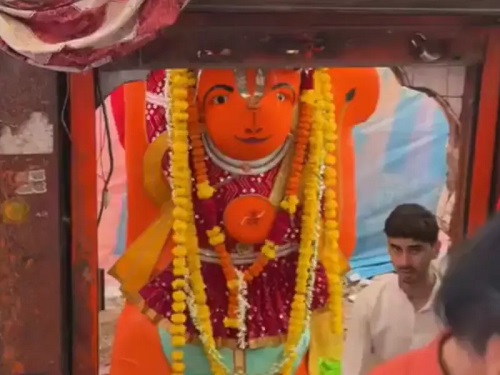
The 170-year-old Khade Hanuman idol at a temple in Ujjain has refused to move despite repeated attempts to remove and relocate it. Even powerful heavy-duty machinery has failed to shift the ancient idol even slightly. While devotees regard the incident as a divine miracle, experts suggest that the answer may lie in the idol’s centuries-old foundation.
What began as an infrastructure exercise ahead of the Simhastha 2028 festival has turned into an extraordinary episode that has captured the imagination of devotees in Ujjain. Workers attempting to relocate an approximately 170-year-old idol of Lord Hanuman from the historic Khade Hanuman temple have reportedly failed despite prolonged efforts and the deployment of heavy machinery.
The eight-foot-tall idol, depicting Lord Hanuman in a standing posture, was to be shifted as part of road-widening and infrastructure work being undertaken ahead of the major religious gathering. Simhastha is scheduled to be held in Ujjain from March 27 to May 27, 2028, with millions of pilgrims expected to visit the city.
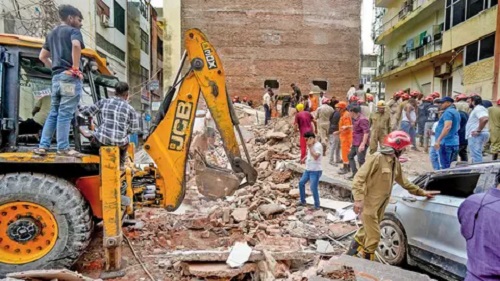
According to local accounts, authorities had arranged specialised equipment and a vehicle to facilitate the relocation. Portions of the temple structure were dismantled to make the process possible. Yet, even after hours of work, the idol reportedly remained firmly in place.
Three teams are said to have worked for nearly 48 hours in an attempt to carefully extract it. More than four days after the relocation exercise began, engineers have reportedly been unable to determine a safe method of removing the idol without risking damage.
The episode has drawn increasing numbers of devotees to the temple. Many have gathered to offer prayers, viewing the difficulty in moving the idol as a sign that Lord Hanuman himself does not wish to leave his traditional abode.
The atmosphere became even more emotional after claims circulated that a large group of monkeys gathered near the temple while attempts were being made to move the idol.
For devotees, the incident has taken on a deeply spiritual meaning. Some believe the presence of the monkeys—traditionally associated with Lord Hanuman—was another indication of divine intervention.
However, these accounts remain part of local belief and should not be confused with an independently established explanation for the incident.
While devotees describe the episode as a miracle, engineers are reportedly looking at the physical structure beneath the idol for answers.
One possibility being discussed is that the idol may be connected to an old subterranean foundation or an interlocking stone structure that has developed around it over decades. If that is the case, applying excessive force could damage either the idol or the fragile historic structure beneath it.
This has reportedly prompted officials to move away from aggressive excavation methods and consider techniques that can reveal what lies beneath the surface before another attempt is made.
The challenge is therefore not simply to move an object weighing several tonnes. It is to determine how the idol is anchored and how it can be separated without causing irreversible damage.
Temple priest Mahesh Bairagi reportedly urged authorities to treat the situation with sensitivity. For devotees, he said, the inability to move the idol should be understood as a possible indication that the deity is not meant to be displaced.
The controversy places Ujjain authorities in a difficult position. Simhastha is one of the world's largest religious gatherings, and the city's roads and public infrastructure need substantial preparation to accommodate the enormous influx of pilgrims.
At the same time, the Khade Hanuman temple represents a deeply rooted religious tradition, with local stories suggesting that both the temple and its idol could be considerably older than the commonly cited 170 years.
For now, the immovable idol has become an unexpected symbol in Ujjain's preparations for Simhastha 2028. Whether the explanation ultimately lies in an unusual foundation, centuries-old construction techniques or something devotees regard as divine intervention, the immediate priority appears clear: find a method that protects both the ancient idol and the faith attached to it.




















Leave Your Comment