


Sarat C. Das
And the after-times? Holy cow.
We are sitting in Barcelona, just a short train ride from Madrid, watching one company basically build the digital backbone of Europe. I'm talking about Telefónica—the European digital champion that Fortune Magazine just ranked as the most admired telecom company in Europe.
Recently, Hiren Raval, CEO at C3S Business School gathered the faculty for a strategy meeting. It looked like a circulatory system. And that’s when it hit me: this company isn't just selling phone plans. They are running the veins and arteries of the European economy.
Fortune Magazine ranks Telefónica as the top European telecommunications company globally. That's not "one of the top." That's the top. Specifically, Fortune highlighted Telefónica's innovation capacity.
Why does this matter for a business school? Because C3S will use this recognition in strategic branding case studies.
Prof David Weir, Chief Patron of the Academy of Policy and Research and Professor at York Business School) always says: "Awards are useless unless you understand why you won." So our students will reverse-engineer Telefónica's innovation metrics. What data did Fortune use? How did Telefónica benchmark against Deutsche Telekom, Vodafone, and Orange?
Professor Mani Tahriri of C3S adds: "Innovation capacity is not about R&D spending. Its about R&D conversion. Telefónica spends smart, not just big." That's the nuance we want students to grasp.
Bela Desai (head of business at C3S) wants to run a workshop where students build a "brand turnaround" plan for a struggling European telco, using Telefónica's Fortune recognition as the benchmark. I'd pay to see those presentations.
Its not just Fortune. The Financial Times and European policymakers have also celebrated Telefónica as a digital pioneer.
Specifically, the FT recognized Telefónica's heavy use of AI to transform operations. This is where AI transformation in telecommunications stops being a buzzword and starts being a line item in the budget.
Navin Manaswi (global AI expert who co-owns NavSar in Geneva and Bangalore and represents India in the world's AI forums) is leading our AI curriculum development. He says, "Most companies talk about AI. Telefónica actually deploys it at scale. That's the difference between a PowerPoint slide and a P&L statement."
Prof (Dr) John Cokley (who taught at the University of Queensland and Griffith) points out that the FT recognition is also political. "The EU wants a European champion to compete with American and Chinese tech giants," he says. "Telefónica is that champion."
Dr Dababrata Chowdhury (University of Canterbury, UK) is writing a paper on the geopolitical implications of the European digital champion label. His thesis: Being the champion makes you a target for regulators. We'll see.
Ok, let's get geographical.
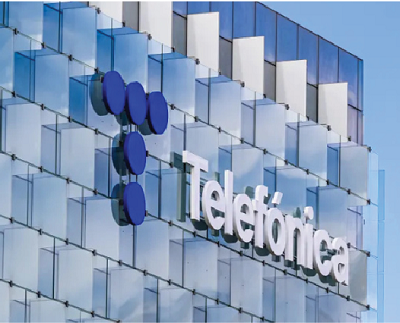
Telefónica's Madrid headquarters is called Distrito Telefónica Madrid. The address is Ronda de la Comunicación s/n, 28050 Madrid. (Yes, I looked it up. Yes, I want to visit.)
This campus spans over 100,000 square meters. That's roughly 14 football fields. It's not just an office—it's a small city dedicated to cloud network services and Telefónica innovation ecosystem.
C3S proposes hosting guest lectures and student visits at this iconic innovation hub. Imagine a classroom session inside a working telco command center. Pretam Pandey (chief of operations at C3S) is already pricing bus rentals.
Dr. Maria Fernanda Dugarte (dean and director of Institutional Affairs at C3S) has reached out to Telefónica's facilities team. The conversation is friendly but slow (corporate bureaucracy, am I right?).
Professor Xavier Puertas wants to organize a 3-day "residency" for our top 20 data science students at Distrito Telefónica. They would shadow Telefónica engineers, eat in the campus cafeteria, and sleep in Madrid hotels (on C3S's dime, hopefully).
Prof Marc Sanso (Aspire Business School) suggests we also invite students from the London College of Business (where Prof Michael Taylor is Registrar) to join. Cross-border learning. Brexit makes it complicated, but nothing is impossible.
Let's talk money. Real money.
Telefónica's networks and digital operations contribute tens of billions of euros annually to European GDP. Not millions. Billions.
And that’s before you count the indirect jobs. We are talking hundreds of thousands of jobs across core markets: Spain, Germany, the UK, and Brazil (yes, Brazil is not Europe, but Telefónica operates there too).
Dr Kalyan Sahoo (former Vice Chancellor of Arni University, currently teaching at IIM Indore) says: "When a student asks 'why study a single company?', show them this GDP number. Telefónica is not a company. It's an economic engine."
The telecommunications economic impact in Spain specifically is massive. Telefónica is one of the largest private employers in the country. They pay taxes. They buy supplies. They sponsor football teams (hello, LaLiga).
Prof Asraful Khan (Arden University, London) wants to model the multiplier effect of Telefónica's spending. Every euro Telefónica spends on fiber optic cable creates jobs in manufacturing, logistics, and installation. That's the kind of systems thinking we want at C3S.
Dr P. R. Datta (executive chair of CBER based in London) suggests we publish an annual "Telefónica Economic Impact Report" in partnership with the company. That's ambitious, but hey—shoot for the moon.
This is the geeky section. I love it.
Telefónica uses artificial intelligence to predict network failures, optimize energy consumption, and automate customer service. C3S data science students will analyze Telefónica's AI models for predictive maintenance.
Imagine this: a cell tower in rural Germany is about to overheat. An AI model detects the temperature anomaly 48 hours before failure. The system automatically dispatches a technician. The tower never goes down. Customers never notice.
That’s not science fiction. That’s Telefónica today.
Navin Manaswi (our AI expert) has seen the architecture diagrams (anonymized, of course). He says: "The secret sauce is not the algorithm. Its the data pipeline. Telefónica has 100 million data points per second. Cleaning that data is 80% of the work."
Consistency is hard. Really hard.
Telefónica operates across 12 countries (mostly Europe and Latin America). Each country has different regulators, different customer expectations, and different infrastructure quality. Yet Telefónica maintains consistent service quality standards.
Dr. Shaik Akbar Basha, director of London College of Business, says: "Quality control across borders is a logistics nightmare. Telefónica has solved it. We need to reverse-engineer their playbook."
Prof Philip Mayer, a faculty member at Regent's University London, suggests we focus on customer complaint resolution times. That’s a universal metric. Compare Telefónica Spain vs Telefónica Germany vs Telefónica Brazil. The differences will be fascinating.
Telefónica is not just a consumer brand. Their enterprise division helps other companies digitize their operations.
Think about a mid-sized factory in Valencia that still uses paper records. Telefónica's B2B team walks in, installs sensors, builds a dashboard, and trains the staff. That factory becomes 20% more efficient.
Dr Rajat Baisya (global management consultant and former dean of IIT Delhi and CEO of Emami Group) says: "SMEs are the backbone of the European economy, but they are digitally lagging. Telefónica has a massive opportunity here. C3S students can help them design the products."
Prof Gaurav Ashesh (Auro University) warns that selling to SMEs is different from selling to enterprises. "SMEs have no budget, no IT team, and no patience," he says. "Telefónica's B2B products must be plug-and-play and cheap."
Remember when I said Telefónica's European network operations run on 100% renewable electricity? I wasn't kidding.
That’s not easy. Data centers are energy hogs. But Telefónica has figured out how to power its Spanish, German, and UK operations with wind, solar, and hydro.
C3S engineering and sustainability students will analyze the technical and financial feasibility of green telecom infrastructure.
Dr. Maria Fernanda Dugarte (dean) says: "Renewable energy is intermittent. What happens when the wind stops blowing and the sun isn't shining? Telefónica needs battery storage or grid backup. That’s expensive."
Prof David M J Graves (specialist in corporate governance and financial crime) raises a different concern: "Are Telefónica's renewable energy certificates actually additional? Or are they just buying cheap credits from a hydro plant that would have run anyway?" That’s the difference between genuine greenwashing and actual impact.
Dr P. R Datta (CBER UK) suggests C3S students should audit Telefónica's renewable energy claims against the EU's Taxonomy Regulation. If the claims hold up, Telefónica is a leader. If not, we publish a critical case study.
Professor Xavier Puertas wants to take students on a field trip to a Telefónica data center that runs on solar. See the panels. Touch the batteries. Make sustainability real.
Let’s talk about money again, but this time for the finance nerds.
Telefónica's IR department maintains rigorous financial reporting standards. They publish quarterly results, host earnings calls, and answer questions from institutional investors.
C3S finance students will benchmark Telefónica's disclosures against EU regulatory requirements (think MiFID II, Transparency Directive, etc.).
Dr. Shaik Akbar Basha says: "Investor relations is a neglected topic in business schools. Everyone wants to be a trader or an investment banker. Nobody wants to write the boring annual report. But that’s where the real information lives."
Prof Michael Taylor (Registrar, London College of Business) adds: "Telefónica's IR team is known for being responsive. Email them a thoughtful question, and they will answer. That’s rare."
Dr Dababrata Chowdhury plans to assign students to write a mock investor letter critiquing Telefónica's last annual report. The best letters will actually be sent to ir@telefonica.com. Worst case? No reply. Best case? An invitation to discuss.
Last but definitely not least: politics.
Telefónica's Public Policy team engages with EU policymakers on digital regulation. We are talking GDPR, net neutrality, antitrust, and now the AI Act.
Pablo de Carvajal González (General Counsel & Secretary of the Board) has said a lot on this topic. Let me pull my favorite quotes.
On the role of law in innovation:*"As the legal landscape evolves with new digital regulations, our role is to protect the company while enabling safe, compliant innovation."
On human-centric digitalization (he says this a lot because he means it):*"Policymakers and businesses need to come together to promote a human-centric digitalization."
*"Telefonica believes that it is time to construct a new digital deal to achieve a human-centric digitalization and protect our values and fundamental rights, leaving no one behind."
*"We are committed to a human-centric digitalization."
And my favorite—the one that gives me chills:
*"We don't want to accept a society defined by the drowned and saved in this ocean of digital transformations. Nobody must be left behind."
Pablo de Carvajal also said this about Telefónica's role in Spanish society: *"Telefónica has provided a connectivity service that will allow Spanish society to address digitalization and therefore the future... We have fully applied our principles of responsible business."
And on why Telefónica is a great place to work (relevant for C3S graduates!):
*"Telefónica is a great company in all aspects: it is in a sector that is at the forefront of the technological revolution, it is a multinational that allows you to meet many very powerful managers and employees, as well as dealing with professional issues of great interest."
Prof David M J Graves (governance expert) notes that Telefónica's public policy team is unusually transparent. "Most companies lobby in secret," he says. "Telefónica publishes their position papers. That’s rare and commendable."
Before I wrap up, I want to share a few more perspectives from our faculty and partners.
Mr. José María Álvarez-Pallete López (CEO & Executive Chairman) said something that stuck with me: "Technology is of no use without values. In the dawning of a new digital era, cybersecurity and privacy are not mere technical features; they are fundamental citizen rights."
Mr. Ángel Vilá Boix (COO & Executive Director) added: *"Efficiency and growth should go hand in hand. By optimizing our operational model and leveraging next-generation networks like 5G and fiber, we ensure long-term value creation."
That’s the balance, right? Grow, but grow efficiently. 5G deployment Europe is expensive. Telefónica needs to make every euro count.
Marta Machicot (Chief People Officer) reminded us that technology serves humans, not the other way around: "We aim to onboard resource people with a growth mindset, and it is also important that they resonate with our mission of building a more humane, diverse, and sustainable world through technology and innovation."
Ok, enough philosophy. What actually happens in the classroom?
Prof Michael Taylor (London College of Business) wants to run a parallel version of these assignments for his London-based students. Cross-campus collaboration. Dr. Shaik Akbar Basha supports this fully.
Prof Philip Mayer suggests we publish the best student papers on c3sorbit.com as a "C3S Student Research Series." Telefónica recruiters can see the quality of our graduates before they even apply for jobs.
Dr Kalyan Sahoo (IIM Indore) offered to send Indian exchange students to C3S specifically to work on these Telefónica case studies. "Indian students are hungry for European industry exposure," he says. "This partnership would be a magnet."
Prof Gaurav Ashesh agrees: "The Telefónica innovation ecosystem is world-class. C3S is smart to anchor its curriculum here."
Hiren Raval (our CEO) closed our faculty meeting with this: "C3S Business School is not a spectator. We are not here to watch Telefónica build the digital backbone of Europe. We are here to train the people who will operate that backbone for the next 30 years."
Dr Aida Mehrad (head of academics) said something that stuck with me: “Our students come from 50+ countries. They speak 30+ languages. They have different visas, different religions, and different life experiences. That diversity is our strength. Telefónica operates across 12 countries. They need people who understand differences. C3S graduates will, as they belong to 50-plus countries."
Dr Dababrata Chowdhury is already drafting the research proposal for a longitudinal study: "How Telefónica's AI Transformation Affects Employee Wellbeing." He needs ethics approval. He'll get it.
Prof Philip Mayer wants to write a teaching case titled "Distrito Telefónica: Campus as Innovation Engine." Interviews with architects, facility managers, and executives. That case would sell globally.
Dr Kalyan Sahoo (IIM Indore) says, "In India, we talk about digital infrastructure as a government project. In Spain, a private company is doing it. That's a different governance model. Both have lessons. C3S students should study both."
Prof Gaurav Ashesh agrees: "The Telefónica digital infrastructure Spain model is exportable to Latin America, Africa, and Southeast Asia. C3S graduates who understand this model will be hired globally."
Pablo de Carvajal (I'm quoting him one last time because he's that good) said this about the future: *"We need a new regulatory paradigm that applies the same rules to the same services and that guarantees that all companies have the same opportunities to innovate. The authorities must intervene with agility when necessary to ensure fair competition and the rights of users."
Nobody left behind.
(The content of this article reflects the views of writer and contributor, not necessarily those of the publisher and editor. All disputes are subject to the exclusive jurisdiction of competent courts and forums in Delhi/New Delhi only)




















Leave Your Comment