


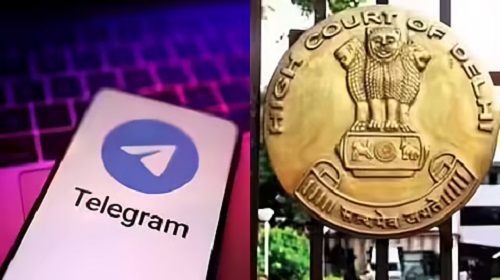
The Delhi High Court on Friday upheld the Central Government’s decision to temporarily block access to the messaging platform Telegram for five days ahead of the NEET-UG re-test scheduled for June 21, ruling that the measure was justified to prevent any potential leakage of examination material and misuse of the platform during the conduct of the examination.
A bench led by Justice Tejas Karia accepted the Centre’s argument that the temporary restriction was a preventive measure aimed at protecting the integrity and fairness of the highly competitive medical entrance examination. The verdict was delivered a day after the court reserved its judgment following extensive hearings on the legality, necessity and proportionality of the blocking order.
While dismissing Telegram’s challenge to the government’s decision, the court held that the reasons provided by the Centre were adequate considering the emergency circumstances surrounding the re-examination.
“After considering all the arguments, we find that given the emergency nature, the reasons supplied are sufficient and the government has followed the procedure under Section 69A,” the court observed.
The High Court further noted that both the original blocking order and the subsequent review conducted by the Review Committee were reasoned decisions that reflected proper application of mind by the authorities.
“The orders are well-founded and supported by reasons. The orders do not suffer from non-application of mind,” Justice Karia said.
Rejecting Telegram’s contention that the ban was excessive and disproportionate, the court agreed with the government’s submission that the restriction was narrowly tailored and limited in duration, making it the least restrictive option available to address the perceived threat.
“The government’s measures are least restrictive. It cannot be held that the order is disproportionate,” the court stated.
The court also dismissed Telegram’s argument that Section 69A of the Information Technology Act could not be used to block an entire intermediary platform. It held that the statutory provision does not exclude platforms from the scope of the term “information” and therefore permits such action when warranted under law.
“We have also held that under the IT Act there is no reason to exclude the platform from the ambit of ‘information’,” the bench observed.
In light of these findings, the High Court declined to interfere with the Centre’s order and dismissed Telegram’s petition challenging the temporary ban.
Defending its decision, the Union Government argued that Telegram had increasingly become a key channel used by organised cheating syndicates to circulate leaked examination papers and related material. The Centre maintained that the temporary restriction was necessary to preserve the sanctity of the NEET-UG re-test, which is being conducted for lakhs of aspiring medical students across the country.
Appearing on behalf of the Union Government, Solicitor General Tushar Mehta informed the court that the blocking order was issued after following the due process prescribed under law. He submitted that the decision was based on credible intelligence inputs indicating large-scale misuse of the platform and was intended as a preventive measure in the larger public interest.
The ruling marks a significant judicial endorsement of the government’s authority under Section 69A of the Information Technology Act to impose temporary restrictions on digital platforms in exceptional circumstances, particularly when concerns relating to examination integrity and public interest are involved.




















Leave Your Comment