


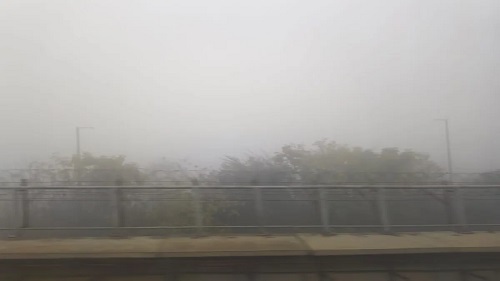
The national capital found itself paralysed on Saturday under the combined assault of extreme winter conditions and hazardous pollution levels. A dense, impenetrable fog blanket reduced visibility to a mere 50 meters, triggering widespread travel chaos, while air quality plummeted, forcing authorities to reinstate stringent anti-pollution curbs across the region.
Fog Creates Transport Nightmare
The Indira Gandhi International (IGI) Airport was among the worst hit, with significant flight delays reported due to the severely compromised visibility. Airlines advised passengers to check real-time flight updates before heading to the airport. The disruption extended across the city and beyond, with road and rail traffic snarled for hours. The India Meteorological Department (IMD) has forecast persistent dense fog conditions for the next two days, advising drivers to use headlights and fog lights, maintain low speeds, and exercise extreme caution. Some relief is expected only by afternoon.
Despite a marginal rise in the minimum temperature to 7 degrees Celsius from Friday's 4 degrees, the cold wave conditions, amplified by the moisture-laden fog, continued to make life harsh for residents across North India.
Air Quality Plunges to 'Severe' Levels
Compounding the misery was a sharp deterioration in air quality. Delhi's overall Air Quality Index (AQI) early Saturday was recorded at 368 ("Very Poor" category), a slight worsening from Friday's 354, according to Central Pollution Control Board (CPCB) data. Several key hotspots entered the "Severe" zone (AQI 401-450), with Chandni Chowk at 427 and ITO crossing 402-405. Other areas like Ashok Vihar (385), Burari Crossing (360), IGI Airport (304), and IIT Delhi (313) languished in the "Very Poor" category.
The pollution crisis had tangible repercussions on international events. Top Danish badminton player Anders Antonsen withdrew from the ongoing India Open 2026, explicitly citing Delhi's poor air quality as the reason. This move casts a shadow over the city's preparedness to host the BWF World Championships later this year.
GRAP Stage-III Reimposed
Anticipating further deterioration, the sub-committee of the Commission for Air Quality Management (CAQM) on Friday proactively reimposed Stage-III of the Graded Response Action Plan (GRAP) across the National Capital Region (NCR). This stage is triggered when the AQI is projected to hit the "Severe" category.
Already under Stages I and II, the escalation to Stage-III brings a nine-point action plan into immediate effect. It mandates a ban on non-essential construction work, demolition, and the operation of certain categories of polluting vehicles. The directive has been issued to the Pollution Control Boards in NCR states and the Delhi Pollution Control Committee (DPCC) for strict enforcement to prevent a further decline in air quality.
With the IMD warning of continued dense fog and stagnant wind conditions, Delhiites brace for another challenging day, navigating the dual threats of blinding fog and breath-taking pollution.





















Leave Your Comment